
How to Visit the Brockton Point Poles in Stanley Park
Find the Brockton Point display, allow 30–60 minutes, compare walking, cycling, transit and driving, and understand the official nine-pole count.
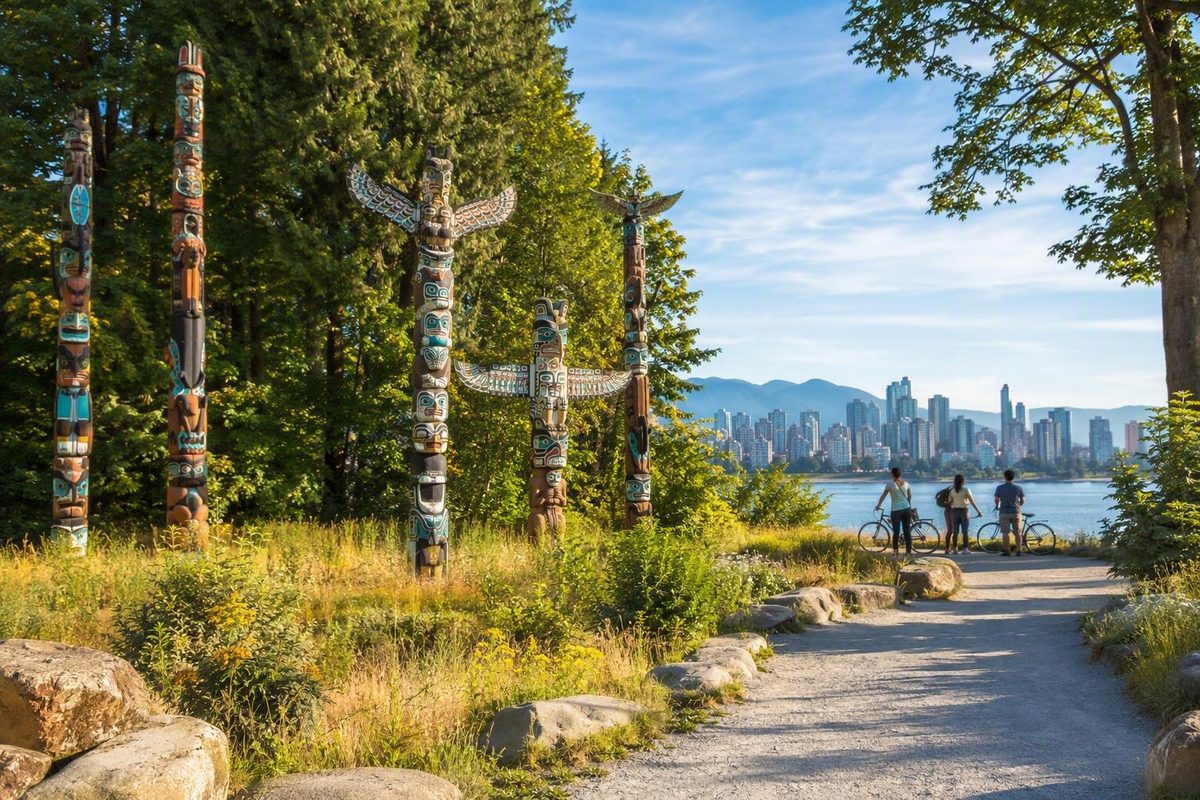
The main Stanley Park totem-pole collection is at Brockton Point, on the park’s eastern side. Allow about 30 to 60 minutes for a focused visit, including time to read the interpretation and see the adjacent Coast Salish artworks; this suggested duration comes from an independent Stanley Park visitor guide, not an official timed itinerary.
On the official park map, look for “Brockton Point Interpretive Centre & Gift Shop (Totem Poles)”. The display is near Brockton Point Lighthouse but has its own mapped stop, so navigate to the interpretive centre and pole site rather than using the lighthouse as your destination.
The short answer: go to Brockton Point
Brockton Point visit at a glance
- Cost: The outdoor display is generally free to view; parking and commercial tours cost extra.
- Suggested time: About 30 to 60 minutes.
- Access: Walk, cycle, drive, take transit and continue on foot, or join a commercial tour.
- Parking: Paid hourly parking is available nearby.
- Facilities: The park guide lists washrooms and a gift shop at or near the site, but availability can change.
Half an hour is reasonable if you want to view the poles and read selected signs. Closer to an hour gives you time to consider the individual works, walk through Susan Point’s nearby portals and find the Shore to Shore sculpture without turning the visit into a quick photo stop.
The site is outdoors, but that does not mean every associated service is always available. Gift-shop, washroom and concession operations may vary, and the official park guide warns that rates and services are subject to change. Check current park information before depending on a particular facility, especially if it is essential to your visit.
Brockton Point works best as one clear component of a Stanley Park day. It can be a short standalone stop, an extension of a Coal Harbour walk or one point on a longer cycling route. The nearby lighthouse provides an easy next destination if you have more time.
How many poles are at Brockton Point?
The City of Vancouver describes nine poles at Brockton Point. Treat that as the City’s official published count for the collection, not as a guarantee that exactly nine will be physically visible on the day you arrive. Conservation work, temporary removals and changes to an outdoor display can affect what visitors see at a particular moment, even when the published description has not changed. The City’s page on the collection is the appropriate source for the official nine-pole figure.
A December 2025 user review reported seeing a lower number and offered a conservation-related explanation. Other recent reviewers continued to refer to nine poles, however, so these conflicting traveler reports do not establish a reliable revised count. User reviews can indicate that conditions may have changed, but they are not a substitute for confirmation from the City or Park Board.
Nine should not automatically be interpreted as the total number of poles throughout Stanley Park. The independent visitor guide cited above reports an additional pole at Stanley Park Junction and further poles along the Miniature Train route. Their current presence, visibility and public access are not verified by the official information available here, so do not build an itinerary around seeing them.
For ordinary trip planning, the useful distinction is straightforward: Brockton Point is the main display, and nine is the City’s published count for that collection. If the exact current inventory matters to you, consult the latest City or Park Board information before visiting and use the interpretation on site to identify what is actually displayed.
Choose the simplest way to reach the display
The best approach depends on where you are starting and what you want to do afterward. Walking and cycling fit naturally into a broader eastern Stanley Park route. Transit still requires a walk, while driving is more practical for a focused stop than for leaving a car in the same short-stay area all day.
| Approach | Best for | What to know |
|---|---|---|
| Walk | Coal Harbour or an eastern Stanley Park outing | Easy to combine with the waterfront and nearby sights |
| Bicycle | A longer Stanley Park or seawall route | Treat Brockton Point as one stop within a park circuit |
| Transit plus walking | Visitors avoiding a car | Route 19 enters the park but does not stop at the poles |
| Drive | A focused visit or limited-time itinerary | Nearby parking is hourly, with no all-day rate at this location |
Walking: Brockton Point is a practical extension of a walk from Coal Harbour or a day concentrated on Stanley Park’s eastern side. Third-party guidance estimates roughly 20 minutes on foot from the Coal Harbour entrance, but that is only an orientation estimate. Your exact starting point, route, pace and crossing conditions will determine the actual time.
Bicycling: The display can be incorporated into a broader Stanley Park ride. Third-party guidance estimates about 10 minutes by bicycle from the Coal Harbour entrance.
Transit plus walking: Route 19 stops inside Stanley Park near the Rose Garden and Malkin Bowl area, not directly at Brockton Point. You will therefore need to complete the journey on foot. Review the full walking connection before setting out if distance, terrain or changing route conditions could affect your plans.
Driving: The official 2026 Stanley Park map and guide identifies parking at the totem-pole area as hourly only, without an all-day rate at that location. Prices and rules can change, so follow the posted signs when you arrive. If Brockton Point is only one part of a longer park day, consider whether another parking area better matches your complete route.
Commercial sightseeing tours may include Brockton Point, but the length and nature of the stop depend on the operator. Confirm that a tour actually stops at the display—and allows enough time to leave the vehicle—rather than assuming every Stanley Park itinerary does so.
Whichever method you choose, think about the next leg of your day before arriving. Walking onward to the lighthouse is simple, while cyclists may prefer to keep Brockton Point within a larger circuit. Drivers should account for hourly parking rather than treating the lot as an automatic base for an all-day park visit.
How the collection reached Brockton Point
The collection did not originate at Brockton Point. In the 1920s, the Vancouver Park Board acquired four poles from Alert Bay on Vancouver Island. Later additions were associated with Haida Gwaii and Rivers Inlet, including works acquired for Vancouver’s 1936 Golden Jubilee. The poles were initially displayed near Lumberman’s Arch before being relocated to Brockton Point during the 1960s, according to the City’s history of the collection.
Sources differ on the exact relocation year. Some accounts give 1962, while the City describes the move as occurring in the mid-1960s. “During the 1960s” is therefore the most defensible wording unless a more precise chronology is established from primary records.
This history explains why the display includes works associated with several communities and regions of British Columbia. It should not be presented as the product of one uniform Indigenous artistic tradition, nor should every pole be described as generically local to Vancouver. The artist, family, Nation, history and purpose of each work matter.
The local territorial context is distinct from the collection’s acquisition history. Stanley Park is on the unceded traditional territories of the Musqueam, Squamish and Tsleil-Waututh Nations, while many historic works in the collection are associated with communities outside Vancouver. Acknowledging both facts helps avoid collapsing different Nations and cultural traditions into a single category. This territorial acknowledgment is also stated in a local guide to the Brockton Point site.
Use the posted interpretation as your starting point for understanding individual works. Avoid assigning a fixed meaning to an animal, figure or crest based on a generic symbol guide. Meanings can depend on the particular Nation, artist, family, story and purpose involved, and not every pole follows a universal reading method.
Why some displayed poles are replicas or replacements
The outdoor collection is not composed solely of original historic poles. Cedar exposed to weather deteriorates, and preservation concerns led older works to be removed during the 1980s. Replicas, borrowed poles and commissioned replacements were then used in the outdoor display; an independent history of the collection places this preservation and replacement work within that decade.
The clearest documented example is the Skedans Mortuary Pole. The work displayed at Brockton Point is a replica, while the original was returned to Haida Gwaii. That does not mean every newer work at the site is an exact copy. The City distinguishes among replicas, borrowed works and commissioned replacements, each of which has a different relationship to an earlier pole or to the collection as a whole.
This conservation history is more useful than a simple “real versus replica” distinction. An outdoor reproduction can represent and interpret an older work while protecting the original from further deterioration. A later commission, meanwhile, may be a new work rather than a reproduction. The status and history of a pole must be considered individually.
Outdoor conditions and stewardship decisions can also change what is on view. A published count may remain stable while a work is temporarily absent, undergoing conservation or represented differently. That is why the City’s nine-pole figure should be understood as a published description of the Brockton Point collection rather than a promise about the exact number visible at any moment.
You do not need to memorize the status of each pole before visiting. Read the individual signs and look for the work’s title, artist or carver, community, date and stated purpose. Where the interpretation identifies a replica or replacement, consider why that distinction is included and what happened to the earlier work.
Look beyond the historic pole collection
Brockton Point is more than a line of historic, replica and replacement poles. Contemporary works at the site connect the visit with living Coast Salish artists, families and cultural expression.
The Rose Cole Yelton Memorial Pole was installed in 2009 and created by many hands under the leadership of Squamish artist Robert Yelton. It honours his mother, Rose Cole Yelton, who was born in Stanley Park and lived near the present site until 1935. Musqueam artist Susan Point’s People Amongst the People consists of three carved red-cedar portals installed in 2008, while Luke Marston’s Shore to Shore is a 14-foot bronze sculpture installed at Brockton Point in 2015. These details are documented in the official 2026 Stanley Park guide.
Susan Point’s portals are gateways, not totem poles. Inspired by traditional Coast Salish slant-roof architecture, they are arranged along paths at the Brockton Point site and welcome visitors to the traditional lands of the area’s Coast Salish peoples. Their form, purpose and cultural context should not be merged with those of the pole collection simply because the works stand near one another.
The Rose Cole Yelton Memorial Pole is likewise more than the newest dated addition to a historical display. Its connection to Rose Cole Yelton and her life near the present site gives the work a specific family and place-based significance. Read its interpretation as a memorial rather than approaching it only as another object in the collection.
Shore to Shore differs again in material and form. Its use of bronze helps make the broader point visible: Brockton Point is a layered Indigenous art site, not a single row of interchangeable objects.
A simple self-guided sequence is:
- View the main pole display and read the individual signs.
- Walk through Susan Point’s three red-cedar portals.
- Find Luke Marston’s Shore to Shore.
- Continue toward Brockton Point Lighthouse if time permits.
Treat Brockton Point as a focused 30-to-60-minute stop rather than a box to tick. Choose the approach that fits the rest of your Stanley Park day, rely on the available interpretation instead of guessing at meanings, and include the contemporary portals and memorial works so your visit reflects both the collection’s complicated history and the site’s living artistic context.