
How to Explore Vancouver’s Historic Core Without Overplanning It
Start near Waterfront Station and follow Water Street past the Steam Clock to Maple Tree Square, with optional food, shopping, galleries or a tour.
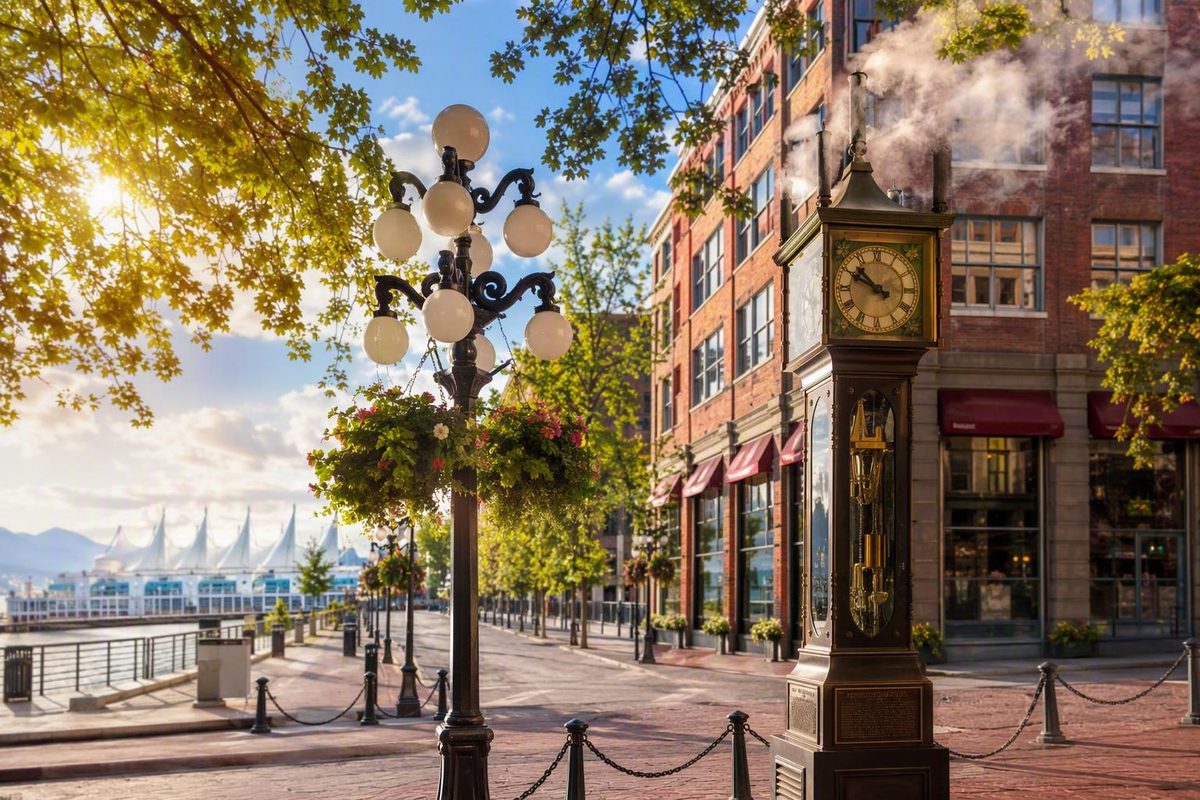
Gastown works best as a focused heritage walk rather than an all-day checklist. Begin near Waterfront Station, follow Water Street past the Steam Clock to Maple Tree Square, and add food, shopping, galleries, photography, or a tour only when those experiences match your interests.
Gastown at a Glance: Is It Worth Visiting?
It is a compact historic urban neighbourhood beside Downtown Vancouver: the city’s original settlement and an early commercial core, now used for dining, shopping, arts, nightlife, sightseeing, and everyday business.
The main attraction is the streetscape. Along Water Street, brick façades, older commercial buildings, textured paving, narrow views, and the transition toward Maple Tree Square create a setting that looks different from Vancouver’s glassier downtown blocks. The Steam Clock is the best-known stop, but it is only one part of a district that also offers photography, independent shopping, galleries, restaurants, cafés, bars, and themed walking tours.
That combination makes Gastown a good fit for visitors interested in:
- Urban history and preservation
- Architecture and older commercial streets
- Street photography
- Independent shops and locally made goods
- Galleries and design
- A meal or drink in a historic district
- History, food, filming-location, or ghost-themed tours
It may feel less substantial if you want a museum-like experience, extensive waterfront scenery, a large collection of major attractions, or a full day of scheduled activities. Gastown’s value comes from observing the neighbourhood and choosing a few relevant stops, not from completing a long checklist.
For a landmark-focused visit, allow about one hour. That is a planning estimate rather than a guaranteed duration: Condé Nast Traveler describes Gastown as small enough to walk through in less than an hour, but stopping for photographs or entering businesses will extend the outing (Condé Nast Traveler’s Gastown review).
Allow several hours if you plan to eat, shop, browse galleries, photograph the district carefully, or join a tour. A meal and one substantial activity are usually enough to turn the basic walk into a relaxed half-day.
Commercial platforms may nevertheless advertise Gastown “tickets” for guided tours or related experiences, so check what a listing actually includes before paying (Tripadvisor’s Gastown listing).
The most useful expectation is simple: Gastown is a lived-in part of the city, not a self-contained heritage park. Visit for the streetscape and history, then add only the experiences that improve the day for you.
Where Gastown Is and How to Arrive Without a Car
Gastown sits beside Downtown Vancouver, near Vancouver Harbour, Canada Place, the cruise terminal, Chinatown, and the Downtown Eastside. These places are geographically close but are not interchangeable. Canada Place belongs to the waterfront and convention precinct; Chinatown is a distinct neighbourhood with its own history and destinations; and the Downtown Eastside is a larger adjoining area with varied communities and conditions.
Published maps do not always draw Gastown in the same way. Historical townsite limits, official neighbourhood boundaries, business-district maps, and visitor-oriented definitions serve different purposes. For a first visit, there is little benefit in trying to resolve those differences before you begin walking.
Instead, use four practical reference points:
- Water Street is the principal sightseeing route.
- Cambie Street intersects Water Street at the Steam Clock.
- Carrall Street marks the eastern end of the core visitor walk.
The easiest transit approach
For most car-free visitors, Waterfront Station is the most convenient gateway. It connects with SkyTrain and SeaBus services and places you near the western end of Water Street. After leaving the station, orient yourself toward Richards and Water Streets and begin walking east.
The precise walk depends on the station exit, crossings, pace, and mobility needs. It is better to think of it as a short orientation walk than to depend on an exact minute count.
Waterfront Station is also the downtown SeaBus terminal for service to Lonsdale Quay, which makes it possible to place Gastown before or after a North Shore waterfront trip. Transit services and schedules can change, so confirm the current route with TransLink before departure (GetYourGuide’s Vancouver transportation overview).
Walking from Canada Place or the cruise terminal
Gastown is commonly approached on foot from Canada Place and the cruise terminal. The simplest strategy is to move toward Waterfront Station and Water Street rather than trying to navigate by a disputed neighbourhood boundary. This produces a legible route and starts at the convenient western end of the main sightseeing corridor.
Cruise passengers should resolve luggage and scheduling questions before beginning. Gastown can work as a compact pre- or post-cruise outing, but even a short walk becomes impractical when you are carrying bags or working against a boarding deadline. Do not assume that luggage storage will be available because an individual traveler found it during a previous visit.
Do you need a car?
No. For a visitor already downtown, Gastown is straightforward to reach on foot or by transit. Driving may add decisions about one-way streets, loading, traffic, and parking without providing much benefit for a compact walking route.
Do not rely on old descriptions of Water Street as permanently pedestrianized. A car-free and car-light arrangement between Richards and Carrall Streets operated as a summer 2024 pilot, not as confirmation of a permanent traffic pattern (Gastown background and the 2024 pilot). If vehicle access or a street closure will affect your plans, consult current City of Vancouver street notices before traveling.
A Simple One-Hour Gastown Walking Route
This route prioritizes the principal outdoor landmarks while keeping navigation simple. The overall one-hour window is flexible. Crossings, weather, mobility, photography, entering businesses, and time spent near the Steam Clock can all change the pace.
1. Waterfront Station to Richards and Water Streets
Start at Waterfront Station and make your way toward the western end of Water Street near Richards Street.
Use the opening part of the walk to get oriented rather than rushing toward the clock. You will be traveling generally east, with the Steam Clock at Cambie Street and Maple Tree Square farther along.
This first stretch establishes the visual contrast that makes Gastown distinctive. Notice the overall pattern of brick façades, older commercial buildings, street-level shops, and textured paving instead of treating every doorway as a required stop.
2. Water and Cambie Streets
Follow Water Street to Cambie Street, where you will find the Gastown Steam Clock. It is easy to identify and frequently becomes the focal point of a first visit.
The clock deserves a look, but it should be one stop rather than the entire purpose of the walk. Although its design evokes an earlier period, it was built in 1977, not during Gastown’s nineteenth-century beginnings. It uses steam from Vancouver’s downtown heating network while also involving non-steam components, so describing it as an entirely steam-powered Victorian artifact would be inaccurate (VancouverBC.com’s Gastown guide).
Do not build a tight itinerary around a promised performance minute. The supplied visitor sources disagree about the precise timing and nature of the clock’s whistles, chimes, and longer sequences, and they do not provide a current first-party operating schedule. If seeing it perform matters, consult a current district or operator update before leaving.
For photographs, consider including the surrounding street rather than trying to isolate the clock. A wider composition gives the landmark architectural context and can be easier when other visitors are nearby.
3. Continue east along Water Street
Keep walking east toward Maple Tree Square. This stretch matters as much as the clock because it supplies the surrounding context: older façades, storefront details, paving, changing street angles, and views toward the eastern end of the district.
At Maple Tree Square, pause to examine the junction and surrounding buildings. The most distinctive architectural subject is Hotel Europe, whose narrow triangular form follows the shape of its lot. It provides a natural visual endpoint for the route.
Nearby Gaoler’s Mews can be included as an optional photo stop. Treat it as a brief detour rather than an essential attraction. Tenants and access conditions can change, and the available evidence does not establish that every part of the mews is step-free.
4. Choose photographs, a return walk, or one extension
From Maple Tree Square, make a deliberate choice:
- Return west along Water Street toward Waterfront Station.
- Stop at a restaurant, shop, gallery, or tour selected in advance.
- Continue into another nearby district only if you have planned that area separately.
Returning along Water Street can still be useful for photography because you will see the buildings and intersections from the opposite direction. It also gives you another chance to stop at a place you passed earlier.
Avoid continuing east or south simply because the street carries on. Gastown borders other neighbourhoods, and a purposeful route makes both navigation and time management easier.
A practical allocation is:
| Route stage | Suggested emphasis |
|---|---|
| Waterfront Station and initial orientation | Find Water Street and establish direction |
| Water and Cambie | View and photograph the Steam Clock |
| Water Street to Maple Tree Square | Observe the streetscape and Hotel Europe |
| Final part of the visit | Add Gaoler’s Mews, take photographs, or begin the return |
The one-hour estimate assumes an outdoor, landmark-focused walk. Careful photography, wet or uneven paving, limited mobility, or entering businesses can extend it substantially.
What to Do Beyond the Steam Clock
If you have several hours, do not simply add more pins to a map. Choose one or two themes instead. That produces a more coherent visit than trying to sample every shop, gallery, café, bar, and tour in a district where businesses and schedules can change.
For architecture and history
Slow down along Water Street rather than walking directly between landmarks. Look for:
- Differences in brickwork and window patterns
- Narrow commercial frontages
- The relationship between Water Street and the harbour
- Maple Tree Square’s irregular street layout
- Hotel Europe’s triangular footprint
- The contrast between historic façades and newer interior uses
A history-focused walking tour can provide context that exterior viewing alone cannot. Before booking, examine the tour’s emphasis. Some tours concentrate on early settlement, commerce, and architecture; others foreground crime stories, nightlife, or theatrical storytelling.
Check the meeting point, route length, group size, accessibility, price, cancellation terms, and whether the historical claims are sourced. A tour can be worthwhile, but only when its subject and format suit your interests.
For photography
A concise subject list includes:
- Water Street’s brick façades and long views
- The Steam Clock at Water and Cambie
- Maple Tree Square
- Hotel Europe
- Gaoler’s Mews
The clock often works better as part of the street scene than as an isolated object. Hotel Europe is most recognizable when the narrow corner and converging streets remain visible in the frame.
Photography can extend the basic visit considerably. If images are a priority, leave enough time to wait, change position, and revisit useful angles instead of trying to keep to the shortest walking time. Wet paving may add reflections, but it also makes careful footing more important.
For independent shopping
Gastown’s retail mix is more useful when approached by category than through a fixed list of businesses. Visitor material describes fashion and design boutiques, jewellery, home décor, vinyl records, souvenirs, makers’ goods, and locally made products.
Choose the category that interests you and then check current business listings and opening hours. Because tenants change, an older recommendation should not become the foundation of your itinerary without direct verification.
Older buildings can also place shops in basements or on upper floors. If step-free access matters, contact the business rather than assuming that a street-level address guarantees a step-free entrance.
For art and galleries
Visitor guidance describes galleries featuring local and First Nations artists, along with shops, tours, food, and photography locations (Alexander College’s Gastown visitor video).
Gallery locations, represented artists, exhibitions, and operating hours can change. Select a specific exhibition or artistic focus in advance if a gallery visit is important. Otherwise, treat galleries as optional discoveries along the walk rather than guaranteed centerpieces.
For food and drink
Gastown is associated with cafés, restaurants, pubs, cocktail bars, breweries, and plant-based dining. The useful decision is not which place is universally “best,” but what role the stop should play:
- A quick coffee during the walk
- Lunch after reaching Maple Tree Square
- Dinner before an evening activity
- A drink as the final stop
- A food tour that replaces the need to choose several venues independently
Check current hours, menus, reservation policies, prices, dietary accommodations, and accessibility directly with the venue. A restaurant or bar mentioned in an older article may have changed its schedule, concept, or operating status.
For a guided tour
Gastown tours generally fall into several categories:
- History tours focus on settlement, commerce, architecture, and urban change.
- Food tours combine neighbourhood interpretation with tastings and generally require a larger time commitment.
- Filming-location tours use the streetscape to discuss Vancouver’s screen appearances.
- Ghost tours prioritize atmosphere, performance, legends, and anecdotes.
Choose according to subject rather than star rating alone. Ghost tours can be entertaining, but supernatural stories and staff anecdotes should not be treated as verified historical events. A theatrical narrative may be memorable without offering a comprehensive account of the neighbourhood.
Before making a tour central to your day, confirm its current operating status, meeting point, duration, price, accessibility, age restrictions, reservation requirements, and cancellation terms.
The History Behind Gastown—and the Modern Clock
Gastown’s visitor story is often compressed into two images: “Gassy Jack” and the Steam Clock. Both need context.
The settlement developed around a saloon opened in 1867 by John “Gassy Jack” Deighton. The name Gastown is associated with Deighton’s nickname and his reputation as a talkative storyteller. From that beginning, the settlement became an early commercial and downtown core shaped by the waterfront, port activity, trade, and nearby industry. Gastown was designated a National Historic Site of Canada in 2009, while the Steam Clock was built much later, in 1977 (Destination Vancouver’s Gastown history).
A visitor-oriented historical account places Vancouver’s incorporation and a major fire in 1886. Those events provide context for why surviving late-nineteenth- and early-twentieth-century buildings matter, although the account should be understood as a condensed visitor summary rather than a complete reconstruction of early Vancouver (VancouverBC.com’s historical summary).
Gastown’s survival was not automatic. A tertiary historical account describes preservation campaigns in the 1960s that resisted proposed freeway development and the loss of older architecture. The same account records that the Gassy Jack statue was toppled in February 2022, so it should not be listed as a currently standing attraction (Gastown’s historical overview).
The Steam Clock is the clearest reminder that a historic district can contain modern landmarks. Standing at Water and Cambie Streets, it looks older than it is. Steam comes from Vancouver’s downtown heating network, while accounts of its mechanism also describe non-steam components. It is therefore better understood as a modern landmark placed within a historic streetscape, not as a surviving Victorian clock.
The familiar colonial origin story is also not a complete history of the place. The Gastown Business Improvement Society acknowledges that Gastown is on the traditional lands of the Musqueam, Squamish, and Tsleil-Waututh Nations (Gastown Business Improvement Society). That acknowledgment should not be mistaken for a full Indigenous history; the standard visitor narrative remains heavily centered on colonial settlement, trade, and preserved architecture.
The most accurate short interpretation is that Gastown is layered: Indigenous lands, colonial settlement, waterfront commerce, fire and redevelopment, preservation, and a modern visitor economy. Its most photographed clock belongs to the late twentieth century rather than the neighbourhood’s earliest period.
Walking Conditions, Accessibility, and Situational Awareness
Gastown is compact and walkable, but those terms do not mean uniformly accessible.
Some businesses occupy basement or upper-floor spaces, according to the available visitor guidance (Alexander College’s practical Gastown guidance).
Do not assume that the suggested route is fully step-free. The supplied evidence does not verify every curb cut, gradient, entrance, seating location, or accessible washroom. If accessibility determines whether the visit will work, review a current street-level map and contact any essential venue directly before departure.
Possible planning adjustments include:
- Allow more time rather than optimizing for speed.
- Use footwear suited to rough or wet paving.
- Keep optional indoor stops close to the main route.
- Confirm step-free entrances directly with businesses.
- Choose a shorter turnaround point if the full route is unsuitable.
- Do not assume that a courtyard, mews, basement shop, or upper-floor gallery is accessible.
These measures do not guarantee that the route will meet an individual traveler’s needs. They are ways to reduce uncertainty while planning.
Gastown also adjoins the Downtown Eastside. Individual travelers have reported discomfort on particular approaches, along with visible homelessness, substance-use concerns, crowds, and parking frustration. These reports are anecdotal: they do not establish current crime levels and do not justify describing all of Gastown as either safe or dangerous. Tripadvisor’s review page contains both positive walking experiences and individual concerns, illustrating the limits of neighbourhood-wide conclusions based on personal reviews (Tripadvisor’s Gastown visitor reviews).
Use ordinary downtown situational awareness:
- Follow a deliberate route rather than navigating reactively.
- Pay attention to the immediate block and surroundings.
- Keep valuables managed in busy areas.
- Avoid obstructing pedestrian movement while taking photographs.
- Change course if a particular approach feels unsuitable to you.
- Consult current official local guidance if safety conditions are a deciding factor.
Visible homelessness and substance-use harms are human and public-health issues, not attractions or shorthand for the character of an entire neighbourhood. Neutral planning language is both more respectful and more accurate.
Driving and parking advice in the supplied visitor sources is incomplete and contradictory. Some descriptions call driving manageable, while others emphasize one-way streets, parking frustration, or changing street access. That inconsistency strengthens the practical case for arriving by transit or on foot, but it does not support categorical claims that current parking is always easy, inexpensive, scarce, or difficult.
How to Fit Gastown Into a Larger Vancouver Day
Gastown works best as one compact part of a downtown day. The simplest extension for many first-time visitors is Canada Place and the nearby waterfront because they are close and easy to understand geographically.
A straightforward half-day can look like this:
- Start at Canada Place or Waterfront Station.
- Follow the Gastown route along Water Street.
- Choose one extension: lunch, a gallery, focused shopping, photography, or a themed tour.
- Return toward Waterfront Station or continue to a separately planned neighbourhood.
This structure leaves room for discovery without turning every storefront into an obligation.
Pairing Gastown with Canada Place
Canada Place provides a clear change of scene from Gastown’s brick streets to the harbourfront. It also requires relatively little backtracking for visitors already downtown.
Cruise passengers should use Gastown as a pre- or post-cruise option only after settling luggage and confirming their available time. A short map distance does not compensate for carrying bags, waiting for storage, or worrying about a ship schedule.
Pairing Gastown with Chinatown
Chinatown is geographically nearby but should be planned as its own stop. Do not blur the two districts into a generic historic-area walk. Each has different histories, cultural institutions, businesses, and practical considerations.
If combining them, decide in advance what you intend to see in Chinatown and how you will travel between the stops. This avoids leaving Maple Tree Square without a route and entering another neighbourhood without enough time to explore it meaningfully.
Pairing Gastown with SeaBus
Waterfront Station makes Gastown compatible with a SeaBus trip to Lonsdale Quay. This can create a varied day combining historic streets, a harbour crossing, and time on the North Shore waterfront.
The best order depends on weather, light, meal plans, and any fixed-time activity. Check current TransLink schedules rather than relying on a static itinerary.
Should you stay in Gastown?
Visiting Gastown and staying there are different decisions. One local accommodation guide reports that lodging within the neighbourhood is limited, which may make an adjacent downtown area more practical for some first-time visitors (Forever Lost in Travel’s Vancouver neighbourhood guide).
That does not make Gastown—or downtown generally—the universally best or worst place to stay. Choose a base according to:
- Transit access
- Walking distance to your highest-priority activities
- The atmosphere you want when returning at night
- Accommodation availability and budget
- Mobility needs
- Noise sensitivity
- How often you expect to cross the city
For a broader framework, see Vancouver Know’s guide to choosing a Vancouver neighbourhood base. If your itinerary is transit-led, the guide to experiencing Vancouver without a car can help organize the city into walkable clusters.
The main planning principle is not to make Gastown carry an entire day unless its architecture, photography, food, shopping, galleries, or tours are central to your interests. For most first-time visitors, the main walk plus one chosen extension is enough.
Frequently Asked Questions
How long should I spend in Gastown?
Allow about one hour for a focused outdoor walk along Water Street to the Steam Clock, Maple Tree Square, and Hotel Europe. This is an estimate rather than a guaranteed duration.
Allow several hours if you want a meal, independent shopping, galleries, careful photography, or a guided tour. Mobility needs, weather, and time spent inside businesses can also extend the visit.
Is Gastown free to visit?
Walking Gastown’s public streets and viewing exterior landmarks does not require a general neighbourhood admission ticket. Meals, drinks, shopping, guided tours, and nearby ticketed attractions cost extra.
If a booking platform advertises Gastown “tickets,” inspect the description carefully. It may be selling a tour or another commercial experience rather than entry to the neighbourhood.
Is the Gastown Steam Clock genuinely historic, and when does it perform?
The clock is a genuine Gastown landmark, but it is not a surviving Victorian artifact. It was built in 1977 and uses steam from Vancouver’s downtown heating network along with non-steam components (Destination Vancouver’s Gastown overview).
The supplied visitor sources disagree about its precise performance schedule. If seeing it whistle or chime is important, check a current district or operator update rather than planning around an unverified minute.
How do I get to Gastown from Waterfront Station or Canada Place?
From Waterfront Station, orient yourself toward Richards and Water Streets, then walk east along Water Street. You will reach the Steam Clock at Cambie Street before continuing toward Maple Tree Square.
From Canada Place or the cruise terminal, walk toward Waterfront Station and use the same Water Street approach. Actual travel time will depend on your starting point, crossings, station exit, pace, and mobility.
Is Gastown suitable for wheelchairs, strollers, or travelers with limited mobility?
It may be visitable with advance planning, but it should not be described as uniformly accessible. Uneven paving, curb conditions, stairs, and older buildings can create barriers, and some businesses may occupy basement or upper-floor spaces.
The supplied evidence does not confirm a fully step-free route or accessible facilities at every stop. Contact essential venues directly, allow extra time, and consider a shorter turnaround point if completing the route to Maple Tree Square would be difficult.
The Best Way to Approach Gastown
Gastown is easiest to appreciate as a focused heritage walk rather than an all-day checklist. Start at Waterfront Station, follow Water Street to the modern Steam Clock, continue to Maple Tree Square and Hotel Europe, and then decide whether food, galleries, shopping, photography, or a tour genuinely improves the day.
Before leaving, verify any detail that could determine whether the visit works: current transit service, Water Street access, clock operation, venue hours, tour status, and step-free entry. A simple route with one well-chosen extension will usually provide a better visit than an overfilled itinerary.