
What to Know Before Seeing Gastown’s Famous Clock
Find it at Water and Cambie streets; it reportedly whistles every 15 minutes, with steam released from the top on the hour.
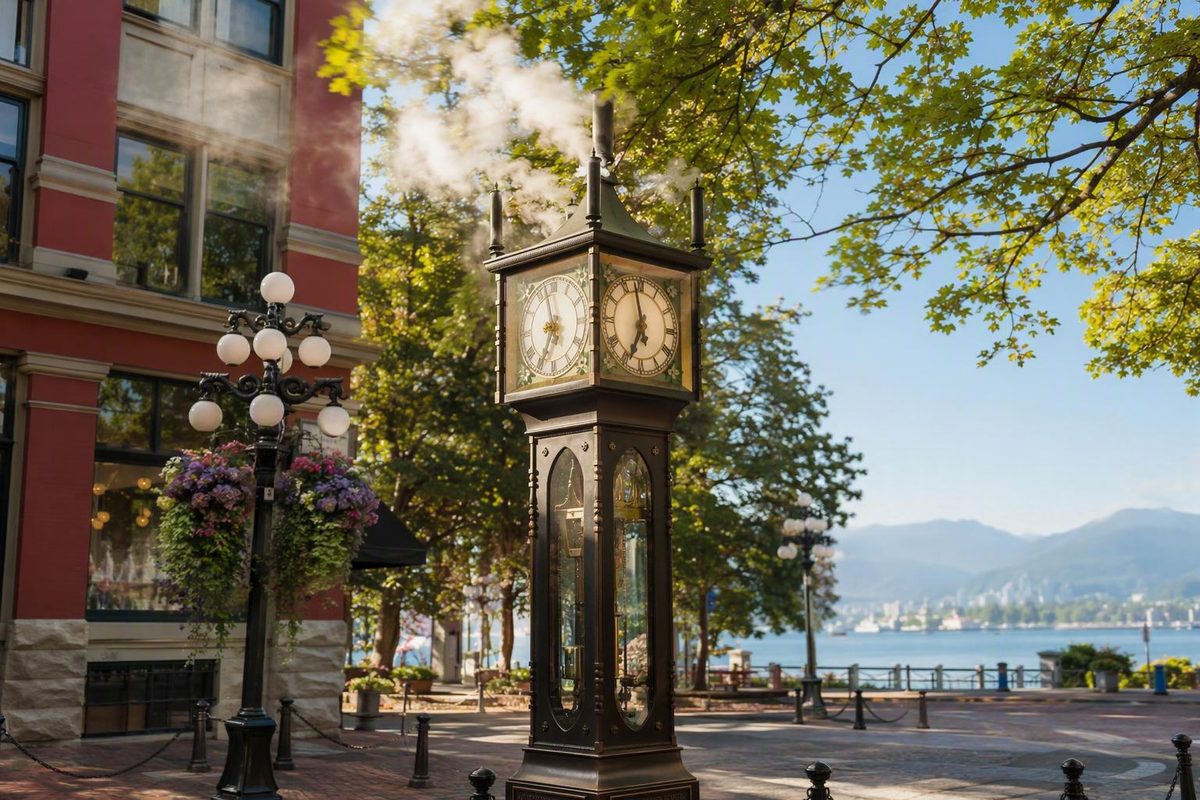
Vancouver’s Gastown Steam Clock is at Water and Cambie streets. Its reported routine is to whistle every quarter-hour and release steam from the top on the hour, so arrive a few minutes before the hour if you want the fullest expected display. The clock dates to 1977 and combines steam-powered effects with electric timekeeping rather than operating entirely on steam. These details come from Wikipedia’s overview of steam clocks, which notes that its own inline sourcing is incomplete; treat the schedule as a reported pattern, not confirmation that the clock will perform on a particular visit.
Gastown Steam Clock quick facts
- Location: Water and Cambie streets in Vancouver’s Gastown neighbourhood.
- Map coordinates: Approximately 49.28444°N, 123.10889°W.
- Reported schedule: The four-faced clock whistles the Westminster Quarters every 15 minutes, with steam released from the top on the hour.
- When to arrive: Come a few minutes before a quarter-hour for the expected melody. If possible, choose just before the hour for the additional steam release.
- Installation: Clockmaker Raymond Saunders reportedly built and installed the clock in 1977.
- How it works: Low-pressure steam reportedly supplies a miniature engine and the whistles, while an electric motor has powered the timekeeping mechanism since 1986.
The location, coordinates, timing, installation date and hybrid mechanism are all reported in the same Wikipedia account of the Gastown clock. That account does not provide live operating information.
Check before making a special trip: A published schedule cannot confirm whether maintenance or a temporary interruption will affect your visit. No dedicated live-status channel is identified here. If seeing the performance is essential, seek recent, date-stamped confirmation from the City of Vancouver or another authoritative local contact rather than assuming the clock will operate as reported.
Use Water and Cambie streets as the practical destination. The coordinates can help with map placement, but the intersection is the clearest reference for finding the landmark.
What happens when the clock performs
The expected performance centres on the Westminster Quarters, the familiar clock melody used at quarter-hour intervals. According to the published overview, the clock whistles this sequence every 15 minutes. The on-the-hour event adds the reported release of steam from the top, making it the more visually distinctive time to visit.
The source does not establish the exact length of each sequence or the number of whistle notes. It also does not confirm that every scheduled performance takes place without interruption.
| Arrival time | Reported sound | Reported top steam release |
|---|---|---|
| Quarter past | Westminster Quarters | Not specified for this interval |
| Half past | Westminster Quarters | Not specified for this interval |
| Quarter to | Westminster Quarters | Not specified for this interval |
| On the hour | Westminster Quarters | Steam released from the top |
“Not specified” does not prove that no other steam is visible at those times. It means only that the available description singles out the top release as an hourly feature. Arriving early gives you time to find the landmark before the expected sequence, but it cannot guarantee a performance.
Is the Gastown clock really powered by steam?
Not entirely. “Steam clock” accurately describes an important part of the spectacle, but it does not mean that steam controls every function inside the structure.
The published account reports that low-pressure steam from Vancouver’s downtown heating network powers a miniature engine and supplies the whistles. It also says that an electric motor has powered the clock’s timekeeping mechanism since 1986, after the earlier arrangement reportedly produced excessive noise and difficulties with accurate timekeeping.
The safest description is therefore partially steam-powered or steam-and-electric.
Myth: Every part of the Gastown Steam Clock runs on steam. Fact: The available account says steam powers the miniature engine and whistles, while electricity powers the timekeeping mechanism.
The use of electricity does not make the name meaningless. The clock reportedly incorporates steam from the downtown network into its operation; it simply does not depend on steam alone.
Why the clock was built
According to the same secondary account, clockmaker Raymond Saunders built the Gastown Steam Clock in 1977. It was reportedly installed over a sidewalk steam vent connected to Vancouver’s downtown heating network.
That origin gives the clock three related roles. Rather than creating a steam network specifically for a tourist attraction, the project reportedly made a visible feature out of infrastructure already present beneath the street.
This helps explain why the clock appears both functional and theatrical. Its pipes, engine and whistles are presented as part of a public spectacle, while its old-fashioned exterior gives the structure a heritage character suited to its Gastown setting.
The central historical point is not that the clock survived from nineteenth-century Vancouver. It is that a modern clock was designed to evoke an earlier period while putting contemporary urban infrastructure on display.
Two misconceptions to leave behind
The first misconception is that the Gastown Steam Clock is Victorian. Its decorative metalwork and antique styling may suggest a much older object, but the reported 1977 installation date makes it a modern heritage-style landmark rather than surviving Victorian-era infrastructure. Appearance alone is not evidence of age.
The second misconception is that steam performs every task. The available account instead describes a hybrid system: steam supplies the miniature engine and whistles, while an electric motor handles timekeeping. That combination is more precise than either calling it fully steam-powered or dismissing the steam element altogether.
For a practical visit, use Water and Cambie streets as the destination and aim to arrive shortly before the hour. Verify current operating conditions first if the performance is the main reason for your trip. The clock is straightforward to include while already exploring Gastown, but its most interesting feature is the contrast between its historic appearance and its reported steam-and-electric mechanism.
Who built the Gastown Steam Clock, and when?
The published secondary account identifies clockmaker Raymond Saunders as the builder and gives 1977 as the installation year. Its antique appearance should not be taken to mean that it survives from Victorian-era Gastown.
Why does the Gastown Steam Clock use electricity?
The available account says an electric motor has powered the timekeeping mechanism since 1986 because the earlier arrangement reportedly caused noise and timekeeping problems. Steam continues to supply the miniature engine and whistles, making the landmark a hybrid rather than a wholly steam-powered clock.
Is the Gastown Steam Clock currently working?
Its current condition cannot be confirmed from the historical operating description. The reported pattern is a Westminster Quarters performance every 15 minutes and a top steam release on the hour, but maintenance or temporary interruptions may affect any particular visit. Seek recent confirmation from an authoritative local source before travelling specifically to watch it perform.