
The Stanley Park Train Is Offline—Here’s What Visitors Can Still Plan
No reopening date, operating schedule or current ticket prices are published. See why service stopped and how to plan nearby instead.
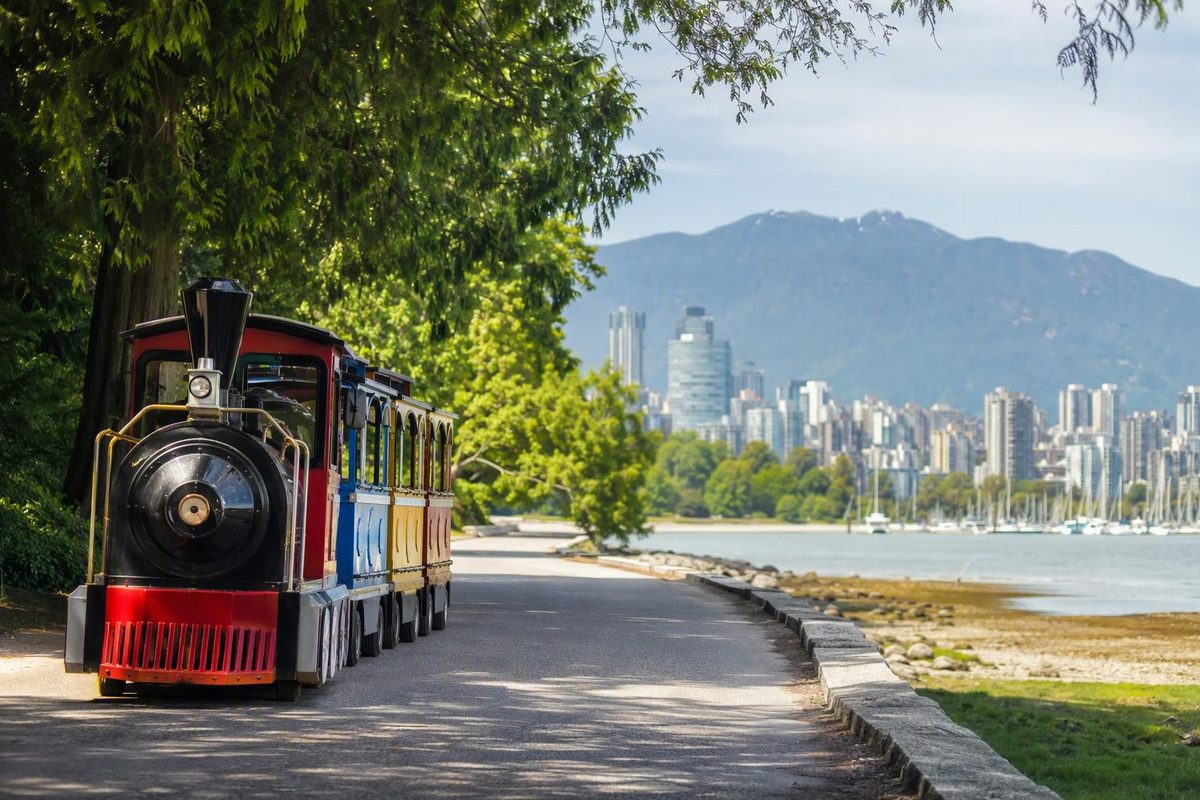
The City of Vancouver’s official page lists the Stanley Park Train as offline because of safety concerns involving aging systems. Unless the City publishes a new operating notice, do not travel to Stanley Park expecting a train ride, tickets, regular hours, or seasonal service. You can still visit the Pipeline Road area, but build your day around nearby Stanley Park stops rather than the railway.
Current status: do not plan on riding the train
Latest verifiable official status: The City of Vancouver’s Stanley Park Train page lists the attraction as offline. The page provides no reopening date, operating schedule, or current ticket prices.
| Planning question | Latest official information |
|---|---|
| Operating now? | Listed as offline |
| Current tickets? | None confirmed |
| Reopening date? | Not announced |
| Future of the site? | Alternative operators and concepts have been explored |
The practical answer is straightforward: do not make plans that depend on rides, ticket sales, scheduled departures, or a seasonal train program.
Schedules, fares, departure intervals, ticket procedures, parking offers, and visitor reviews from 2024 or earlier are historical. They should not be used to plan a current visit, even if an old page appears in search results without a clear date.
Check the official City page immediately before leaving. Travelers with specific accessibility or site-access questions can also contact stanleyparktrain@vancouver.ca.
Why the Stanley Park Train went offline
Service stopped indefinitely on December 13, 2024, after a driver required medical attention following reported exposure to locomotive exhaust. That incident marked the start of the latest shutdown, but it was not the railway’s only difficulty.
Park Board staff also cited aging combustion engines, operator safety, mechanical and infrastructure problems, reduced operating capacity, repeated closures, financial pressure, and reputational risk. Staff estimated that operating the attraction in 2025 would produce a loss of $700,000 and said it had lost nearly $3 million over the preceding five years. The locomotives’ combustion engines were also reported to be more than 50 years old. CBC documented the shutdown and the Park Board’s operational and financial concerns.
The railway’s recent operating history shows why the problem extended beyond one incident:
- 2020: Service was cancelled because COVID-19 physical-distancing restrictions made operation impractical.
- 2021: Coyote-related safety concerns interrupted service, although the train operated again that December.
- 2022: The railway did not operate after failing a safety inspection; the City also cited mechanical and supply-chain problems.
- 2023: Service returned after the two-year interruption.
- 2024: The train carried more than 90,000 visitors before the December shutdown.
- December 13, 2024: Service stopped indefinitely after the reported exhaust-exposure incident.
- 2025: The railway remained closed throughout the year.
The December 2024 event explains when the latest shutdown began. The broader viability question reflects accumulated concerns involving equipment, infrastructure, safety, reliability, capacity, and cost.
What could happen to the railway site next
The Park Board has explored partnerships and alternative operating models rather than announcing a firm railway reopening. At the procurement stage reported in February 2026, prospective operators were allowed to propose a restored or reinvented train, a substantially altered rail attraction, or a different all-ages experience.
| Possible direction | What it could involve | Procurement-stage status |
|---|---|---|
| Rehabilitate or reinvent the railway | Retain a train-based attraction with changed equipment or operations | Permitted as a proposal |
| Introduce an electric rail concept | Change the propulsion system and potentially other railway components | Discussed, not an approved project |
| Replace the railway | Develop a different all-ages attraction | Also permitted as a proposal |
The reported opportunity covered roughly 16 acres, including the train site and the former Children’s Farmyard. It was therefore broader than repairing a locomotive or reopening the existing route unchanged.
Expressions of interest were due March 31, 2026. The procurement-stage report did not identify a selected operator or approved concept. It described an opening around June 2027 as an approximate target for a future attraction—not a guaranteed opening date and not necessarily a return of the train. The February 2026 procurement report outlines the site, permitted concepts, deadline, and provisional timing.
Do not treat that bidding-stage timetable as a current operating announcement. Before considering the project settled, look for:
- An officially selected operator or partner
- An approved attraction concept
- Confirmed public or private funding
- A construction or rehabilitation schedule
- A published accessibility plan
- Confirmed opening dates, operating hours, and ticket arrangements
“Redevelopment” does not automatically mean that the existing railway will reopen. A future announcement could preserve the train, substantially change it, or introduce a different attraction.
Bright Nights also moved away from Stanley Park for Christmas 2025. That relocation should not be treated as temporary unless the organizer or City explicitly announces a return.
What the former train ride was like
When operating, the Stanley Park Railway typically offered an approximately 15-minute journey over a two-kilometre forest track. It was a 20-inch-gauge miniature railway, and its locomotive collection included a locally built replica of Canadian Pacific Railway Engine No. 374.
Multiple locomotives were associated with the attraction. That helps explain why historical accounts and visitor reviews sometimes described different engines rather than one consistent locomotive.
The railway historically operated regular summer rides and seasonal programs tied to Easter, Halloween, and Christmas. The Halloween version was known as the Ghost Train, while the Christmas program was associated with Bright Nights.
Historical visitor guides described a tunnel, a trestle over water, music or narration, and displays that changed with the season. These details describe earlier operations and are not experiences currently promised to visitors. An unofficial local attraction guide documents the traditional route and seasonal formats.
Attendance figures need context. The City says the railway historically welcomed more than 200,000 visitors annually, while CBC reported more than 90,000 visitors during the disrupted 2024 season. The figures describe different operating conditions and should not be treated as competing estimates of the same type of year.
Where the train site is and how to reach it
The railway site is at Stanley Park Junction on Pipeline Road, reached through the West Georgia Street entrance to Stanley Park. The area remains reachable even though visitors should not expect train service.
For a car-free visit, TransLink route 19 stops at Stanley Park Loop, near the train site. Public transit does not circulate around Stanley Park’s interior, so plan to continue on foot or by bicycle—or return to the loop when you are ready to leave. The City’s Stanley Park directions page explains transit access, cycling options, driving entrances, and parking-pass rules.
Walking or cycling into the park from downtown is another practical option.
Drivers can enter through:
- Georgia Street: the main entrance at the west end of West Georgia Street
- Beach Avenue: an alternate way into the park
If parking, pay attention to the type of pass you buy. A daily Stanley Park parking pass allows the vehicle to be moved among parking locations within the park. An hourly pass is valid only near the meter where it was purchased.
Check current meter information when you arrive. Do not rely on parking prices or offers associated with an old train or seasonal event.
A practical Stanley Park fallback plan
Do not visit Pipeline Road solely to ride the train while the official page lists it as offline. Instead, use Stanley Park Loop as the start of a compact group of stops:
- Check the official train page before departure or on your phone.
- Arrive near Stanley Park Loop.
- Visit the railway area only if seeing the site itself interests you.
- Choose one or two nearby stops, such as the Rose Garden, Vancouver Aquarium area, Lumberman’s Arch, or Lost Lagoon.
- Connect those stops with a walk or bicycle segment rather than repeatedly crossing the park.
This approach works particularly well without a car because it does not depend on transit circulating inside the park. Choose a short sequence that suits your group instead of trying to cover every landmark in one visit.
Proximity does not confirm that each nearby attraction is open. The aquarium, event venues, concessions, gardens, and other facilities may have separate hours, admission requirements, seasonal schedules, or temporary closures. Check the relevant operator before setting out.
Do not assume that a familiar seasonal train will fill the planning gap. Bright Nights relocated away from Stanley Park for Christmas 2025, and no return of Bright Nights, the Ghost Train, Easter rides, or regular summer trains should be assumed without an official announcement.
Former accessibility and animal rules
These were the former train’s arrangements, not guarantees for a future operator, redesigned railway, or replacement attraction.
The City described Stanley Park Junction and the train as having wheelchair-accessible provisions, including a carriage that accommodated children using wheelchairs. Free tickets were offered for wheelchair-accessible seating and for attendants accompanying guests with eligible accessibility needs.
Electric wheelchairs could not be accommodated. A manual transfer wheelchair was available, and wheelchair users were advised to have an attendant help with boarding. Stroller parking was also provided.
Dogs were not permitted aboard the train, while certified service animals were allowed.
Anyone planning around a specific mobility, transfer, sensory, stroller, or service-animal requirement should contact stanleyparktrain@vancouver.ca before visiting. Any future attraction could use different vehicles, paths, boarding procedures, or admission policies.
For now, treat the Stanley Park Railway as unavailable unless the City explicitly announces otherwise. Check the official page immediately before your visit, then build the day around nearby Stanley Park stops rather than an unconfirmed ride. The procurement-stage concepts did not settle the site’s long-term form: a future project could restore the railway, substantially change it, or replace it.