
Plan a Calm Walk Around Stanley Park’s Gateway Lagoon
The 1.75–1.8 km loop takes about 45–60 minutes at a comfortable pace; find directions, Nature House hours, access notes and wildlife rules.
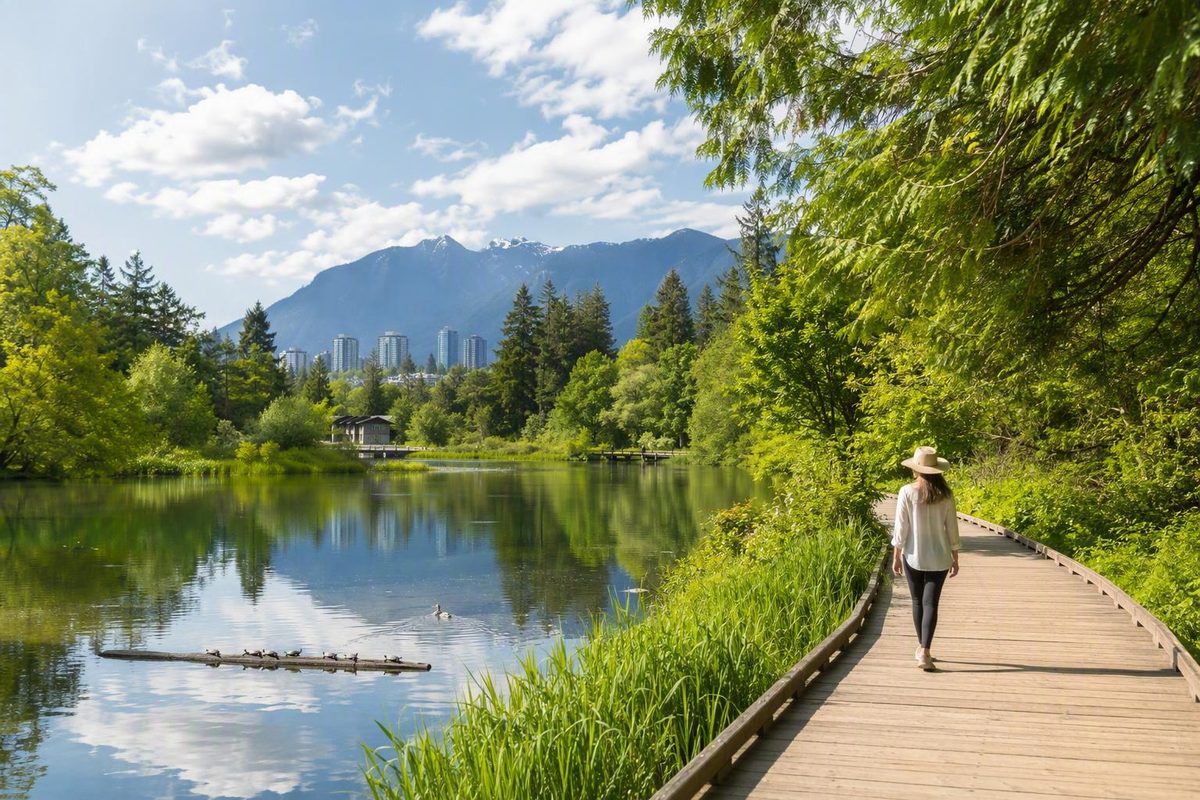
Lost Lagoon is an easy, mostly car-free introduction to Stanley Park. It sits near the Georgia Street entrance, within walking distance of downtown Vancouver and the West End. Treat it as a flexible urban nature stop rather than a fixed itinerary or a place where particular wildlife sightings are guaranteed.
Lost Lagoon at a glance: how to plan your stop
Lost Lagoon is worth visiting if you want an easy-paced walk, birdwatching, photography or a quieter first look at Stanley Park. Its position on the downtown side of the park also makes it simpler to reach than attractions deeper inside Stanley Park.
The lagoon covers roughly 16 hectares. Its perimeter is measured at approximately 1.75–1.8 kilometres, with minor differences reflecting how sources round the route. It is a human-managed water body occupying a former tidal area, so neither “natural lake” nor “artificial freshwater lake” tells the complete story. The measurements and variable water conditions are documented in the Park Board’s ecological report.
| Time available | Practical plan | Best for |
|---|---|---|
| About 30 minutes | Brisk loop with few stops | Travelers fitting in a short walk |
| 45–60 minutes | Comfortable circuit with viewing pauses | Most first-time visitors |
| 1–2 hours | Slow loop plus wildlife watching or the Nature House | Families, photographers and birdwatchers |
The 30-minute benchmark comes from an individual visitor report rather than an official completion time. That visitor also described the route as almost flat, but pace, surfaces, crossings and pauses affect how long the circuit takes. The Tripadvisor Lost Lagoon listing provides the anecdotal benchmark; 45–60 minutes is the more comfortable planning default.
A longer visit is optional. In pleasant weather, you may naturally spend more time watching birds or photographing reflections and skyline views. If it is wet, the Nature House is closed or you have a larger Stanley Park day ahead, one simple circuit can be enough.
How to reach Lost Lagoon from downtown and the West End
Lost Lagoon lies beside Stanley Park’s Georgia Street entrance. The Nature House and viewing plaza are on the southeast shore, at the north end of Alberni Street.
From the West End, a practical landmark-based approach is to head toward the north end of Alberni Street, where the viewing plaza overlooks the lagoon and the Nature House sits below it. From elsewhere downtown, walk west toward the West End and Stanley Park, then choose an approach through Alberni Street, Denman Street or the Georgia Street side according to your starting point. Pedestrians and cyclists can also reach the park using routes connected with the Seawall.
No single approach is necessarily shortest or easiest for everyone. Your accommodation, road crossings, construction and temporary closures can change the best choice.
Stanley Park can be entered by vehicle from Georgia Street or Beach Avenue. Route 19 has been identified as serving the park near the Lost Lagoon area, but routes and stops can change. The official Stanley Park map and visitor guide provides general orientation; check TransLink’s current trip planner immediately before departure.
Most Stanley Park parking is paid. Stanley Park Ecology lists paid parking near the tennis courts and at the north end of Denman Street, but neither location is guaranteed to be closest, available or appropriate for your needs. Drivers should confirm current rates, time limits and accessible-space locations.
For a simple car-free visit:
- Walk or take transit to the southeast side of the lagoon.
- Check whether the Nature House is open.
- Walk the loop at a comfortable pace.
- Return to the West End or continue farther into Stanley Park.
What to do on the lagoon loop
The central experience is straightforward: walk the approximately 1.75–1.8-kilometre perimeter and stop when the water, reflections or wildlife catch your attention. Independent visitor descriptions characterize the trail as flat or almost flat and gravel surfaced, but that should not be treated as an official accessibility assessment.
Ducks, Canada geese, great blue herons and turtles are commonly associated with Lost Lagoon. Visibility varies with the season, weather, time of day and activity around the shoreline. Binoculars can help, but approach every sighting as a possibility rather than an expectation.
Older photographs often show mute swans on the lagoon. They are not a current attraction: the last three managed mute swans were relocated in 2016, according to the Lost Lagoon historical overview.
Use a few simple habits to protect wildlife and habitat:
- Keep dogs leashed and under control.
- Prevent dogs from chasing wildlife or entering sensitive areas.
- Remain on designated routes.
- Give resting and feeding animals plenty of space.
- Never feed ducks, geese, turtles or other wildlife.
Feeding wildlife in Vancouver parks is prohibited and may result in a $500 fine. The City’s official park guide also directs handlers to keep dogs controlled and away from sensitive habitat.
The walk is most rewarding when it remains unhurried. Look across the water rather than concentrating only on the path, pause before approaching groups of birds and leave room for other walkers. For current cycling rules, facilities or route restrictions, rely on official park notices rather than undated visitor reports.
Add the Stanley Park Nature House when it is open
The Stanley Park Nature House sits on the southeast shore of Lost Lagoon, beneath the viewing plaza at the north end of Alberni Street. It is the most useful addition for families and visitors who want ecological context for what they see outside.
Listed offerings include interactive ecology displays, wildlife specimens, nature-themed activities and books, a gift shop, and guidance from staff or volunteers. General admission is listed as free, with donations appreciated. Particular activities and staff availability may vary.
The published seasonal schedule is:
- September through June: Saturday and Sunday, 10 a.m.–4 p.m.; closed on weekdays.
- July and August: Daily, 10 a.m.–4:30 p.m.
Verify the schedule before making a special trip because programming and seasonal hours can change. Current hours, offerings and contact details appear on the Stanley Park Ecology Nature House page.
Stanley Park Ecology describes the facility as wheelchair accessible, but the approach needs more careful planning. Access from the Chilco viewing platform includes a short unpaved section. Flood barriers installed from November through February can also make the facility difficult to reach for wheelchair users and other visitors with mobility limitations.
Those details apply to the Nature House and its approach, not to the entire lagoon circuit. Do not assume that every part of the loop will meet a particular wheelchair or stroller user’s needs; check current official access information and plan conservatively.
If the Nature House is closed, the lagoon still works as a satisfying standalone walk. The facility adds context but is not essential to the visit.
Why it is called Lost Lagoon
Before the familiar open-water lagoon existed, this area was a tidal mudflat or salt-marsh environment connected to Coal Harbour. As the tide receded, substantial areas could dry out.
The English name “Lost Lagoon” is associated with poet E. Pauline Johnson, and the Park Board officially adopted it in 1922. The Jubilee Fountain was later created for Vancouver’s 1936 golden jubilee. Both dates are summarized in the published history of Lost Lagoon.
CBC’s 2026 report on the proposed tidal restoration translates the Squamish name Ch’ekxwa‘7lech as “gets dry at times,” a reference to the former tidal conditions. This brief translation, presented through a news report, should not be treated as a complete account of Indigenous history, use or stewardship.
Causeway construction and later water-control infrastructure transformed the tidal area into a managed lagoon. Historical records conflict over the definitive year of separation, so it is more accurate to describe the transformation as a process rather than attach it to one uncontested date.
The present lagoon does not fit permanently into a single water category. Depending on water controls and incursions, it can experience fresh, brackish or occasionally saline conditions.
The Jubilee Fountain remains the lagoon’s most recognizable built feature, but the City’s official 2026 Stanley Park guide lists it as under restoration and provides no completion date. Do not plan your visit around seeing the fountain operating or fully visible.
This history explains why Lost Lagoon can appear both natural and engineered. It occupies part of a former tidal ecosystem, while its present shape and water conditions have also been influenced by roads, controls, runoff and park management.
Why the lagoon sometimes looks troubled
Lost Lagoon is shallow, so its water can warm relatively quickly. Restricted exchange limits water movement, while sediment, nutrients and organic material can accumulate. Together, those conditions can encourage algae and contribute to odours or visibly poor water quality.
A 2011 Park Board report identified Lost Lagoon’s water quality as one of Stanley Park’s priority ecological concerns. At the time, documented issues included low summer water, accumulated sediment and waterfowl waste, variable salinity, algae blooms, unpleasant odours and potential harm to habitat or larger organisms. These are historical assessments rather than precise measurements of present-day conditions.
The report also records that an engineered wetland was built in the northeast corner in 2001 to treat causeway runoff before it entered the lagoon. That intervention addressed a particular runoff source; it did not demonstrate that the lagoon’s broader problems had been resolved. The conditions and management concerns are detailed in the 2011 Stanley Park ecological action plan.
Visible algae can make Lost Lagoon appear neglected, especially when growth covers broad sections of the water. It is better understood as a variable ecological condition in a shallow, heavily modified system. Appearance alone does not prove that the lagoon is permanently unsafe, abandoned or in the same condition throughout the year.
The 2026 tidal-restoration proposal: what has and has not happened
In 2026, the Vancouver Park Board voted unanimously to have staff explore funding options for reconnecting Lost Lagoon to tidal ocean water. The vote advanced investigation and funding work; it did not authorize construction.
Current project status
- Estimated cost: About $30 million
- Funding secured: No
- Construction approved: No
- Completion timeline: None established
Concepts under consideration have included restoring tidal exchange with Coal Harbour or Second Beach. No final design has been selected.
Planners have discussed the possibility of mudflats appearing at low tide and marsh-like conditions developing at high tide. These are potential future outcomes, not present conditions or guaranteed results.
Tidal reconnection is intended to address limited water exchange, stagnant conditions, algae and degraded habitat. Possible benefits for fish, birds and marsh habitat remain projections unless a design is approved, funded, built and monitored. CBC’s report on the 2026 Lost Lagoon tidal-reconnection vote confirms the unanimous vote, approximately $30 million estimate and unfunded status.
If restoration eventually proceeds, the familiar open-water landscape could change substantially. A dynamic tidal system might look muddier or less lake-like at low water and more marsh-like at high water. For now, visitors should not expect active construction or a restored tidal lagoon solely because the Park Board supported investigating funding.
Check these details before you go
Use this checklist on the day of your visit:
- Nature House: Confirm seasonal hours, events and the winter access notice with Stanley Park Ecology.
- Park conditions: Check the City’s current Stanley Park map and notices for route work, closures and available facilities.
- Jubilee Fountain: Verify whether restoration is continuing; do not plan around seeing it operate.
- Transit: Check TransLink for current route 19 service and the most convenient active stop from your starting point.
- Parking: Confirm current rates, time limits, availability and accessible-space locations.
- Mobility: Do not assume that the full loop is wheelchair or stroller accessible. Check current official information about surfaces, crossings and temporary barriers.
- Wildlife: Keep dogs leashed and controlled, remain on designated routes and never feed animals.
Lost Lagoon works best as a low-pressure gateway to Stanley Park. Choose a simple loop when time is short, or slow down for wildlife watching and the Nature House when its schedule fits. A few current checks—and an understanding that this is an evolving, managed ecosystem rather than just a scenic lake—will make the stop easier to plan and more meaningful.