
From Simple Handlines to Engineered Footbridges
A low supervised pioneering activity, a private recreational link and a permanent or public footbridge are not versions of the same project.
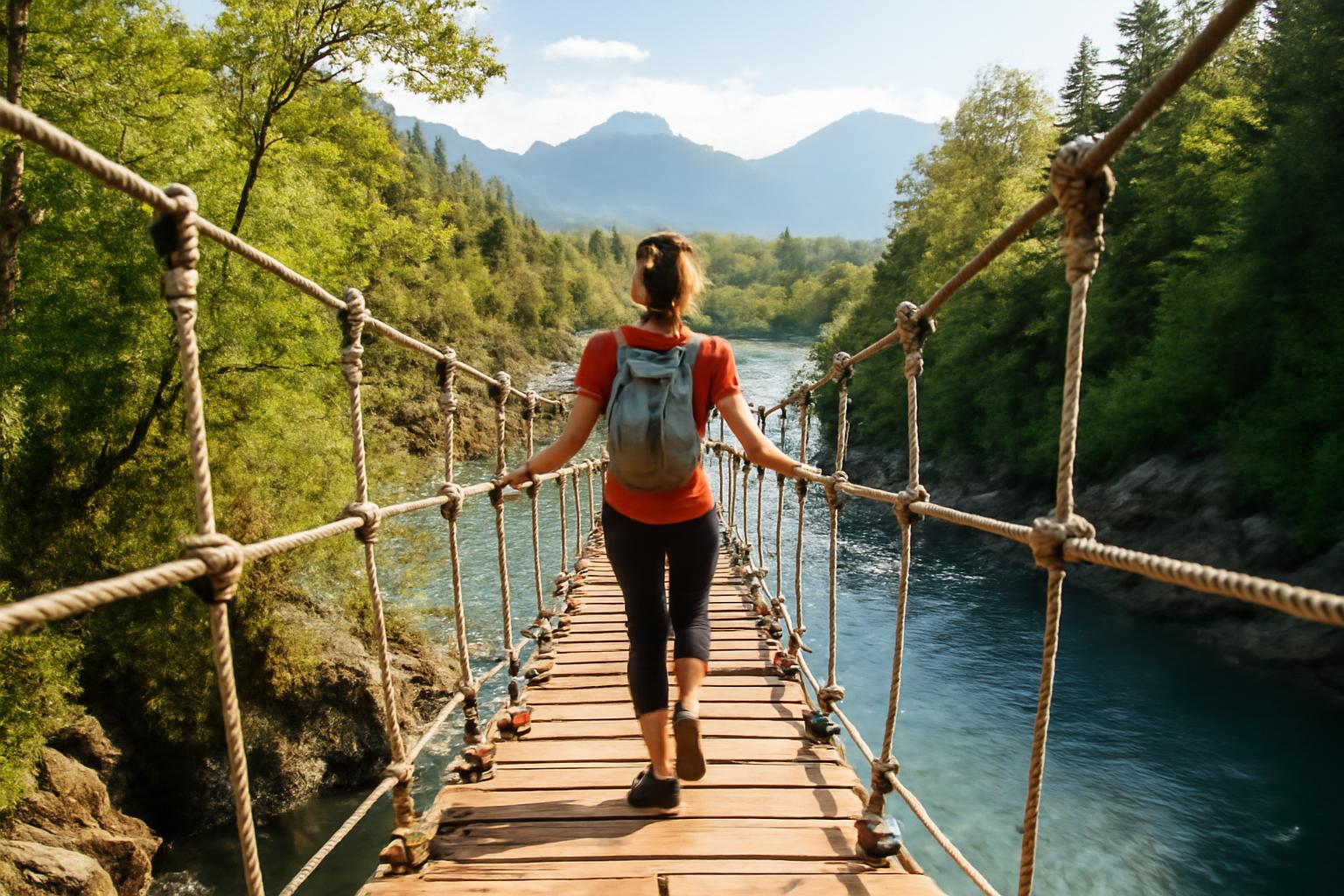
A rope bridge can be anything from a single line used in a supervised outdoor exercise to a permanent cable-and-timber footbridge over a ravine. These structures may look related, but they do not have equivalent capacities, operating conditions, or safety requirements.
The useful question is not simply, “How do you build a rope bridge?” It is: What kind of crossing is this, who will use it, what happens if it fails, and how will every load reach the ground?
This article is a conceptual guide to rope bridges—their configurations, load paths, materials, uses, history, and broad risk considerations. It is not a construction plan, inspection standard, or substitute for site-specific advice from an engineer, inspector, manufacturer, arborist, or local authority.
What Is a Rope Bridge?
Broadly, a rope bridge is a flexible pedestrian crossing whose principal ropes, chains, or cables remain in tension. Loads pass through those tensioned elements to anchors at each end and then into supporting trees, rock, soil, posts, or engineered foundations.
In a common simple-suspension arrangement, the walking surface rests directly on or between the main load-bearing lines. Those lines dip between their supports, so the footway follows a sagging curve. “Rope” is therefore partly a historical and visual description: modern examples may use fiber rope, synthetic rope, chain, steel wire rope, or a combination of materials. A general overview of simple suspension bridges describes the deck as resting on parallel load-bearing cables anchored at both ends.
A modern suspended-deck bridge has a different configuration. Its main cables pass above a distinct deck, while vertical hangers or suspenders transfer the deck loads to those cables. Towers may redirect the cable forces before they reach the end anchors. In simplified terms:
- Simple suspension bridge: The footway lies directly on or between the sagging structural lines.
- Suspended-deck bridge: A separate deck hangs below the main cables from vertical elements.
Terminology is inconsistent. “Rope bridge,” “hanging bridge,” “simple suspension bridge,” and “suspended bridge” can overlap, and “simple suspension bridge” can describe more than one unstiffened arrangement. It is safer to classify a crossing by what physically supports the user than by its name alone. In the standard modern configuration, vertical hangers transfer deck loads to the main cables, as summarized in this overview of suspension bridges.
Why does a flexible bridge move?
A flexible bridge sags because its curved structural lines must provide an upward component of tension to support downward loads. When a pedestrian steps onto the crossing, the shape and tension of the system change. The foot line or deck dips, nearby components move, and the forces reaching the end supports change.
Walking also introduces changing loads. The crossing may move vertically, shift from side to side, or respond rhythmically to a pedestrian’s steps. Some movement is inherent in a flexible structure and is not, by itself, proof of failure. At the same time, general observation cannot establish whether a particular degree of movement is acceptable. That depends on the bridge’s design, materials, condition, and intended use.
The curved surface and movement under load are among the reasons simple rope bridges are generally pedestrian structures rather than vehicle bridges.
The core load path is:
Pedestrian → foot line or deck → main lines and connections → anchors → supporting tree, soil, rock, post, or foundation
Every part of that path matters. A sound-looking deck does not establish the condition or capacity of the main lines, connectors, anchors, supporting trees, banks, or foundations.
The Main Types of Rope Bridge
Rope bridges range from balance challenges to substantial decked crossings. The following comparison describes configurations and broad concerns, not universal designs, capacities, or inspection criteria.
| Configuration | Intended context | Principal components | Expected movement | Defining concern |
|---|---|---|---|---|
| Crawl rope | Supervised balance or pioneering activity | One tensioned line and end anchors | High local deflection, rotation, and lateral movement | Sideways slipping and fall exposure |
| Postman’s bridge | Supervised rope-crossing activity | Lower foot line, upper hand line, anchors | Foot-line sag and possible rotation | Rollover if the line relationship is poorly controlled |
| Monkey bridge | Organized pioneering activity | Foot rope or hawser, handrails, connecting ropes, supports, guys, lashings, and anchors | Noticeable sag, bounce, and side movement | Instability involving supports, anchors, lashings, or lines |
| Decked rope walkway | Recreational or professionally designed pedestrian access | Deck-support lines, boards or grating, hand lines, ties or mesh, hardware, and anchors | Flexible deck movement | Dependence on a continuous multi-component load path |
| Double-A-frame bridge | Temporary, supervised group project | A-frames, foot and hand ropes, stringers, lashings, stakes, and anchors | Deliberate but obvious rope movement | Use outside the project’s bounded conditions |
| Picket-supported bridge | Temporary pioneering exercise | Spars, driven pickets, lashings, and handrails | Depends partly on support stiffness | Movement or failure of the driven supports |
These hazards are descriptive, not diagnostic. Whether any particular structure is suitable for use requires evaluation under the rules and inspection plan governing that bridge.
Crawl rope
A crawl rope is a single tensioned line spanning a gap. The participant balances on, around, or against the line instead of walking on a deck. Its low component count does not make it a general access route or establish that it is low-risk.
Sideways slipping and fall exposure are central concerns. The line, anchors, operating rules, supervision, and any separate fall controls must be considered together. A crawl rope is best understood as a supervised challenge or rope-skills activity.
Postman’s bridge
A postman’s bridge pairs a lower foot line with an upper line held by the user. The upper line provides a second point of contact, but the two-line arrangement can rotate if their relationship is not properly controlled.
Machovec’s activity-specific rope-bridge instructions warn that insufficient upper-line tension can allow a postman’s bridge to turn over and throw off the participant. The same page describes crawl, picket, and monkey bridges, but it does not provide engineering calculations, certified capacities, or a permanent-bridge standard.
Monkey bridge
A monkey bridge is a more developed pioneering structure. Its components can include:
- A main foot rope or hawser
- Two handrails
- Connecting or stringer ropes
- Upright supports such as sheer legs
- Guy ropes
- Lashings
- End anchors
- Protective material where rope contacts trees or supports
The user walks along the lower rope while holding the side lines. Connecting ropes help maintain the relationship between the foot line and handrails, but they do not independently establish the adequacy of the anchors, supports, alignment, lashings, or operating conditions.
Decked rope walkway
A decked walkway replaces the single foot line with boards, grating, or another walking surface. One general treehouse configuration uses two lower deck-support cables, two upper hand cables, and vertical ties or mesh joining the upper and lower elements.
A deck can make the crossing easier to use, but it also adds weight, connections, and exposed components. The boards are only one part of the system. Main lines, terminations, fittings, anchors, hand lines, ties, and supporting structures remain integral to the load path.
Temporary double-A-frame bridges
Their purpose may include practicing knots, lashings, planning, leadership, and teamwork. They are erected under bounded conditions, checked before use, operated under project-specific rules, and dismantled afterward.
That use is materially different from a permanent treehouse entrance or creek crossing. Temporary project instructions should not be enlarged, elevated, or left outdoors indefinitely merely because the resulting structure resembles a permanent footbridge.
Picket-supported arrangements
Picket bridges use spars and driven supports to carry or stabilize the crossing. Their load path includes the spars and the resistance of the driven pickets, so they are not purely suspended rope systems.
Visual similarity is not evidence of equivalent performance. Two crossings with wooden treads and rope handrails can differ completely in structural materials, anchor arrangements, exposure, intended life, and users.
Temporary Project, Treehouse Link, or Permanent Crossing?
The first classification should be based on the consequence of failure, not the desired appearance.
A low bridge erected for a supervised exercise is one category. A private treehouse link used repeatedly by family and visitors is another. These are not simply small, medium, and large versions of one project.
Temporary pioneering activity
A temporary pioneering bridge assumes a controlled setting and prior competence with knots, lashings, anchors, and rope handling. Relevant planning includes:
- Trained supervision
- Restricted height and span under the governing activity instructions
- Suitable ground and anchor conditions
- Checks of ropes, knots, lashings, supports, and anchors before use
- Controlled access and occupancy
- A clear rule for stopping use
- Dismantling after the activity
- Dry storage of ropes and poles
A Scouting magazine project illustrates how narrowly such an activity can be defined. Its instructions limit foot-line height and A-frame spacing, require checks of every knot and lashing, specify one participant at a time, and call for dismantling and dry storage afterward. Those requirements belong to that particular temporary Scout project; they are not general bridge capacities or a plan for permanent access.
“One person at a time” is an operating rule, not proof that a structure can carry any particular person. It cannot replace assessment of the complete system.
Private treehouse bridge
A private treehouse bridge may remain outdoors throughout the year, receive repeated use, and be approached by visitors who do not anticipate its movement. Private ownership does not resolve the structural or fall consequences.
Trees present additional uncertainty because they grow, move in wind, and can develop defects. Attachments and contact points can also affect the tree or change as the supports move. General treehouse guidance warns that bridge failure can cause serious injury or death and recommends professional help beyond low, short spans; its treehouse bridge discussion also emphasizes strong anchors, rated hardware, controlled use, and recurring inspection.
Questions to resolve include:
- Are the proposed supports suitable for the forces involved?
- How will independent tree movement affect the crossing?
- Who can access the bridge?
- How will access be prevented after damage or during adverse conditions?
- What are the consequences of a fall?
- How will attachments and contact points be examined?
- Who is responsible for closing, repairing, and eventually retiring the structure?
A low recreational link and an elevated access bridge are not equivalent. As height, span, use, or uncertainty increases, professional assessment becomes more important.
Permanent creek or ravine crossing
A permanent crossing is a site-specific structural and civil problem. Its planning can involve:
- Clear span and bridge geometry
- Intended users and expected occupancy
- The weight of structural lines, decking, rails, ties, and fittings
- Pedestrian and dynamic loads
- Bank and slope stability
- Flood stage, drainage, debris, and erosion
- Wind, snow, ice, and falling vegetation
- Anchor or foundation conditions
- Deck deflection and lateral movement
- Rhythmic response
- Inspection and maintenance access
- Rescue access
- Permits, standards, and authority requirements
A private account of an 80-foot cable footbridge illustrates the range of issues that can arise. Its builders discussed engineered buried anchors, flood setbacks, deck movement, and harmonic response, and recommended engineer approval for the site-specific design. The project account is anecdotal rather than an engineering standard and should not be treated as a reproducible plan.
Where living trees form part of the support system, qualified arborist input may also be appropriate.
A supported or prefabricated pedestrian span may be preferable to a custom suspension bridge. Possibilities include a beam bridge, supported timber span, or manufactured pedestrian bridge. The available evidence does not establish which option will be cheaper or safer at a particular site; that depends on span, ground conditions, access, loads, maintenance, and applicable requirements.
A conceptual decision tree
Use this sequence before choosing rope, cable, or decking:
-
Will the crossing be left in place? - No: Treat it as a temporary activity governed by competent supervision, bounded geometry, access control, pre-use checks, and dismantling. - Yes: Continue.
-
Could a fall cause serious harm because of height, water, rocks, slope, or difficult rescue access? - Yes or uncertain: Stop at the concept stage and obtain qualified site assessment. - No: Continue without assuming the project is risk-free.
-
Will children, guests, customers, groups, or members of the public use it? - Yes: Obtain professional review and determine applicable guarding, access, inspection, and authority requirements. - No: Continue.
-
Is the bridge long, frequently used, exposed to flooding or severe weather, or intended for year-round service? - Yes or uncertain: Obtain structural review. - No: Continue.
-
Will living trees serve as supports? - Yes: Seek structural advice and qualified arborist input. - No: Have the proposed posts, foundations, buried anchors, rock attachments, or other supports evaluated for the site.
-
Are the loads, anchor capacity, connections, materials, inspection duties, or legal requirements uncertain? - Yes: Do not proceed from a generic online template. - No: Document how those conclusions were verified before procurement or installation.
Where either the consequences or the uncertainties are substantial, professional assessment is the appropriate endpoint.
Materials and Components: More Than Rope and Planks
Historically, flexible bridges used plant fibers and timber. Modern structures may use synthetic rope, chain, steel wire rope, timber boards, metal-grid decking, or combinations of these materials.
A crossing can still be called a rope bridge even when steel cable or chain carries its principal structural loads. The name often refers to the flexible suspension configuration rather than the literal use of natural-fiber rope.
Structural materials are not interchangeable
Plant fiber, nylon, other synthetic ropes, chain, and steel cable should not be treated as interchangeable. Available sources establish that these material categories are used in rope bridges, but they do not provide a universal technical comparison or selection rule.
For any particular project, the material and its associated connections must be verified for the intended structure. Relevant questions include:
- What documented strength information is available?
- How much does the system stretch under its intended conditions?
- Which terminations and connectors are compatible with it?
- How will exposed and hidden portions be examined?
- What does the manufacturer or project-specific plan require?
- How will the material interact with supports and contact surfaces?
Limited stretch is generally useful in a suspended walkway because changes in line length alter sag and the relationship between the footway and hand lines. “Low stretch,” however, is not a complete specification and cannot determine the correct material or size by itself.
Common components
Depending on its configuration, a rope bridge may include:
- One or more foot lines
- Lower deck-support cables
- Boards, grating, or another walking surface
- Upper hand lines or cables
- Vertical ties, stringers, netting, or mesh
- Rated connectors
- Terminations and tensioning hardware
- A-frames, sheer legs, posts, or other supports
- Guy ropes or lateral restraints
- Tree slings or engineered support connections
- Buried, rock, or foundation anchors
- Backup elements where specified
- Protective material at contact points
- Gates or other access controls
Knots, splices, lashings, clips, shackles, eye bolts, turnbuckles, and similar fittings are not cosmetic accessories. They transfer loads between major components. An unknown or unsuitable connection can determine the performance of the whole crossing.
The visible walkway is therefore only one section of a continuous structural system. No universal rope diameter, cable size, hardware rating, deck arrangement, or component life can be derived from a general article. Those decisions depend on configuration, geometry, loads, environment, installation, and consequences of failure.
Why Anchors, Alignment, and Tension Matter
A rope bridge does not create only downward effects from its weight and users. The tensioned main lines also pull toward the center of the span, creating horizontal forces at their end connections. Those forces must pass through the hardware and anchors into the supporting ground, trees, posts, rock, or foundations.
For a decked walkway, the conceptual load path is:
User → deck → deck-support lines → terminations and hardware → anchors → supporting ground or trees
For a foot-line bridge, it is:
User → foot line → end termination → anchor → support
Hand lines, stringers, mesh, guys, frames, and backup elements can create additional paths, depending on the configuration.
Suitable anchors are a prerequisite
Possible supports include trees, engineered buried anchors, foundations, posts, or professionally evaluated rock connections. No support type is automatically adequate. Its suitability depends on its condition, the site, the bridge geometry, and the forces it must carry.
General treehouse guidance specifically warns against attaching bridge cables to an unreinforced deck edge or railing. Such an attachment can introduce bridge forces into members and connections not intended for that purpose. The same guidance emphasizes appropriate anchors and hardware with documented ratings for their role.
Alignment affects how supports behave
The main structural lines, supports, and anchors must be arranged so that the forces reach the supports as intended. In a monkey bridge, the hawser, sheer legs, guys, and anchors operate as one connected system.
Machovec’s monkey-bridge guidance warns that the hawser, sheer legs, and anchors should remain aligned to reduce the risk of the sheer legs flipping. This is a configuration-specific warning from a pioneering guide, not a general engineering calculation.
More tension is not automatically safer
A bridge needs controlled tension to produce the geometry intended for that particular system. Excessive slack can change footing, hand-line position, and movement. It does not follow, however, that indiscriminately tightening the lines makes the bridge safe.
Tension, sag, geometry, anchor forces, and material behavior are connected. If a bridge’s sag or movement changes, the cause cannot be determined by appearance alone. Adjustment should follow the bridge’s approved design, manufacturer instructions, or qualified assessment rather than improvisation.
Recurring themes in the available guidance include:
- Hardware with documented ratings appropriate to its assigned role
- Deliberately planned terminations and connections
- Backup measures where the design specifies them
- Protection at abrasion and contact points
- Stable alignment
- Control over who may adjust the system
- Access for examination of anchors and connections
Tree-supported systems require particular attention because trees grow and move, and their condition can change. The structural effect of an attachment and its effect on the tree may both require recurring assessment. Anchor dimensions, cable tensions, soil capacities, and connection details cannot be generalized safely from the available evidence.
Safety, Inspection, and Environmental Exposure
This section is a risk-awareness framework, not a certification checklist. It does not establish that a bridge is safe, compliant, suitable for children, or fit for public access. The significance of any observed condition depends on the material, design, manufacturer guidance, environment, and qualified inspection plan.
Observations that warrant stopping use
Access should be prevented and qualified advice sought when users or owners observe a material change, visible damage, or a condition they cannot confidently assess. Broad examples supported by the available guidance include:
- A support or anchor that appears damaged, displaced, or to be moving
- A substantial or unexplained change in sag
- Changed alignment between the bridge lines, supports, and anchors
- Visible abrasion or damage at a rope, cable, tree, frame, or deck contact point
- Corrosion affecting metal components
- Loose or damaged decking
- Deteriorated lashings, ties, hand lines, or mesh
- Hardware of unknown rating or uncertain intended use
- New or unusual twisting, bouncing, or side movement
- A recurring need for adjustment without an understood cause
- Inability to prevent use during damage, storms, flooding, or inspection
This is not a set of universal retirement criteria. It does not tell an owner how much wear, corrosion, movement, or slack is acceptable. Those determinations require the applicable manufacturer information, design documentation, and competent inspection.
A pre-use observation should follow the visible load path rather than focus only on the deck surface. Boards may be the easiest components to see, but the main lines, connections, supports, and anchors are equally important.
Operating controls
Depending on the bridge and its governing plan, controls may include:
- Direct supervision
- Restricting or locking access
- Preventing running, jumping, bouncing, or deliberate synchronized movement
- Avoiding use during storms or other adverse conditions
- Following the occupancy rule established for that specific bridge
- Maintaining an appropriate emergency or rescue plan
- Preventing unauthorized adjustment or repair
Some temporary instructions specify one person at a time. That may limit simultaneous use, but it does not prove structural capacity and cannot be generalized to all rope bridges.
Children should not be allowed onto a bridge merely because it has boards, hand lines, or mesh. Suitability depends on the complete design, fall exposure, access controls, guarding, movement, verified condition, and supervision.
Environmental effects
Outdoor suspension systems can change over time. Relevant exposures identified across the available sources include:
- Storms and wind: Trees and flexible bridge elements can move, while branches may fall.
- Flooding: Water can affect banks, approaches, foundations, and debris exposure.
- Tree growth and movement: Attachment geometry and contact points can change.
- Impacts: Supports, anchors, or the suspended system may be affected.
- Abrasion: Repeated contact can damage lines or protective material.
- Corrosion: Exposed metal components may deteriorate.
- Stretch: Line length and bridge geometry may change.
- Dynamic movement: Pedestrians can produce vertical, lateral, or rhythmic response.
General treehouse guidance recommends strong anchors, rated components, inspection, restricted access, and avoiding use during storms. It does not provide a universal inspection interval or a complete acceptance standard.
A changed sag profile, unusual movement, damaged support, or unexplained need for repeated adjustment should therefore lead to restricted access and qualified assessment, not casual retensioning.
Maintenance is a system responsibility
Conceptual maintenance responsibilities include:
- Examining anchors and supports
- Checking accessible terminations and connections
- Observing rope, cable, chain, and lashings
- Checking decking, hand lines, mesh, and ties
- Examining protective material at contact points
- Reviewing tree condition and attachments
- Comparing alignment and geometry with project documentation
- Controlling access during damage or adverse conditions
- Replacing or retiring components under qualified guidance
- Recording observations, repairs, incidents, and significant environmental events
Temporary equipment should be checked before use, dismantled afterward, and stored as required by its activity instructions. The available general sources do not establish universal inspection intervals, rejection thresholds, or retirement schedules.
Commercial Rope-Bridge Kits: What They Do and Do Not Solve
A commercial kit can simplify the purchase of selected cables, connectors, or related hardware. It does not establish that a site is suitable, that the anchors can carry the required forces, that occupancy is safe, or that the completed crossing satisfies applicable requirements.
Kit contents and advertised span ranges are vendor claims, not independent engineering approvals.
As a vendor-specific example viewed in the supplied research, Treehouse Supplies lists a standard cable kit associated with spans of 6 to 30 feet and a deluxe extra-cable option associated with spans of 32 to 75 feet. The seller says the walking surface is excluded, advises customers to finalize connection points and consult an engineering professional before ordering, and notes that additional cable components may be required. These statements come from the vendor’s treehouse bridge kit collection, not an independent design review.
The same page describes the products as made to order and nonreturnable. Product ranges, contents, availability, and purchasing terms can change, so buyers should verify current information directly with the seller before ordering.
Procurement checklist
Before purchasing a kit or individual components, establish:
- Intended use: Temporary activity, private recreational access, permanent private crossing, commercial use, or public access.
- Exact site: Measured span, height, approaches, clearance, exposure, and rescue access.
- Users: Expected occupancy, frequency of use, user characteristics, and access controls.
- Support plan: Trees, posts, foundations, buried anchors, rock, or another system.
- Connection plan: How loads will move from kit components into the supports.
- Decking scope: Which boards, rails, ties, mesh, and fasteners are excluded.
- Included hardware: Exact quantities, documentation, ratings, and intended functions.
- Professional review: Who will verify geometry, loads, anchors, connections, and environmental effects.
- Authority requirements: Which permits, inspections, or approvals may apply.
- Inspection responsibility: Who will examine the crossing before opening and during service.
- Replacement support: Whether compatible parts and relevant guidance will remain available.
- Documentation: Installation limits, maintenance instructions, warranties, and exclusions.
Buying components is procurement. It is not the completion of structural design.
A Short History: Fiber Bridges, Iron Chains, and Living Roots
Flexible suspension crossings developed in more than one region, notably the Andes and the broader Himalayan and East Asian region. Their histories should not be reduced to a single definitive “first” bridge.
A tertiary historical overview reports early Chinese descriptions of crossings made from multiple vine cables and later versions with planks resting on cables. It also records that Inca rope bridges existed before Spanish arrival in the Andes in the 16th century. Because the account is a general encyclopedia summary rather than a primary historical source, it is best used to identify broad traditions rather than settle disputed chronology.
Traditional Andean fiber bridges depended on periodic renewal because their plant-fiber structural materials had limited lives. In that tradition, durability does not mean that the original fibers remain indefinitely.
Materials later expanded beyond vines and plant rope. The Luding Bridge, dated to 1703, used iron chains as its principal tension elements. In 1822, Marc Seguin and his brothers built a temporary wire-cable simple suspension bridge at Annonay, illustrating the introduction of wire into this form of crossing. These dates and developments are summarized in the same overview of simple suspension-bridge history, so they should not be treated as independently verified claims about the world’s first or oldest example.
Meghalaya’s living-root bridges represent a distinct tradition. They are formed by guiding living roots of Ficus elastica across a gap and allowing the biological structure to develop. They are not ordinary rope bridges assembled from replaceable lines, fittings, and decking.
Frequently Asked Questions
Why do rope bridges sag and sway?
Sag allows tension in the structural lines to provide an upward component that supports downward loads. When a pedestrian steps onto the crossing, its flexible lines and deck change shape. Walking can also introduce vertical, lateral, and rhythmic movement.
Some movement is inherent in this type of structure. General observation alone cannot determine what amount is acceptable, however. A new or substantial change in sag, alignment, or movement should be treated as a reason to prevent access and seek assessment rather than to make an improvised adjustment.
Are rope bridges safe for children?
No rope bridge can be declared child-safe as a category. Suitability depends on the complete design, fall exposure, guarding and openings, access control, movement, verified condition, and supervision.
The cited Scout project, for example, imposes specific height and span limits, pre-use checks, and one-person occupancy within a supervised activity. Those controls are documented in its temporary project instructions, but they do not certify other bridges or make permanent elevated crossings suitable for children.
Can I build a permanent rope bridge from Scout or online instructions?
Temporary Scout and pioneering instructions should not be treated as permanent bridge plans. They assume particular materials, skills, geometry, supervision, operating rules, and a temporary service period.
Online examples can explain terminology and show how components relate conceptually. They do not supply the site-specific load analysis, anchor evaluation, environmental assessment, inspection plan, or authority review required for a permanent crossing.
Do rope-bridge kits include everything needed for a complete bridge?
Not necessarily. The cited Treehouse Supplies kits exclude the walking surface. The seller also advises buyers to finalize connection points and consult an engineering professional before ordering, and it notes that additional cable components may be required.
A kit does not by itself resolve decking, anchors, support suitability, permits, installation, inspection, maintenance, or safe occupancy. Vendor descriptions and purchasing terms should be verified before purchase.
When should a structural engineer or arborist be involved?
Qualified structural assessment is appropriate when a crossing is high, long, permanent, heavily used, commercial, publicly accessible, exposed to significant environmental effects, or dependent on uncertain supports or ground conditions. It is also appropriate whenever failure could cause serious harm or the loads and movement cannot be confidently evaluated.
A qualified arborist should be considered when living trees form part of the support system, particularly where tree condition, defects, root stability, movement, growth, or attachment effects are uncertain.
Classify the Crossing Before Choosing Materials
A rope bridge may look simple, but it is a complete tension system. Its performance depends on intended use, load path, anchors, connections, supports, environment, operating controls, and maintenance.
Classify the proposed crossing before thinking about rope, cable, or decking. A low supervised pioneering activity, a private recreational link, and a permanent or public footbridge are not versions of the same project.
For anything high, long, permanent, tree-supported, heavily used, commercial, publicly accessible, or otherwise high-consequence, the appropriate next step is qualified site-specific assessment—not a universal online plan.