
How to Plan a Capilano Bridge Visit Without Losing Half the Day
Plan on two to three hours inside the park, plus transport; weigh the free downtown shuttle, transit, parking, accessibility and Lynn Canyon.
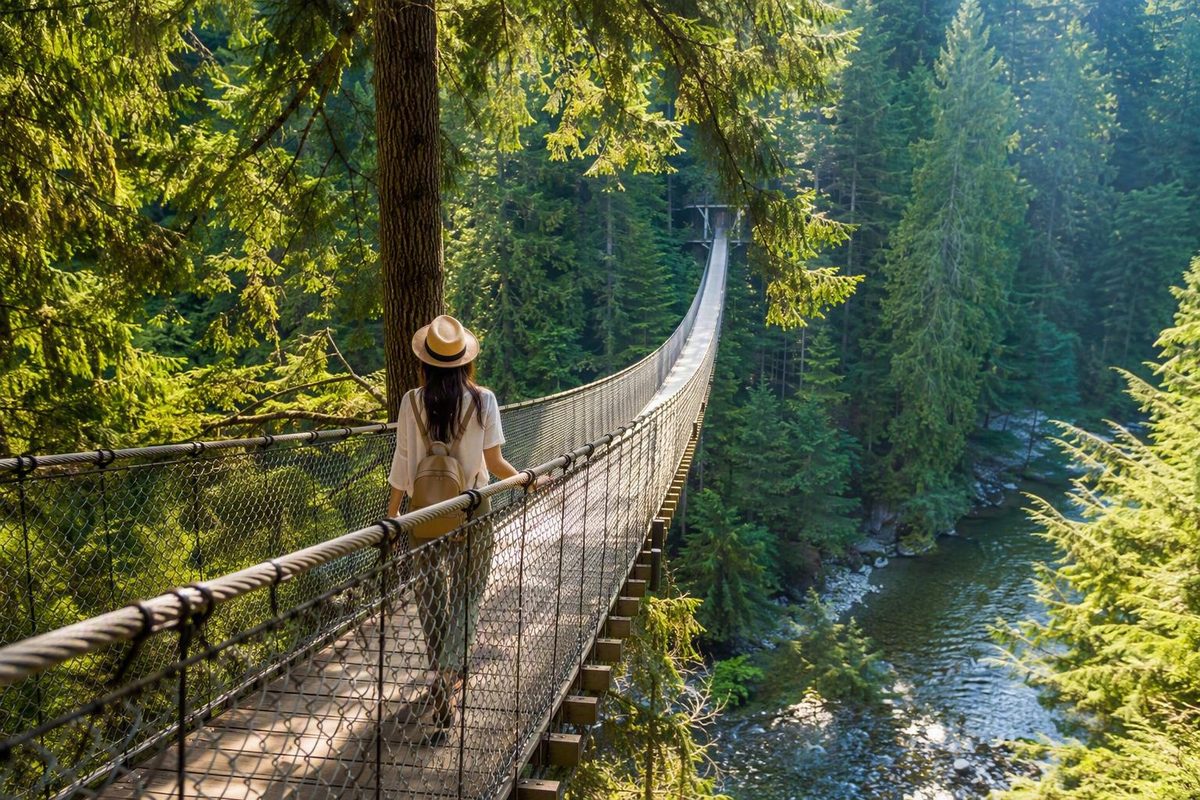
Capilano Suspension Bridge Park is easier to plan when you treat it as a developed North Vancouver attraction rather than a quick bridge photo stop. Admission covers three principal elevated experiences, interpretation, visitor facilities, and programs that vary by season. For a first visit, allow roughly two to three hours inside the park, plus transportation; a slower visit can approach four hours.
The main decisions are simple: choose the downtown shuttle or public transit, decide whether moving bridges and exposed walkways suit everyone in your group, and leave enough time to experience more than the main crossing. If the admission cost is difficult to justify, compare the complete park with the free, trail-oriented alternative at Lynn Canyon—not merely one bridge’s length.
Capilano Suspension Bridge at a glance
Capilano Suspension Bridge Park is at 3735 Capilano Road in the District of North Vancouver. Although it is commonly marketed as a Vancouver attraction, it is not within the City of Vancouver.
This is a privately operated attraction with paid admission, not a free public bridge. The pedestrian suspension bridge is approximately 140 metres long and hangs about 70 metres above the Capilano River. Published lengths vary slightly, commonly between 137 and 140 metres, so an approximate measurement is more useful than false precision. The original crossing was built in 1889, a wire-cable bridge followed in 1903, and the structure was rebuilt in 1956, according to an overview of the bridge’s address, dimensions, and history.
For planning purposes, the important point is that admission covers a developed park rather than one crossing. The main bridge is joined by Treetops Adventure, Cliffwalk, entrance-area interpretation, forest features, food outlets, and changing programs. That makes Capilano a substantial half-day outing, but it need not occupy the entire day.
A practical time budget is:
- About two hours: A focused visit covering the main bridge and one secondary attraction.
- About three hours: The best general allowance for a first visit covering all three headline experiences.
- Up to four hours: A relaxed visit with interpretation, food, photography, breaks, and any seasonal programming available that day.
Travel time is additional. Your outing begins when you leave for the shuttle stop, transit station, or parking area and ends when you return downtown. Do not build a rigid schedule around the frequently quoted idea that the park is about 15 minutes from downtown. The journey depends on your starting point, Lions Gate Bridge traffic, waiting time, and mode of travel.
Planning note: Prices, opening hours, ticket procedures, shuttle schedules, parking arrangements, events, and attraction closures are time-sensitive. Check the official Capilano Suspension Bridge Park website immediately before booking and again on the day of your visit.
Operational details last verified: Not independently verified for publication. Confirm all date-specific information directly with the park before relying on it.
Buy tickets through capbridge.com or an authorized ticket partner. The park warns that entry is guaranteed only for tickets purchased through recognized sales channels. That matters when resale sites, third-party listings, or old articles display ticket conditions that may no longer apply.
The simplest decision rule is this: choose Capilano if you want a structured North Shore attraction with several engineered viewpoints, interpretation, and visitor services. Reconsider it if the admission cost, bridge movement, stairs, or inaccessible elevated routes would prevent your group from using the main experiences.
What admission covers beyond the main bridge
Admission is best understood as access to a multi-part park, not as a fee for walking across one suspension bridge. Each of the three principal experiences presents the canyon and forest differently.
The Suspension Bridge is the park’s central crossing over the Capilano River. It is long, exposed, and intended for pedestrians. Movement becomes noticeable as people walk across it, and crowd levels can affect how freely you choose your pace. The bridge provides the broad canyon view associated with Capilano, but it also serves as the route to attractions on the opposite side.
Treetops Adventure consists of seven suspended footbridges through the forest canopy.
Cliffwalk follows the canyon’s granite cliff using narrow walkways, stairs, platforms, and projecting sections. Its emphasis is the cliff face and the space above the canyon rather than a broad river crossing. The route’s stairs, narrow passages, and exposure are important considerations for anyone with limited mobility or discomfort around heights.
Admission has also been described as covering entrance-area interpretation, the Story Centre, Kia’palano, and programs offered according to season. Exact inclusions can change, but Destination Vancouver’s park guide describes the three principal attractions, seven Treetops bridges, additional interpretation, and season-dependent programming.
A practical route through the park is:
- Begin with the entrance-area interpretation.
- Cross the main Suspension Bridge.
- Complete Treetops Adventure and any forest-side features you want to see.
- Cross the Suspension Bridge again to return.
- Finish with Cliffwalk on the entrance side.
This is an editorially suggested sequence rather than a mandatory park route. It limits unnecessary backtracking and places Cliffwalk near the end, after you have learned how comfortable you are with elevation and moving walkways.
The sequence also reveals an important limitation: reaching the far-side experiences requires crossing the main bridge. Someone who cannot manage that crossing may be unable to use Treetops Adventure even if its shorter forest bridges appear less intimidating. If anyone in your party is uncertain about moving bridges, judge the visit first by whether the main crossing feels realistic.
Seasonal programming can add value, but it should be treated as a bonus rather than the foundation of your itinerary. Canyon Frights in autumn, Canyon Lights around the holiday period, and bird-related programming are examples that have been offered. Dates, operating times, and ticket inclusions vary, and no seasonal program should be assumed to be available without checking the current event information.
Value therefore depends on how much of the park you will use. Someone interested only in one bridge photograph may find the admission expensive relative to the time spent. Someone who completes the main bridge, Treetops Adventure, Cliffwalk, interpretation, and an available seasonal feature receives a much broader experience from the same ticket.
Tickets, timing, and realistic visit lengths
Current visitor guides describe Capilano as using dated or timed entry, with customers selecting a visit date and arrival window. Confirm the actual booking process on the official ticket page before paying. A timed ticket can regulate arrivals, but it does not promise an empty park or eliminate queues at individual experiences.
Do not rely on a price copied from an old search result, screenshot, or travel blog. Check the final amount, ticket category, applicable taxes, and date-specific conditions during the official checkout process. The same principle applies to discounts, refunds, changes, missed entry, and re-entry: if the current official terms do not state a policy, do not assume an older arrangement remains valid.
Recheck before visiting:
- Admission price and tax treatment
- Operating hours for your date
- Entry window and arrival procedure
- Shuttle timetable and boarding process
- Parking rate, time limit, and payment options
- Seasonal-event dates and inclusions
- Weather, maintenance, and attraction closures
- Current accessibility and stroller procedures
For most visitors, three itinerary lengths are more useful than a single average duration.
Focused two-hour visit
Choose this plan only when the rest of your day is tightly scheduled. Arrive with your ticket ready, briefly view the entrance interpretation, cross the main bridge, and make Treetops Adventure your principal far-side priority. Return across the bridge and add Cliffwalk only if time, queues, and comfort permit.
Two hours leaves little room for food, extensive photography, long waits, or a hesitant member of the group. It is a workable minimum for a focused visitor, not a promise that everyone can complete every experience comfortably.
Standard three-hour visit
This is the most practical default for a first visit. It provides time for the entrance area, the main bridge in both directions, Treetops Adventure, Cliffwalk, and short stops for views or interpretation.
Published visitor guidance commonly recommends approximately two to three hours, with closer to four hours for a slower visit. One local guide describes two to three hours as typical and up to four at a relaxed pace.
A three-hour park visit still occupies a wider part of the day. If you use the downtown shuttle, your real schedule includes walking to the pickup point, waiting, travel in both directions, and any buffer before the final suitable return. Calculate from accommodation departure to return, not merely from ticket time to park exit.
Relaxed four-hour visit
Allow up to four hours when photography, exhibits, food, young children, seasonal programming, or a deliberately slow pace matter. This is also the safer plan for a group that does not move at one speed or needs frequent breaks.
Four hours is not mandatory. The park is compact enough for focused visitors to cover its main components more quickly. The additional time buys flexibility and depth rather than being required for distance alone.
A weekday or early-morning arrival may reduce exposure to peak crowds, but it cannot guarantee a quiet park. Holidays, tour groups, cruise schedules, weather, school breaks, and special events can alter attendance. Evening events may also move demand later into the day.
Check same-day conditions even if the park itself is open. A valid ticket is not a guarantee that every feature mentioned in an older guide will be operating.
How to get there from downtown Vancouver
For many visitors without a car, the complimentary downtown shuttle is the simplest option. It avoids transit transfers and travels directly to the attraction, making it particularly convenient when Capilano is your only North Shore destination that day.
The park’s published downtown pickup points are:
- Canada Place
- Hyatt Regency
- Blue Horizon Hotel
Proof of park admission is required for the return journey. Shuttle stops, schedules, capacity, and boarding procedures can change, so consult the park’s official transportation directions before leaving downtown. The supplied evidence does not establish that seats can be reserved or guaranteed.
At the pickup point, confirm where the line forms and how early passengers are expected to arrive. Before entering the park, identify the final return departure that works for your plans. Keep your ticket accessible for the return rather than relying on a screenshot or confirmation that may be difficult to retrieve later.
If the shuttle timetable is inconvenient, public transit provides an alternative.
The principal public-transit route
The park’s published route from central downtown is:
- Travel to Waterfront Station.
- Take SeaBus to Lonsdale Quay.
- Transfer to bus 236 toward the Capilano or Grouse Mountain area.
- Get off at the stop serving the park.
- Check the reverse journey and evening frequency before departure.
Use TransLink’s current trip planner on the day of travel to confirm the boarding bay, stop name, service notices, transfer time, and final practical return. Route numbers and schedules can change, and this article does not establish the last departure for your date.
Other routes published by the park include bus 246 from downtown, followed by a walk north along Capilano Road, and bus 232 from Phibbs Exchange. These may be useful from particular accommodation areas, but they are not necessarily simpler than the Waterfront–SeaBus–236 route.
The choice comes down to flexibility:
- Complimentary shuttle: Direct and simple, but tied to the park’s operating timetable and available capacity.
- Public transit: More independent and easier to combine with other North Shore locations, but requires transfers and careful return planning.
- Taxi or rideshare: Direct and independent of a fixed timetable, but the price varies with origin, traffic, and demand.
The park publishes taxi and rideshare pickup and drop-off information for the area across from the entrance. Confirm the roadside pickup location when arranging your return rather than assuming a driver can wait within the entrance area.
Bicycle racks are also listed across Capilano Road. The approach includes hills and busy road sections, making it most appropriate for riders comfortable with North Shore terrain and traffic. Bicycles and e-scooters are not permitted inside the attractions and must remain outside at the designated area.
For a low-stress car-free outing, settle the return plan before departure. Reaching Capilano is only half the transportation problem; the final shuttle, evening transit frequency, or backup ride matters just as much.
Driving, parking, and building a North Shore day
Driving gives you control over departure time and can simplify a second North Shore stop, but it does not guarantee the fastest journey. Traffic across Lions Gate Bridge and congestion on North Vancouver roads can substantially change travel time. Treat any published 15-minute estimate as a favorable approximation, not a promise.
On-site parking is limited and paid, which is especially relevant on weekends, holidays, and during popular seasonal events. The park’s official directions have published a parking rate and time allowance, but both are time-sensitive. Verify the current rate, permitted duration, payment methods, and re-entry conditions before driving.
Do not create a four-hour park plan around an unconfirmed three-hour parking allowance. If your intended stay is longer than the available parking period, resolve that conflict before arrival.
Overflow parking and shuttle transport may sometimes operate from other North Vancouver locations. These are conditional arrangements rather than permanent capacity. Confirm whether an overflow lot is active for your date and where its shuttle boards. RV parking is described by the park as extremely limited, so visitors in oversized vehicles should seek direct guidance rather than expecting a standard space.
Capilano pairs more naturally with Grouse Mountain than with attractions elsewhere in North Vancouver. The two are near the same general corridor, although Grouse Mountain is separately ticketed and has its own weather, transportation, operating-hour, and queue considerations.
A realistic full-day structure is:
- Morning: Arrive at Capilano near opening and spend approximately three hours on its principal experiences.
- Midday: Leave a generous buffer for transportation, lunch, and any wait involved in reaching the next attraction.
- Afternoon: Visit Grouse Mountain with a separate ticket, subject to current seasonal hours and conditions.
- Evening: Return downtown using a route checked in advance.
This is a full day rather than two quick stops. It becomes more demanding if you add a long meal, extensive mountain activities, or an evening event at Capilano.
Families who drive may appreciate having spare clothes, carriers, and rain gear nearby, but limited parking can offset that convenience. A family travel account describes Capilano as close to Grouse Mountain while also reporting dated entry, paid parking, and stroller restrictions; these operational details still require current confirmation rather than being treated as permanent policy.
Car-free visitors should not assume that one attraction’s shuttle connects conveniently with another attraction. A service designed to return passengers downtown may not serve your desired transfer, and seasonal North Shore transportation can end before your visit does. Check the current connection in a transit planner. If no convenient link is shown, route through a dependable transit interchange instead of improvising late in the day.
The useful planning principle is to pair destinations by transport corridor, not simply because both have a North Vancouver address.
Families, accessibility, heights, and weather
Capilano can work well for some families, but it is not universally accessible and should not be described as suitable for every visitor.
The Suspension Bridge, Treetops Adventure, and Cliffwalk are reported as not wheelchair accessible. Selected entrance-area interpretation, shops, and dining spaces may be accessible, but that does not make the complete park accessible. Destination Vancouver’s guide reports these elevated-attraction limitations and some entrance-area access; visitors should still obtain direct confirmation of current routes, surfaces, washrooms, assistance procedures, and ticket arrangements before purchasing admission.
Do not assume that an older complimentary-admission or companion policy remains in force. Eligibility, documentation, and ticket procedures are operational matters that require current first-party confirmation.
Strollers are reported as prohibited on the three principal elevated attractions. A family-focused visitor guide reports the restriction for the Suspension Bridge, Treetops Adventure, and Cliffwalk and recommends using a carrier, but families should confirm the current rule directly with the park before arrival.
A child carrier solves only the stroller problem. The adult still needs stable footing, enough endurance, and confidence on moving or narrow walkways. Allow additional time and dress the child for outdoor conditions that may feel cooler or wetter than those in central Vancouver.
The main physical and sensory demands include:
- Movement on suspended bridges
- Exposure to the canyon and river below
- Narrow cliffside sections
- Stairs and changes in level
- Extended outdoor walking and standing
- Damp walking surfaces after rain
- Crowding that may limit your preferred pace
The main Suspension Bridge is the critical test because it provides access to attractions on the far side. If someone cannot cross it, a substantial part of the park experience may be unavailable. Buying admission in the hope that the person can bypass the main bridge could result in a limited visit.
Fear of heights is individual. One person may struggle with movement on the main bridge but feel comfortable on forest paths. Another may cross the bridge yet dislike Cliffwalk’s narrow positioning. Give everyone permission to skip a component rather than treating completion of every attraction as the measure of a successful outing.
Wear secure footwear with dependable traction. Closed shoes that remain stable on stairs and damp surfaces are more practical than loose sandals. Bring rain protection and dress in layers because much of the visit is outdoors and North Shore conditions can differ from downtown.
For children, check current age, supervision, footwear, and attraction-specific requirements. Admission to the park does not establish that every child is physically or emotionally ready for every elevated experience. Explain beforehand that the bridge moves, keep children with supervising adults, and do not force a reluctant child onto a crossing merely to preserve the itinerary.
Avoid broad claims that the park is categorically safe or unsafe based on historical incidents or personal impressions. Suitability depends on current operating conditions, posted restrictions, individual mobility and health, weather, and compliance with staff instructions. If an attraction is closed, treat that as an operational decision rather than an obstacle to work around.
When to visit: seasons, crowds, and changing conditions
There is no universal best season for Capilano. The right time depends on whether you prioritize long daylight, mild temperatures, seasonal lighting, rainfall tolerance, or lower exposure to peak demand.
Spring can bring fresh forest conditions and substantial rain. Waterproof layers and shoes with traction matter more than finding a perfect forecast. Variable weather also favors an itinerary that can be adjusted rather than one tied to a narrow outdoor schedule.
Summer generally gives you more daylight for combining Capilano with another North Shore stop. The trade-off is stronger visitor demand, especially on weekends and holidays. An early entry may help but cannot guarantee an empty bridge or viewing platform.
Autumn may suit visitors who prefer cooler conditions and seasonal atmosphere. Canyon Frights is a recurring example of autumn programming, but its dates, hours, and inclusions vary. Do not promise children a particular activity or reserve transport around it until the current event listing confirms the details.
Winter and the holiday period can bring evening lighting and shorter daylight. Canyon Lights is a recurring seasonal example rather than a year-round inclusion. Evening visitors need to account for rain, cold, visibility, demand, and the return downtown. Check both the last suitable shuttle and the final practical public-transit journey before purchasing an evening ticket.
The park is presented as a year-round attraction, but that does not mean every walkway, program, or presentation operates every day. Its three principal attractions generally operate year-round only weather permitting, and maintenance or seasonal schedules can still affect individual experiences.
Weekdays and mornings are reasonable crowd-management choices, not guarantees. Attendance also responds to holidays, tour groups, cruise schedules, events, and weather. Conversely, a rainy or overcast day need not be dismissed if your group has suitable clothing and footwear. The relevant question is whether the conditions match your expectations for footing, photography, visibility, and transportation.
Some guidance is relatively stable:
- Most of the visit is outdoors.
- Layers and rain protection are useful.
- Secure footwear improves comfort.
- Morning or weekday entry may reduce exposure to peak crowds.
- Return transportation should be planned in advance.
Other information should always be treated as volatile:
- Exact operating hours
- Ticket prices and entry windows
- Shuttle stops and departure times
- Final evening service
- Parking and overflow arrangements
- Seasonal-event dates
- Attraction closures
- Weather-related operational changes
Check the official site on the day of your visit, not only when booking. A valid ticket does not tell you whether a shuttle timetable has changed or maintenance has affected one experience.
Capilano or Lynn Canyon: which bridge fits your trip?
The two places use different models and suit different priorities.
Capilano Suspension Bridge Park is a paid, curated attraction. It combines an approximately 140-metre main bridge about 70 metres above the Capilano River with Treetops Adventure, Cliffwalk, interpretation, visitor services, and changing family or seasonal programs. Its direct downtown shuttle can simplify the trip for first-time visitors.
Lynn Canyon Park is a free public forest park. Its suspension bridge is approximately 40 metres long and about 50 metres above Lynn Creek. The surrounding park includes boardwalks, forest trails, an ecology centre, and nature-based recreation rather than a sequence of ticketed elevated attractions. Vancouver’s North Shore Tourism describes the bridge dimensions, free public-park model, trails, ecology facilities, and parking guidance.
Choose Capilano when you want:
- Three principal elevated experiences in one admission
- A developed attraction with a legible route
- Interpretation and visitor facilities
- Seasonal or family programming when available
- A direct complimentary shuttle from central downtown
- A structured half-day attraction
- A longer bridge as the central experience
Consider Lynn Canyon when you want:
- Free park entry
- Forest walking as the main activity
- A public-park setting rather than a curated attraction
- More control over how far and how long you walk
- To preserve your admission budget for another activity
- A suspension bridge as one feature of a broader outdoor visit
Free entry does not eliminate planning. Reaching Lynn Canyon still takes time, parking conditions can change, and trails require suitable clothing and footwear. North Shore tourism guidance warns that the parking area can fill quickly and recommends weekdays, early mornings, public transit, or cycling as alternatives during busy periods.
Do not assume Lynn Canyon will always be quiet. Visitor reports differ: some describe a peaceful alternative, while others encounter a busy bridge and full parking area. Crowd levels at either location depend on timing and conditions, not simply whether admission is charged.
Atmosphere and commercialization are also matters of preference. Some visitors value Capilano’s organized route, facilities, interpretation, and multiple built experiences. Others prefer Lynn Canyon’s less structured forest setting. Neither preference is an objective measure of quality.
Value depends on what your group will actually use. If you intend to cross the main bridge, complete Treetops Adventure and Cliffwalk, view the interpretation, and use the downtown shuttle, Capilano functions as a multi-hour attraction. If you mainly want a shorter suspension-bridge crossing followed by forest walking, Lynn Canyon may fit better.
Do not automatically schedule both in one car-free day. They are in different parts of North Vancouver, and the transfer can consume more time than the map suggests. Unless a current transit plan demonstrates that the connection fits comfortably, choose one bridge and spend the remaining time nearby.
The practical verdict is conditional: choose Capilano when a curated North Shore attraction, straightforward downtown connection, and several elevated experiences justify the admission and two-to-three-hour commitment. Choose Lynn Canyon when free access and forest trails matter more. In either case, confirm current hours, transportation, weather effects, accessibility, and closures before leaving.
Frequently asked questions
Is Capilano Suspension Bridge in Vancouver or North Vancouver?
It is at 3735 Capilano Road in the District of North Vancouver. It is often described as a Vancouver attraction because it belongs to the wider destination and is accessible from downtown, but it is not within the City of Vancouver.
How long should I spend at Capilano Suspension Bridge Park?
Allow approximately three hours inside the park for a first visit covering the Suspension Bridge, Treetops Adventure, and Cliffwalk. A focused visit can take about two hours, while a relaxed visit with interpretation, food, photography, breaks, and seasonal programming can approach four hours.
Add transportation separately. A three-hour park visit can occupy much of a half day once shuttle waits, SeaBus and bus connections, or driving and parking are included.
Is there a free shuttle from downtown Vancouver to Capilano Suspension Bridge?
The park advertises a complimentary shuttle from downtown pickup points including Canada Place, Hyatt Regency, and Blue Horizon Hotel. Proof of park admission is required for the return journey.
Schedules, stops, capacity, boarding procedures, and final departures can change. Confirm the timetable before leaving downtown, and do not assume that a seat is reservable or guaranteed.
Is Capilano Suspension Bridge wheelchair and stroller accessible?
Not completely. The Suspension Bridge, Treetops Adventure, and Cliffwalk are reported as not wheelchair accessible. Selected entrance-area interpretation, shops, and dining spaces may be accessible, but visitors should confirm current routes, washrooms, assistance, and ticket procedures directly with the park.
Strollers are reported as prohibited on the three principal elevated attractions. Families with babies or toddlers should verify the rule and consider whether a secure child carrier is practical for the adult who will use it.
Is Capilano Suspension Bridge worth it compared with Lynn Canyon?
Capilano may justify its admission when you want a developed attraction with a longer main bridge, Treetops Adventure, Cliffwalk, visitor facilities, and a direct downtown shuttle. It is best evaluated as a two-to-three-hour park experience rather than one bridge crossing.
Lynn Canyon is a better fit when free entry, forest trails, and a less structured public-park visit matter more. Its bridge is shorter, and the overall outing is more oriented toward walking in the forest. Neither is universally better: choose according to budget, transportation, mobility, comfort with heights, desired amenities, and how you want to use your North Shore time.