
How a Garden Crossing Shapes the Path, View, and Experience
They range from broad wooden pond arches and uncut stream stones to stepping-stone lines in shallow water and zigzag routes among irises.
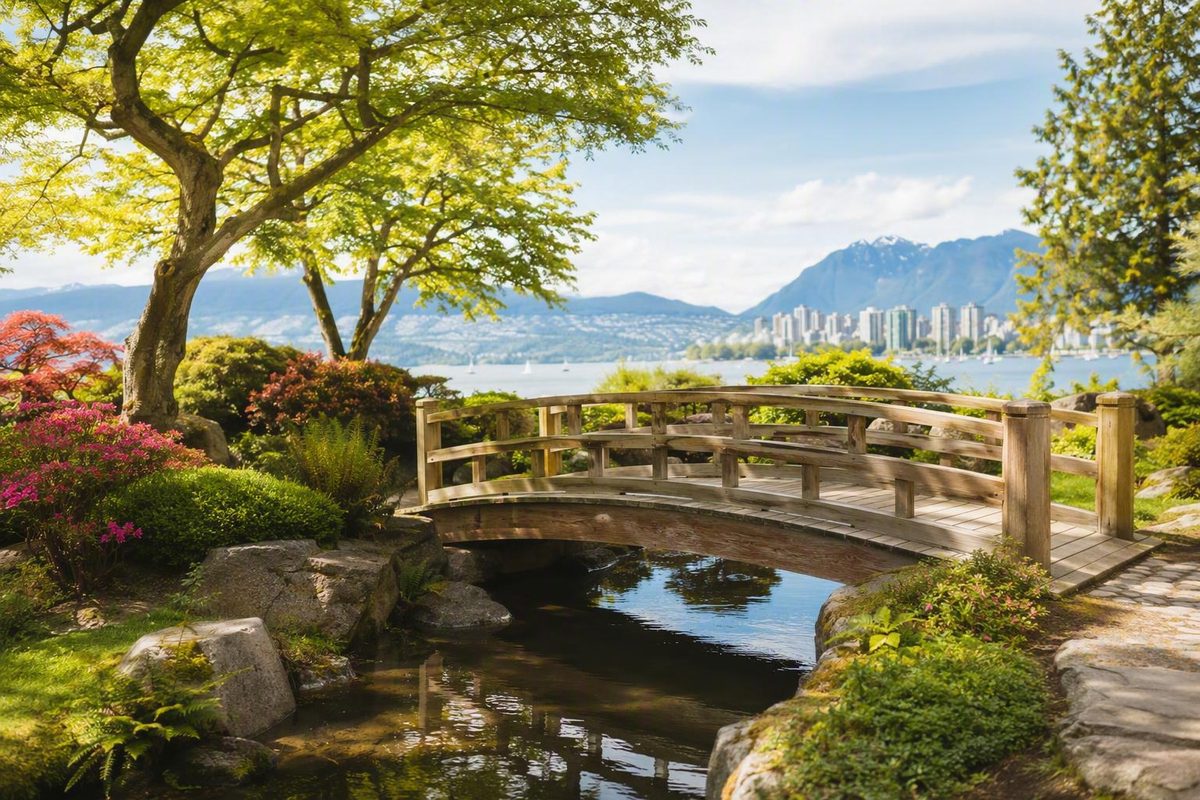
How a garden crossing shapes the path, view, and experience
The basic Japanese word for bridge is hashi, written 橋. In compound names, the same character is often pronounced bashi, as in ishibashi, or stone bridge. That linguistic shift hints at the variety hidden behind the English phrase “Japanese garden bridge”: no single form, material, color, or meaning defines them all.
A bridge may be a broad wooden arch above a pond, an uncut stone laid across a narrow stream, a line of stepping stones through shallow water, or a zigzag route among irises. It may even cross gravel representing water. Some bridges are conspicuous landmarks; others nearly disappear into the path.
The most useful way to understand bridges in Japanese gardens is therefore not to isolate them as objects. A bridge belongs to a route. Its form responds to what lies beneath it, what stands at either end, what visitors can see while crossing, and what destination makes the crossing worthwhile.
The terminology and chronology below draw mainly on professional-association, university, and specialist summaries. Where those sources do not provide primary texts or detailed scholarly documentation, the article treats their historical and symbolic claims as qualified overviews rather than definitive rules.
More Than a Way Across: What a Garden Bridge Does
At the most practical level, a bridge solves a problem of movement. It can carry a path across water or uneven ground, connect a shore to an island, join one island to another, or cross a symbolic stream represented by sand or gravel. A sequence of stones may perform the same basic task without forming a continuous span.
Crossing is only the beginning. A bridge also organizes circulation. Its position determines where visitors approach the water, whether the route continues directly or changes direction, and how one garden scene gives way to another. A highly visible bridge can announce a destination from a distance. A low stone slab may remain concealed until the path reaches the water’s edge.
The crossing changes walking behavior as well. A narrow slab, a series of stepping stones, and a sharply arched wooden bridge each require a different pace and degree of attention. Even an easy crossing introduces a change in surface or elevation that may prompt a pause. From the span, visitors may see water, shoreline planting, rocks, reflections, islands, or distant scenery from an angle unavailable on land.
A bridge is therefore both part of the path and a potential viewing place. Its compositional role can be read through four questions:
- Where does the visitor first see it?
- How does the approach prepare the crossing?
- What becomes visible from the bridge?
- What scene or destination follows it?
Physical and metaphorical functions can coexist. Because a bridge visibly connects separated places, transition and connection are natural interpretations. In a particular garden, the destination may add religious, literary, or historical meaning. A bridge leading toward a temple precinct, a culturally significant island, or a pavilion does not carry the same associations as a modest crossing on an ordinary circulation path.
Some interpretations extend the bridge’s meaning to passage between earthly and sacred realms or between states of consciousness. Such readings appear in writing about Japanese gardens, but they should not be assigned automatically to every example. One professional-association handbook, for instance, discusses both practical and metaphorical roles and identifies tsūtenkyō as a context-specific “pathway to heaven bridge,” rather than as a name or meaning applicable to all crossings.
The more dependable principle is that a bridge is a relationship, not merely an ornament. It connects two points physically while tying together water, stones, plants, paths, views, and the visitor’s movement through the garden.
Japanese Garden Bridge Types at a Glance
Japanese bridge terminology may describe material, structure, shape, or manner of crossing. Categories can overlap: an arched bridge may also be wooden, while a stone bridge may be flat or curved. Romanization varies as well. Soribashi may appear as sori-hashi or sori bashi, and yatsuhashi as yatsu-hashi.
The table below synthesizes terminology presented in a university overview of Japanese garden bridges.
A specialist survey supplies additional structural names, including log, girder, movable, sod-covered, and roofed forms. Its terminology is useful for identification but should not be mistaken for a perfectly standardized classification system across every period and source.
| Term | Basic form | Usual material | Typical setting | Defining feature |
|---|---|---|---|---|
| Hashi / bashi | General term | Varies | Any crossing | “Bridge”; bashi commonly appears in compounds |
| Ishibashi | Broad stone-bridge category | Natural or dressed stone | Streams, pond edges, islands, dry landscapes | Defined primarily by stone construction |
| Kiri-ishibashi | Cut- or dressed-stone bridge | Worked stone | Formal or visibly constructed compositions | Stone has been shaped rather than left natural |
| Hirabashi | Generally flat slab span | Usually an undressed stone slab | Narrow streams, channels, or shorelines | Restrained, nearly level continuous crossing |
| Itabashi | Plank or slab bridge | Commonly wood; usage varies | Narrow water or simple path connections | A thick plank or slab forms the deck |
| Kibashi | Simple wooden bridge | Wood | Streams, ponds, and island links | General wooden crossing, sometimes using parallel logs |
| Maruki-bashi | Natural-log crossing | Wood | Rustic or small-scale settings | Timber retains an evident natural form |
| Keta-bashi | Girder-supported bridge | Often wood | Structurally supported spans | The deck rests on girders |
| Hane-bashi | Movable or drawbridge form | Often wood | Uncommon in gardens | Part of the crossing can be raised or moved |
| Sori-hashi / soribashi | Arched bridge | Wood or stone | Ponds, island approaches, boating landscapes | Curved, rising profile |
| Taiko-bashi | Pronounced drum-like arch | Commonly wood | Ponds or formal focal settings | High arch with a strongly rounded profile |
| Engetsukyō | “Full-moon” bridge | Wood or stone | Still water where reflection is visible | Arch and reflection may create a circular image |
| Yatsuhashi / yatsu-hashi | Zigzag sequence | Usually wooden planks | Shallow water, marsh, or iris beds | Route repeatedly changes direction |
| Sawatari-ishi | Separate crossing stones | Stone | Broad, shallow water | Visitors step from one flat-topped stone to another |
| Sod- or earth-covered bridge | Planted, solid-looking span | Wooden substructure, soil, vegetation | Larger naturalistic compositions | Surface visually continues the ground plane |
| Rō-kyō / tei-bashi | Roofed bridge | Commonly wood | Major ponds or pavilion-scale settings | A roof, and sometimes walls, encloses the crossing |
Several distinctions deserve emphasis.
Ishibashi is a broad category, not the name of one fixed silhouette. It can include a rough natural slab, dressed stone construction, or a lightly arched stone bridge. Hirabashi is narrower, generally describing a simple, flat slab span. Kiri-ishibashi identifies cut or worked stone more specifically.
Itabashi is less consistent across the available terminology. It is often translated as a plank bridge and therefore understood as wooden, but one specialist source includes thick slabs made from either wood or stone. When identifying an actual bridge, its material and construction are more informative than the label alone.
Arched terms also overlap without necessarily being exact synonyms.
Finally, sawatari-ishi do not form a continuous bridge deck. They create a crossing through a sequence of deliberate steps. Their experiential effect—slower movement, careful foot placement, and close engagement with water—is distinct from that of a slab or plank span.
From Boating Ponds to Contemplative Landscapes
Japanese garden bridges did not all emerge at the same time or for the same purpose. Their changing forms reflect differences in garden scale, social use, pond design, and circulation.
In some Heian-period estate gardens, large ponds supported boating. Chinese-influenced arched bridges made from wood or stone could provide clearance for boats to pass underneath. In that setting, the rise of the bridge was not merely picturesque or symbolic; it answered a practical requirement created by the pond’s use. University teaching material also notes that later gardens with ponds too small for boats often used simpler stone slabs, singly or in short combinations (Bowdoin College).
Heian-period summaries mention natural stone slabs, dressed stone slabs, and wooden arches with vermilion railings. The presence of vermilion in that context matters, but it does not establish red as the standard color of every Japanese garden bridge. Material and finish varied alongside form.
As ponds became smaller or ceased to function as boating waters, boat clearance was no longer a governing requirement. Low stone spans could connect a shoreline, channel, or island edge without the height and visual mass of an arch.
Professional-association summaries describe single stone slabs as prominent in Muromachi-period dry landscapes and contemplative settings. The same account identifies Momoyama-period pond-and-island compositions in which several bridges could connect a shore with crane- and turtle-associated islands, and it notes the use of sawatari-ishi in broad, shallow waters of Tokugawa-period stroll gardens. These are documented patterns in the source, not formulas that every garden followed (North American Japanese Garden Association).
A flat stone could cross a real channel, mark passage over a gravel stream, or connect parts of a composition without dominating it. Multiple crossings could likewise turn islands into stages of a longer journey rather than leave them as isolated scenery.
Historical manuals add another layer, but the available evidence reaches them through modern summaries rather than verified primary passages. A specialist account reports that the late-Heian Sakuteiki advised against a bridge leading toward a Horai island and against placing one at the base of a waterfall. It also reports that later Muromachi manuals recommended stones at the edges of slab bridges and that later gardens departed from some earlier guidance (Real Japanese Gardens). These statements are best treated as period-specific summaries, not timeless design laws or direct quotations from the manuals.
The chronological lesson is not that one bridge type simply replaced another. Arches, slabs, logs, and stepping stones could coexist. Each form answered a combination of practical need, garden type, available space, and desired visual effect.
Stone Crossings: Slabs, Cut Stone, and Stepping Stones
Stone bridges range from rocks that appear minimally altered to carefully dressed construction. This is why ishibashi should be understood as a material category rather than a single style.
A natural slab can retain irregular edges, variations in thickness, and the surface character of the original stone. Its visual weight may make it appear to belong to the surrounding geology rather than to be an inserted structure. A kiri-ishibashi, by contrast, uses cut or dressed stone, creating a more visibly constructed crossing.
The restrained hirabashi is generally a flat, often undressed slab placed over a narrow stream, channel, or pond edge. Its apparent simplicity can be deceptive. The span must meet the path convincingly, sit in proportion to the watercourse, and relate to the stones and planting around its ends.
Where a single slab does not suit the crossing, short combinations of slabs may create a longer span. Their joints and supports then become part of the composition. Several slabs can establish a measured rhythm across the water, whereas one long stone makes a single, decisive gesture.
Stones positioned around the four corners of a slab bridge are known as hashibasami. They can contribute to physical and visual stability. The handbook source describing this arrangement also notes that deliberately varied stones help avoid rigid symmetry (North American Japanese Garden Association).
These anchoring stones need not mirror one another. Variation in size, orientation, and prominence can help a bridge belong to an irregular shoreline. One end might meet a low horizontal stone while the other is visually supported by a taller upright. Nearby planting may also anchor a landing, soften its edge, or balance the mass of the stone without concealing the route.
The goal is not asymmetry for its own sake. It is integration. Visitors should be able to read where the path continues while perceiving the bridge as part of a larger arrangement of shoreline, stone, and vegetation.
A continuous slab differs fundamentally from sawatari-ishi. On a slab, the visitor crosses along one surface. With sawatari-ishi, each step is separated. Gaps expose water between the stones, foot placement becomes more deliberate, and the route may shift slightly instead of following a rigid line. Flat tops make the intended stepping surfaces legible, while varied stone forms preserve a naturalistic appearance.
Stone crossings can operate in several settings:
- A narrow stream: A slab creates a compact, direct crossing.
- A pond shoreline: A span may bridge an inlet or connect land to an island edge.
- A shallow pond: Stepping stones carry the route through the water rather than above it.
- A dry stream: A stone bridge crosses gravel or sand representing flowing water.
- Uneven ground: A slab can maintain the path over a depression or rocky interval.
In a dry landscape, the absence of water does not eliminate the idea of crossing. The bridge strengthens the imagined topography. Gravel reads as a channel because the bridge treats it as one, while banks, stones, and the direction of the span suggest an implied flow.
Wooden Arches, Log Bridges, and Covered Crossings
Wood allows a broader range of shapes and scales than a single stone slab. It can remain close to its natural form, as in a log crossing, or be framed into planks, girders, railings, steep arches, roofs, and walls.
At the rustic end of the range is the maruki-bashi, made from natural logs. Its identity depends on the visible character of the timber. The crossing may feel like a direct extension of woodland materials, especially when elaborate rails and framing are absent.
A simple plank bridge, often called itabashi, offers a flatter and more regular walking surface. A kibashi is a general simple wooden bridge; documented descriptions include parallel logs supported on a framed structure. A keta-bashi introduces girders beneath the deck, making the supporting system a defining feature.
These forms can remain visually quiet. Their horizontal lines may continue a path across a stream without turning the crossing into the garden’s main landmark. Their differences are partly structural, but they also affect perception: natural logs emphasize material irregularity, planks emphasize the deck plane, and girder construction can give a longer crossing a stronger architectural rhythm.
The arched sori-hashi or taiko-bashi creates a different experience. Its rising profile interrupts the horizontal surface of the pond and may conceal the landing on the far side. Climbing changes the walker’s elevation, while the crest can open a broader view across the water.
In large historical boating ponds, the height of an arch could allow boats to pass beneath it. That practical function matters because it prevents the form from being reduced to pure decoration or generalized spirituality.
The full-moon label, engetsukyō, should be read cautiously. When a high arch is reflected in still water, the two curves may appear to form a circle. That is an observable visual effect. It does not, by itself, prove one universal symbolic meaning for every bridge carrying the name.
Covered bridges extend the architecture further. Roofed forms such as rō-kyō and tei-bashi may include walls and can approach the scale or visual presence of a pavilion. Crossing becomes an enclosed interval between outdoor scenes. Openings may frame the pond, while the roof can make the bridge a destination as well as a route.
Earth- or sod-covered bridges work in the opposite visual direction. A wooden substructure supports compacted soil and vegetation so the span appears to continue the ground plane. Rather than displaying its deck as architecture, the bridge may read as a planted rise in the landscape.
Scale is crucial in all these cases. A simple log or plank may fit a small stream because its mass remains subordinate to the surrounding scenery. A high arch needs room for its rise, approaches, reflection, and visual prominence. A sod bridge needs enough breadth to read as land rather than as a thin structure covered with grass. A roofed crossing requires still more space if it is not to crowd the pond or overwhelm nearby planting.
The question is not which wooden form is most impressive. It is which one belongs to the water, route, destination, and scale of the garden.
Yatsuhashi: The Zigzag Bridge, Irises, and Literary Memory
A yatsuhashi is a crossing formed by planks arranged so that the route repeatedly changes direction. It is often placed through shallow water, marshy ground, or an iris bed. Instead of taking visitors directly from one bank to another, it divides the passage into short segments.
One specialist description defines the form through eight boards, reflecting a conventional interpretation of the name. The same body of modern usage applies yatsuhashi more broadly to the zigzag bridge type, however, so board count alone is not a reliable test for every built example (Real Japanese Gardens).
The form is conventionally associated with an iris-marsh scene in the Ise Monogatari, commonly known in English as The Tales of Ise. The available sources repeatedly connect the zigzag crossing, irises, and this literary tradition, but they do not provide the primary passage or a scholarly translation. The relationship is therefore best presented as a well-established conventional association, not reconstructed here as a definitive textual interpretation.
The bridge’s observable effects require less speculation. Each turn asks the walker to adjust direction. The route takes longer than a straight crossing over the same area, and views shift as the body rotates. Water, flowers, banks, and neighboring planks move in and out of sight. In an iris bed, the route can place visitors among the planting rather than leaving them at its edge.
The zigzag also makes movement visible from elsewhere in the garden. A straight bridge efficiently connects two points; a yatsuhashi draws a broken line through the landscape. That line can articulate a broad, shallow area without the visual weight of one large continuous structure.
Folklore, not established design history
A popular story says that evil spirits can travel only in straight lines and therefore cannot follow a person around a zigzag bridge. A personal garden project repeats the story but attributes it only to what “some” people believe. It does not establish protection from spirits as the historical reason yatsuhashi developed (My Japanese Garden).
Keeping folklore separate from documented design history does not make the bridge less interesting. Its literary association with irises and its direct effects on pace, direction, and view already explain why the form remains distinctive.
Placement Is the Design: Water, Islands, Approaches, and Views
A bridge type cannot be judged independently of its setting. The same arch that commands a broad pond may overpower a small stream. A rough slab that seems understated in isolation may become the essential hinge between two carefully composed scenes.
Narrow stream
A narrow stream often calls for a direct, low-mass response. A slab, log, or simple plank can preserve the visual importance of the water while carrying the path across it. The approach may align directly with the span or arrive at an angle, depending on what the composition is intended to reveal.
An angled approach can delay the full view of the bridge and keep it from reading as a freestanding object. Stones and planting at the landings can connect the crossing to both banks, while a change in path material may signal the transition before the visitor steps onto it.
Pond shoreline
At a pond edge, a bridge may cross an inlet, reach a projection of land, or begin an island connection. The breadth of the water and the shoreline’s stone composition influence how substantial the bridge can appear without dominating the scene.
The view from the span matters as much as the view of it. A bridge near the shore may orient the visitor toward reflections, a waterfall, seasonal planting, or the open center of the pond. Its position can also determine whether the far bank is revealed gradually or seen all at once.
Island connection
An island bridge has an especially legible destination, but the island’s role still matters. It may continue the path, support a pavilion, provide a viewing point, or carry religious or literary associations. In some compositions, several bridges create a route from shore to island and onward rather than a simple out-and-back crossing.
The destination should justify the visual and physical emphasis of the bridge. A major arch leading nowhere perceptible can feel detached from the garden sequence. A modest slab leading to a carefully framed viewpoint may have greater compositional force.
Shallow marsh or iris bed
A yatsuhashi suits a shallow, planted setting because its segmented route can pass among vegetation. Its turns prolong the crossing and produce changing views. Because the planks draw a strong geometric line, the surrounding planting needs enough visual breadth to accommodate the pattern.
Broad, shallow pond
Sawatari-ishi can carry a path through broad, shallow water without dividing the pond with a continuous deck. The stones make visitors engage with the surface one step at a time. Their alignment can remain readable without becoming mechanically regular.
Symbolic dry watercourse
A bridge over gravel or sand makes an implied stream more convincing. The span establishes banks and a point of passage even though no physical water is present. Nearby stones can suggest a channel, cascade, or island, giving the imagined topography a practical role in the route.
Across these settings, scale and visual mass should respond to the garden. A simple log or slab can belong in a confined scene where a large arch would consume the view. Conversely, a tiny ornamental bridge may look inconsequential across a broad pond if it has no relationship to the route or shoreline.
Approaches deserve as much attention as the span. Path alignment, landing stones, nearby planting, and changes in surface affect the visitor before and after the crossing. A straight approach may emphasize destination and ceremony. A curved or partly concealed approach can create surprise. Unequal stones and planting at opposite ends can integrate the bridge into an asymmetrical composition without obscuring the path.
A useful way to read any garden bridge is sequentially:
- Find the first point from which it becomes visible.
- Notice whether the path reveals or conceals the far side.
- Observe changes in pace, direction, texture, and elevation on the approach.
- Look outward from the span rather than only at the bridge itself.
- Identify the destination and the next scene.
- Turn back and see how the crossing works in reverse.
This method recognizes that a bridge can be both a route and a place to pause. These are principles for observation and composition, not instructions for designing or constructing a pedestrian structure.
Meaning, Color, and Authenticity: What the Evidence Can Support
Claims about bridges in Japanese gardens become clearer when separated into five evidence layers.
| Evidence layer | What it can establish | Example |
|---|---|---|
| Observable function | What the bridge physically does in the landscape | Crosses water, changes direction, creates a viewing position |
| Documented historical use | How a form was used in a particular period or garden type | A high arch providing boat clearance |
| Literary association | A connection carried through a text or its reception | Yatsuhashi, irises, and The Tales of Ise |
| Conventional symbolism | A recurring interpretation that may vary by context | Transition, connection, or passage |
| Modern marketing or folklore | Popular imagery or stories not necessarily grounded in historical design evidence | Every Japanese bridge must be red; zigzags repel spirits |
At the first layer, a bridge joins separated spaces and changes the visitor’s route. Connection and transition are therefore reasonable recurring interpretations because they grow directly from what the structure does.
Stronger meanings require context. A bridge may participate in ideas of paradise, immortality, sacred passage, or movement between realms when its garden, destination, period, or religious setting supports that reading. A community-authored travel account, for example, connects early central islands and bridges with the Pure Land of Amida Buddha, but its broader symbolic statements should be understood as an interpretive summary rather than a rule for all gardens (Japan Travel).
Color presents a similar problem. Red arched bridges are prominent in contemporary Japanese-inspired imagery. They create strong focal points and contrast sharply with green planting, dark water, and stone. Commercial design collections repeatedly use the red arch as an immediately recognizable visual cue, while also presenting natural-finish wooden and miniature decorative bridges (Foter).
Historical descriptions, however, include natural and dressed stone, wooden planks, logs, earth and sod, stepping stones, arches, and roofed structures. Vermilion railings appear in some historical contexts, but the evidence does not establish red as mandatory, universally traditional, or inherently protective.
Authenticity is therefore better considered through relationships than through a checklist of iconic features. A bridge belongs convincingly when:
- its scale responds to the garden and watercourse;
- its material relates to paths, stones, architecture, and planting;
- its approaches make visual and spatial sense;
- its destination matters;
- its form intentionally affects movement and view;
- and its prominence is proportionate to its role.
A retail object may borrow a red arch as a Japanese visual cue without reproducing these relationships. That does not automatically make it unattractive, but color and curvature alone do not create a historically grounded Japanese garden composition.
The available handbook evidence names Tōfuku-ji, Tenryū-ji, Sampō-in, Heian-jingū, and Kōraku-en among gardens associated with notable bridge examples. These names are best treated as leads for site-specific research rather than as complete case studies here. Before drawing conclusions about date, reconstruction, or original fabric, visitors and researchers should consult current records from the relevant garden or an authoritative scholarly source.
When viewing a bridge, use this observation checklist:
- Identify the form: slab, log, plank, girder, arch, zigzag, stepping stones, sod-covered, or roofed.
- Identify the material: natural stone, worked stone, wood, earth, vegetation, or a modern substitute.
- Inspect the approaches: note path alignment, landing stones, planting, and changes in surface.
- Ask what it crosses: moving water, still water, marsh, shoreline, uneven ground, or symbolic gravel.
- Determine where it leads: another path, an island, a pavilion, a viewpoint, or a culturally significant space.
- Observe the framed views: look from the bridge as well as toward it.
- Separate effects from stories: distinguish what the design visibly does from symbolism, literary association, folklore, and marketing attached to it.
A bridge ultimately joins more than two banks. It connects the path to a destination, actual or imagined water to surrounding stone, and movement to a sequence of views. Whether it is arched, zigzagged, wooden, stone, planted, or painted matters less than how completely it belongs to that sequence.
What do bridges symbolize in Japanese gardens?
Connection and transition are the most defensible general interpretations because a bridge physically joins separated spaces and changes the visitor’s route. It may also mark passage into a new garden scene.
More specific meanings—such as movement toward paradise, immortality, a sacred realm, or a different state of consciousness—depend on the period, garden, destination, and interpretive source. They should not be assigned to every bridge merely because it appears in a Japanese garden.
Are bridges in Japanese gardens always red and arched?
No. Documented forms include natural and cut-stone slabs, wooden planks, logs, girder-supported crossings, stepping stones, zigzag bridges, sod-covered spans, roofed bridges, and arches made from wood or stone.
Red or vermilion appears in some historical and modern contexts, and the red arch is now a prominent Japanese-inspired image. Neither the color nor the arch is a universal requirement. Many bridges instead use natural stone, subdued wood, earth, vegetation, or restrained finishes.
Can a Japanese garden bridge cross gravel instead of water?
Yes. In a dry landscape, sand or gravel can represent a stream or another body of water. A slab or wooden bridge crossing it reinforces the imagined watercourse by establishing banks, direction, and a point of passage.
Such a crossing can remain part of a real circulation route even though the feature beneath it represents water rather than containing it.
What is the difference between soribashi, taiko-bashi, ishibashi, and yatsuhashi?
Soribashi or sori-hashi is an arched bridge. Taiko-bashi generally refers to a pronounced drum-like arched form, although modern sources sometimes use the labels interchangeably. They should not be assumed to have been exact synonyms in every historical context.
Ishibashi is the broad category for a stone bridge and does not specify one shape. It may be a flat natural slab, dressed stone construction, or an arched stone crossing.
Yatsuhashi is a zigzag crossing, usually formed from planks over shallow water, marshy ground, or an iris bed. Its defining feature is the repeated change in direction rather than an arch or a particular material.
Is every ornamental Japanese-style bridge safe to walk across?
No. An ornamental object should not be assumed to be a pedestrian bridge merely because it resembles one. One documented zigzag project explicitly described its narrow bridge as decorative and “not meant to be walked over” (My Japanese Garden).
That example establishes only the intended use of that particular project. The evidence reviewed here does not provide a basis for assessing structural capacity, construction methods, or pedestrian suitability in other bridges. Those questions fall outside this historical and visual guide.