
How to Plan a Granville Island Visit Without Wasting Half the Day
Related: Experience Vancouver Without a Car, but Plan by District.
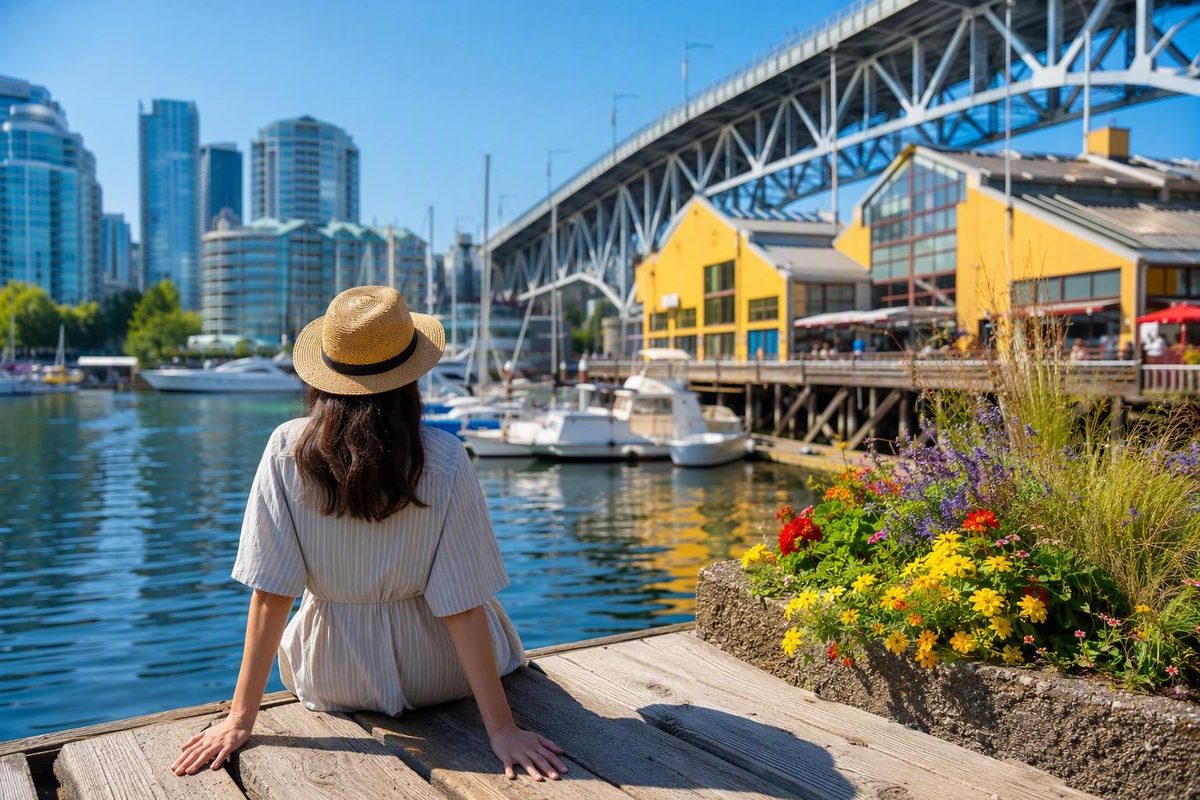
Start here: what Granville Island is and why people visit
Granville Island is a waterfront food, shopping, arts, and entertainment district beneath the south end of the Granville Street Bridge. It sits beside False Creek, across the water from downtown Vancouver. Despite the name, it is not a conventional natural island: reclamation created the modern landform, which now functions geographically more like a peninsula connected to Vancouver’s south shore.1
Related: Experience Vancouver Without a Car, but Plan by District.
The Public Market is the natural anchor for a first visit. Inside, you can browse produce, seafood, baked goods, specialty foods, prepared meals, and crafts. But treating Granville Island solely as a food market means overlooking much of the district. Nearby are specialty shops, working artisan spaces, galleries, theatres, restaurants, family attractions, marina activity, and places to pause beside the water. Destination Vancouver describes the area as a former industrial site repurposed for food, shopping, performance, art, and culture.2
Whether Granville Island belongs in your Vancouver itinerary depends less on ratings or rankings than on the kind of day you want. It is a strong fit if you prefer several flexible activities in one compact district: eating, browsing, looking at art, buying crafts, watching boats, or attending a performance. It may be less compelling if your priority is wilderness, a conventional museum visit, or an attraction with a single prescribed route.
Choose your approximate visit length before deciding what to include:
- About two hours: Make a focused circuit through the Public Market, choose one meal or a few samples, browse Net Loft, and take a short waterfront walk.
- Half a day: Add an unhurried lunch, artisan studios, galleries, more shopping, or Kids Market.
- Most of a day: Allow for family time, deeper browsing, a restaurant or brewery stop, and a scheduled theatre, improv, music, or festival event.
These are planning frameworks rather than fixed rules. A visitor who already knows what they want can complete a satisfying market-and-waterfront circuit quickly. Families, dedicated shoppers, photographers, and performance audiences will usually need more time.
General entry is reported as free, so you do not need a district-wide admission ticket to walk around or enter the Public Market. Ferries, parking, food, shopping, tours, attractions, and performances remain optional expenses.3
The most useful opening question is therefore not whether Granville Island is free or universally “worth it.” Ask whether its combination of food, arts, shopping, family activities, and waterfront atmosphere matches the Vancouver day you want.
Choose the right way to get there
There is no universally best way to reach Granville Island. Your starting point, mobility requirements, bicycle plans, luggage, schedule, and willingness to search for parking should determine the choice.
| Arrival method | Best when | Main trade-off |
|---|---|---|
| Small passenger ferry | You want a scenic False Creek arrival | Fares, docks, schedules, and vessel accommodation vary |
| #50 bus | You want conventional public transit | The stop is outside the central market area |
| Bicycle | Granville Island is part of a seawall day | Weather, bike security, and carrying purchases matter |
| Taxi or rideshare | You want direct transportation | Road conditions and pickup locations can affect convenience |
| Car | You are carrying equipment or continuing elsewhere | Parking is limited and internal streets require attention |
Choose a ferry when the arrival itself is part of the appeal. Aquabus and False Creek Ferries serve Granville Island from locations around False Creek. They are separate operators, so do not assume that one ticket, timetable, dock list, bicycle policy, or mobility-device arrangement applies to both. Follow the operator links available through the official visitor information and check live routes, fares, vessel details, and boarding requirements before leaving.4
A ferry works particularly well when you are already near a False Creek dock. If you are using a stroller, bicycle, wheelchair, or other mobility device, ask about the specific departure rather than relying on a general statement about the operator’s fleet. Vessel designs and available capacity can differ.
Choose the #50 False Creek bus for straightforward public transit. The bus stops near Granville Island at Anderson Street and West 2nd Avenue. From there, follow Anderson Street toward the main entrance area. Stops around Granville Street and West 5th Avenue are described by the official visitor information as approximately a five-to-ten-minute walk from the destination.4
This can be the simplest option if you already have a convenient connection to the downtown bus network or do not want to coordinate a ferry departure. Use live TransLink information for current arrivals, stop changes, and service alerts. For a broader trip strategy, see Vancouver Know’s guide to experiencing Vancouver without a car.
Choose a bicycle when Granville Island is one stop in a waterfront itinerary. The district connects to the False Creek Seawall and provides bicycle racks and Mobi Bikeshare stations. Decide beforehand whether you will ride back, end a bike-share trip nearby, or attempt to continue by ferry.
Aquabus advertises a bike-carrying Cyquabus service from Hornby Street with an additional bicycle charge. Verify current vessel availability, capacity, rules, and charges before depending on that service. A bicycle-capable boat does not mean that every departure can carry your bike. Vancouver Know’s seawall-planning guide can help you decide whether Granville Island fits best into a loop or a one-way ride.
Choose a taxi or rideshare for directness. This option can make sense with luggage, young children, limited time, or a starting point poorly served by a convenient ferry or bus connection. Select a clear return pickup location rather than assuming the busiest entrance will be the easiest place to meet a driver.
Drive when the practical benefit outweighs the parking uncertainty. A car may be sensible for a group, for someone carrying equipment or substantial purchases, or for a day continuing to places that are awkward to reach by transit. The principal disadvantages are limited parking and a one-way internal street pattern.
Walking can form part of the journey from nearby Fairview, Kitsilano, or False Creek locations. Check the ground-level route rather than assuming that the bridge overhead provides the most direct pedestrian approach.
Pick a visit length: two hours, half a day, or most of a day
Published suggestions range from a short two-hour market itinerary to more than three hours or a full day.5 That variation is reasonable because different guides count different activities, and some include transportation while others measure only time at the destination.
Your priorities provide a more useful answer than a universal duration.
A focused two-hour visit
A short visit works when Granville Island is one stop in a larger Vancouver day and you are comfortable making quick decisions.
- Arrive close to the Public Market’s opening time. This gives you the largest usable window and may reduce some crowd or parking friction.
- Orient yourself before buying. Make one quick market circuit to see the main food categories.
- Set a narrow food goal. Choose one meal or a small number of samples instead of repeatedly comparing every option.
- Browse Net Loft. This adds a non-food shopping stop without requiring a major detour.
- Finish beside the water. Leave time to watch the ferries and marina activity before returning to your departure point.
Two hours can feel comfortable when you arrive on time and know your priorities. It can feel rushed if you encounter queues, compare many lunch options, shop carefully, or need to coordinate a fixed departure. The existence of a two-hour commercial tasting tour shows that a structured itinerary can fit that window; it does not establish that every independent visitor will enjoy the same pace.
A half-day visit
A half-day is a practical default for many first-time visitors because it provides room for one proper meal and at least two experiences beyond the Public Market.
A workable sequence is:
- Arrive by ferry or bus.
- Explore the Public Market without immediately committing to every purchase.
- Stop for an unhurried lunch.
- Browse Net Loft.
- Continue through an artisan, workshop, or gallery area.
- Visit Kids Market if traveling with children, or use that time for more studios and waterfront walking.
- Return to your departure point with enough time to make the connection comfortably.
The additional time also absorbs ordinary delays. Transportation, food queues, restroom stops, shopping decisions, and different walking speeds all affect what fits. A little slack is generally more valuable than one more tightly scheduled attraction.
A longer visit
Plan most of a day when Granville Island is the main destination. Start with the market, then explore specialty shops and studios more deliberately. Add a restaurant or brewery stop if it suits your interests, and reserve the evening for theatre, improv, live music, or a festival event.
This structure works especially well when an evening ticket supplies a fixed endpoint. You can complete the market and retail portion while daytime businesses are open, pause for a meal, and then continue to the performance venue.
Families may also benefit from the longer format. Kids Market, snacks, waterfront pauses, and transitions between buildings can matter more to children than seeing every studio. Dedicated shoppers need extra time for comparison and packing purchases.
If you are undecided, reserve a half-day rather than forcing everything into two hours. You can always finish early; recovering from an overfilled itinerary is harder.
Build the visit around more than the Public Market
The Public Market deserves its role as the anchor, but it should not automatically become the entire itinerary. Its appeal lies in variety rather than a definitive list of “best” stalls. Expect categories such as produce, seafood, baked goods, specialty foods, prepared meals, and crafts. Individual businesses and availability can change, so browse before committing to an old vendor list.
The market is also a decision bottleneck. Entering hungry without any plan can lead to repeated line-ups and prolonged comparisons. Decide whether the market is primarily your breakfast, lunch, snack stop, or food-shopping stop. That choice preserves time for the surrounding district.
Net Loft is the simplest next stop. It is a nearby collection of specialty shops with hours listed separately from the Public Market. It suits visitors interested in gifts, design, textiles, paper goods, and specialty retail, although the tenant mix should be checked before making a trip for one particular store.
Beyond Net Loft, look for artisan studios, workshops, and galleries. These reinforce the district’s active arts and production identity. Public access and opening hours vary, so do not assume that every workspace offers demonstrations or visitor entry.
Theatres and performance venues extend the usefulness of Granville Island beyond the daytime shopping period. A ticketed show can turn a market visit into a compact afternoon-and-evening itinerary.
Kids Market is the most clearly family-oriented indoor stop in the supplied visitor coverage and has been described as a two-level attraction.3 Families should still confirm current businesses, activities, and hours instead of assuming every feature mentioned in an older review remains available.
The waterfront and marina areas offer a break from shopping and eating. Ferries, boats, docks, industrial structures, and views across False Creek make the physical setting part of the visit. These areas are also useful for groups with different interests: one person can continue browsing while another takes a shorter waterside pause.
The Giants mural on the industrial silos is an optional visual stop. It underscores that Granville Island still contains industrial and working-waterfront elements rather than functioning as a sealed entertainment complex. Perimeter paths and marina views may be less concentrated than the market area, but quiet conditions are never guaranteed.
A route designed to limit backtracking is:
Arrival point → Public Market → Net Loft → artisan or gallery areas → Kids Market if relevant → waterfront or ticketed performance
The exact order should reflect where you arrive. Ferry passengers may naturally begin near the water, while bus passengers may encounter Kids Market first. The sequence is a planning aid, not a requirement to walk past something interesting.
For a rainy day, combine the Public Market, Net Loft, shops, studios, Kids Market, and a performance. These stops provide substantial indoor time, but Granville Island is a district of separate buildings. You will still travel outdoors between them.
Use official hours—and know what they do not cover
Granville Island does not have one universal opening time. It is a mixed district containing a market, shops, restaurants, studios, theatres, community facilities, and outdoor spaces.
The official visitor information lists these general hours:4
| Place | Listed hours |
|---|---|
| Public Market | Daily, 9 AM–6 PM |
| Public Market, June 4–September 7 | Monday–Wednesday, 9 AM–6 PM; Thursday–Sunday, 9 AM–7 PM |
| Net Loft | Daily, 10 AM–6 PM |
| Kids Market | Daily, 10 AM–6 PM |
These are published building or destination hours, not a guarantee that every tenant follows the same schedule. Individual shops, restaurants, studios, theatres, and community facilities may open later, close earlier, or follow event-specific arrangements.
For a short first visit, arriving near 9 AM lets you begin in the Public Market and move to Net Loft or Kids Market after those spaces open at 10 AM.4 This staggered sequence is more efficient than waiting for every component of the district to open simultaneously.
Weekday mornings or arrival before 11 AM are commonly suggested as ways to reduce crowd and parking friction.6 Treat that as directional advice, not a promise of an empty market. Third-party coverage also characterizes summer weekends and Saturday afternoons as busy, but the supplied evidence does not contain robust crowd counts.
Restaurants and performance venues may operate after the market closes. Conversely, a small studio or merchant may keep a shorter schedule. Always distinguish between the hours of a major building and those of the particular business or venue you intend to visit.
Verify before leaving — information reviewed August 26, 2026
This guide is based on official and third-party source research, not a firsthand accessibility or route audit. Check the following on the day of your visit:
- Public Market, Net Loft, and Kids Market hours
- Individual merchant, restaurant, studio, and gallery hours
- Aquabus and False Creek Ferries docks, fares, schedules, and vessel policies
- Transit alerts and stop changes
- Parking rules, fees, signs, and availability
- Event dates, start times, age guidance, ticket prices, and remaining inventory
- Seasonal activities and temporary closures
Do not rely on old construction notices or infer that a past project is either currently underway or complete.
Plan for parking, bicycles, dogs, mobility needs, and weather
Driving is possible, but the official visitor information warns that parking is limited. Paid parking is in effect daily from 9 AM to 10 PM, while overnight parking is allowed only in the multi-level parkade on Old Bridge Street. Most streets become one-way after the turn onto Cartwright Street, so follow posted signs instead of trying to reverse a route suggested by a navigation app.4
Granville Island also lists reserved Evo car-share stalls and six Level II charging stations in the Old Bridge Street indoor lot. Charging is billed in addition to parking.4 Availability, parking conditions, fees, and time restrictions can change, so verify them before depending on a charger.
Cyclists can connect from the False Creek Seawall and use bicycle racks or Mobi Bikeshare stations. Think about the return journey before locking a private bicycle, particularly if you hope to board a ferry or expect to carry food and fragile purchases.
Dogs must be leashed throughout Granville Island and are not permitted inside the Public Market.4 A market visit with a dog therefore requires an outdoor-focused itinerary or a companion who can remain outside with the animal while someone else enters.
A designated HandyDART pickup and drop-off area is listed on Johnston Street near Anderson Street.4 That facility does not establish that every route, building, washroom, theatre seat, dock, or ferry vessel will meet every visitor’s requirements.
If accessibility will determine whether the trip works, contact the relevant venue and ferry operator with route-specific questions:
- Is there step-free access from the arrival point?
- What slopes and surfaces occur along the route?
- Can the intended vessel accommodate the specific mobility device?
- Is boarding level, ramped, or assisted?
- Where are the accessible entrances and washrooms?
- Is seating available along the route?
- Can the theatre or activity reserve an appropriate space?
- Will the return departure use the same vessel type?
Verified individual facilities should not be expanded into a blanket claim that the entire district or every transport option is fully accessible. The same route-level caution applies to strollers.
For rainy weather, the trade-off is simple: the Public Market, many shops, studios, Kids Market, and performance venues provide indoor time, but movement between buildings remains exposed. Plan clothing and the route accordingly if you are also including a ferry, seawall segment, mural stop, or marina edge.
Visitors arriving by private boat can use the free public dock behind the Public Market under specific conditions: moorage is first come, first served, limited to three hours, and requires phone registration on arrival.4
Add an event without making the guide expire
Granville Island is an active performance and festival district, not solely a daytime market. Theatre, improv, music, and festival programming can turn a half-day visit into a full afternoon and evening.
As of August 26, 2026, the official listings include:
- The Play That Goes Wrong: through August 30, 2026
- TriviaProv: through August 26, 2026
- Blockbuster: through August 27, 2026
- Theatresports: through August 29, 20267
The official site also lists the Vancouver Fringe Festival for September 10–20, 2026, describing a program of 84 shows and hundreds of performances, with tickets starting at $16. The listing advertises free Kids Fringe programming and a free Fringe Patio music series.7 These are dated examples, not permanent offerings, and ticket availability is not guaranteed.
There is an internal inconsistency in the Labour Day Fringe Patio listing. The displayed event date is September 5, while the description says the music series runs from September 5 through September 20.7 Verify the date and start time directly with the organizer rather than trying to reconcile the discrepancy by assumption.
For every event, confirm:
- The correct date and venue
- Start time and expected running time
- Age guidance or content advisories
- Accessibility and seating arrangements
- Ticket price and added fees
- Remaining ticket availability
- Entry and late-seating rules
On an event day, complete the Public Market and most shopping first. Daytime businesses may close before restaurants, theatres, or improv venues. A meal or waterfront pause can fill the interval between retail closing time and the performance.
If you have an evening ticket, work backward from curtain time. Allow time to find the venue, collect or display tickets, use the washroom, and manage purchases. The event should structure the day rather than create a rushed final hour.
Do not assume that the listed 2026 productions or festival dates will recur unchanged. Programming, prices, venues, and schedules can vary from year to year.
Understand the place beneath the visitor attractions
The available evidence offers only brief secondary accounts of Indigenous history. It is not sufficient for a complete or community-authoritative account, and Granville Island’s story should not be presented as though the area began with reclamation or tourism.
Secondary summaries describe the False Creek area as a place used by Musqueam and Squamish peoples for fishing and settlement before industrial development.1 That context matters, but a short visitor guide cannot substitute for historical material produced or endorsed by the communities themselves.
The modern landform emerged through reclamation around 1915–1916. The supplied sources use different years, which may reflect different stages or milestones in the project.12 Preserving the range is more accurate than declaring one date unquestionably correct.
Reclamation used fill to create usable land from water, tidal flats, or sandbar terrain. The resulting site developed as an industrial district containing factories, mills, warehouses, machinery, and waterfront infrastructure.
During the 1970s, government-supported redevelopment adapted former industrial buildings for public, commercial, artistic, and cultural uses. The Public Market was established in 1979, while Destination Vancouver gives July 12, 1979 as Granville Island’s official opening date.2 Its account emphasizes the reuse of old warehouse buildings rather than wholesale replacement of the industrial site.
That layered history remains visible. Granville Island does not resemble a purpose-built indoor shopping centre because it is not one. Food vendors, shops, studios, galleries, theatres, docks, and public spaces occupy a district whose industrial forms and working-waterfront character were retained and adapted.
The silos, service lanes, workshops, marine activity, and varied buildings are therefore not incidental scenery around the market. They help explain why the destination feels different from a conventional retail complex.
Frequently asked questions
Is Granville Island actually an island?
Not in the conventional natural-island sense. Reclamation created the modern site, which now functions geographically more like a peninsula connected to Vancouver’s south shore.1 The name reflects its industrial history and its position beneath the Granville Street Bridge.
Is Granville Island free to visit?
General entry is reported as free, and there is no district-wide admission ticket for walking around or entering the Public Market.3 Ferries, parking, food, shopping, tours, attractions, and performances can still add to the cost.
What is the easiest way to get to Granville Island from downtown Vancouver?
A small passenger ferry is often the most distinctive option because the False Creek crossing becomes part of the outing. The #50 bus is the conventional public-transit alternative. A taxi or rideshare may be more practical with luggage, young children, mobility considerations, or a tight schedule.
The easiest option depends on your exact starting point, so check current ferry and transit information instead of relying on old fares or travel-time estimates.
How long should a first-time visitor spend at Granville Island?
Allow about two hours for a focused Public Market, Net Loft, and waterfront loop. Choose a half-day if you want lunch, studios, galleries, shopping, or Kids Market without rushing. Plan longer when adding substantial shopping, family activities, a restaurant stop, or an evening performance.
Remember that transportation time is separate unless you deliberately include it in the visit window.
Can I bring a dog into the Granville Island Public Market?
No. Dogs must be leashed throughout Granville Island and are not permitted inside the Public Market.4 Plan an outdoor-oriented visit or arrange for a companion to remain outside with the dog while another person enters.
Make the final decision in four steps
- Choose two hours, a half-day, or most of a day according to how much eating, shopping, family time, and entertainment you want.
- Select ferry, bus, bicycle, taxi, rideshare, or car based on your starting point and practical needs.
- Use the Public Market as the anchor, but include at least one non-market stop such as Net Loft, an artisan area, Kids Market, the waterfront, or a performance.
- Shortly before leaving, verify live hours, ferry details, transit conditions, parking rules, merchant status, accessibility arrangements, and event tickets.