
Plan a Simple Visit Above Downtown Vancouver
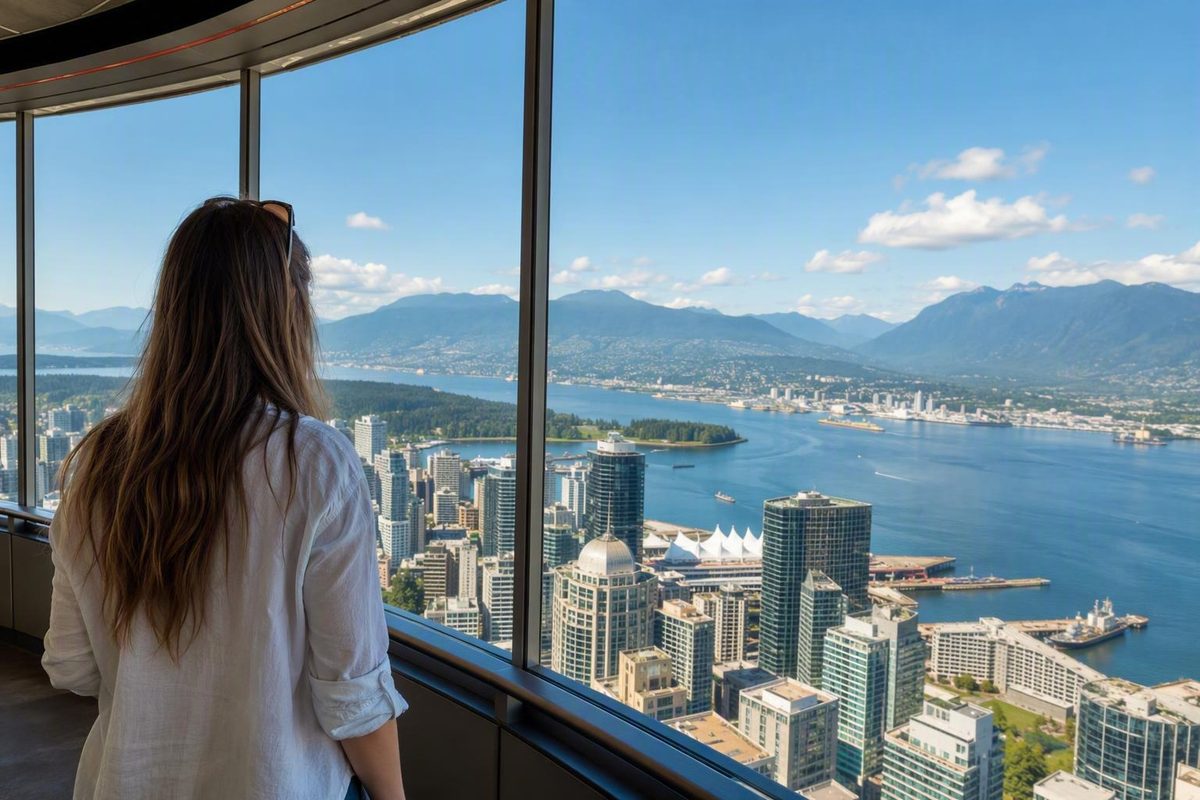
Vancouver Lookout is the enclosed, circular observation deck at the top of Harbour Centre in downtown Vancouver. It works best as a compact sightseeing stop rather than an all-day attraction: allow roughly 30–60 minutes, then continue to Gastown, Canada Place, or the downtown waterfront.
The deck is indoors, but the view remains weather-dependent. Before setting out, check current visibility, admission totals, operating hours, the final elevator time, special closures, and the entry conditions attached to your ticket.
Operational details last checked: August 24, 2026. The dated fact box below covers only information confirmed on the attraction’s official visitor pages at that check. Prices and checkout terms remain dynamic.
Vancouver Lookout at Harbour Centre: the essentials
Vancouver Lookout is inside Harbour Centre at 555 West Hastings Street, Vancouver, BC V6B 4N6. The three names visitors commonly encounter refer to different things:
- Harbour Centre is the mixed-use complex and tower.
- Vancouver Lookout is the ticketed observation attraction at the top.
The experience begins with an exterior glass-elevator ascent. Multiple attraction and tourism listings describe the ride as taking approximately 40 seconds. Visitors then enter an enclosed circular deck where they can walk around the windows, compare views in different directions, read landmark panels, and use a mobile audio tour. The attraction has been associated with Vancouver’s skyline since 1977, according to Destination Vancouver’s Vancouver Lookout listing.
The elevator is part of the arrival rather than the main event. Because the ascent is brief, most of the visit is spent moving around the observation deck, identifying landmarks, and taking photographs through the windows. Give the full circle a chance before deciding which direction offers the most useful view.
Published height figures are less straightforward. Different sources appear to measure the building, roof, pinnacle, observation level, elevator rise, or elevation from different street entrances. Those figures should not be collapsed into one supposedly definitive building height. For trip planning, the useful point is simply that Vancouver Lookout provides a high-level indoor view over downtown and the harbour.
Simple planning summary
- Use 555 West Hastings Street as the destination.
- Arrive through or near Waterfront Station where practical.
- Allow 30–45 minutes for a focused circuit or about an hour for interpretation and photography.
- Check whether the North Shore Mountains and far side of the harbour are visible.
- Verify live hours, the final elevator, admission totals, special closures, and ticket conditions before arriving.
How to get there by transit, on foot, bike, or car
Vancouver Lookout is across from Waterfront Station, making public transit the simplest option for many visitors. Waterfront connects with SkyTrain, SeaBus, West Coast Express, buses, and other local services. The attraction’s official hours and directions page confirms the address, nearby transit, bicycle racks, and parking guidance.
A practical arrival sequence is:
- Travel to Waterfront Station.
- Exit toward West Hastings Street.
- Locate Harbour Centre across from the station.
- Enter the complex.
- Follow posted Vancouver Lookout signs to the ticketing and elevator area.
This approach is more reliable than assuming there is one exact indoor route. Your path can vary with the station exit or building entrance you use. If you have luggage, a stroller, or mobility requirements, consult posted directions or ask staff for the most suitable route.
Arriving on foot
The attraction is convenient if you are already visiting:
- Gastown
- Canada Place
- The cruise-terminal area
- The Vancouver Convention Centre
- The downtown waterfront
- The blocks around Waterfront Station
Vancouver Lookout can work near the beginning of a first visit because the elevated view helps establish how Gastown, the harbour, downtown towers, Stanley Park, and the North Shore relate to one another. It can also work near the end of a trip, when you are more likely to recognize places already visited.
Official visitor information calls it a short walk from many downtown attractions, but exact walking times depend on the starting point, chosen entrance, pedestrian conditions, and personal pace.
Arriving by bicycle
Bike racks are available off Hastings Street. Bring your own secure lock.
Do not assume that Lookout admission includes monitored bicycle storage or that large cycling equipment can be taken to the observation deck. If secure storage is essential, confirm the current arrangement before riding there.
Arriving by car
Harbour Centre does not provide public or paid visitor parking. Vancouver Lookout directs drivers to the 450 Cordova Street Parkade.
Parkade rates, operating hours, vehicle clearance, payment methods, accessible stalls, and availability are separate matters and can change. Verify them directly with the parking facility rather than treating the attraction’s directions as a guarantee of space.
Driving is often unnecessary if the rest of the day is concentrated around Gastown, Canada Place, and the downtown waterfront. For a broader transit-based itinerary, see Vancouver Know’s guide to experiencing Vancouver without a car.
What the observation-deck visit includes
A standard visit follows a simple sequence:
- Find the Vancouver Lookout ticket area inside Harbour Centre.
- Present or purchase the appropriate ticket.
- Take the exterior glass elevator.
- Enter the enclosed circular observation deck.
- Walk around the viewing windows.
- Use the information panels or mobile audio tour.
- Revisit the most useful windows for photographs.
- Descend when finished.
The deck is indoors, so you do not need outdoor clothing beyond what conditions require for reaching the building. Once at the top, you can move around the circular interior instead of viewing the city from one fixed direction.
Interpretation, audio tour, and Wi-Fi
Visitor information lists landmark panels, free Wi-Fi, and a complimentary self-guided audio tour. The tour runs on a visitor’s own mobile device and is offered in 10 languages. Vancouver Attractions advises bringing personal headphones or earbuds and describes the mobile audio tour and on-site Wi-Fi.
Useful items to bring include:
- A charged phone
- Personal headphones or earbuds
- A portable battery if the phone is also your camera
- A clean lens cloth
- Any accessibility technology you normally use
Do not count on loaner headphones; the evidence does not establish whether they are available. Third-party descriptions also disagree about whether the audio lasts approximately 10 or 15 minutes, so treat it as optional interpretation rather than building an itinerary around a fixed running time.
The panels are useful even without the audio tour. They can help identify neighborhoods, mountains, harbour infrastructure, and prominent buildings, making the attraction more valuable as a geographic introduction than as an elevator ride followed by photographs.
Some third-party visitor reports mention tables, chairs, or places to pause. Seating location and availability should not be treated as guaranteed, particularly if reliable seating is an accessibility requirement.
How much time does the experience take?
A quick visual circuit usually fits into 30–45 minutes. That is enough time to walk around the windows, identify the principal landmarks, and take a modest number of photographs.
Allow closer to an hour if you intend to:
- Use the audio tour
- Read several interpretation panels
- Help children identify landmarks
- Wait for clouds or changing light
- Photograph the view in several directions
- Move at a slower pace
A ticket marketplace also lists a typical visit at 30–45 minutes, while noting that some visitors remain longer; this supports using the range as a planning estimate rather than a required or guaranteed duration (AAA Trip Canvas admission information).
Do not infer from a longer marketplace estimate that standard admission requires one or two hours. There is no time limit Plan Your Visit | How to Get to Vancouver Lookout. The terms attached to your ticket control those points.
What you may see—and how weather changes the view
Treat the deck as a landmark-spotting circuit rather than a guarantee that every named feature will be visible. Nearby buildings and districts are usually easier to identify in imperfect conditions, while mountains, islands, and distant shorelines depend heavily on atmospheric clarity.
Toward Gastown and the eastern downtown edge
Gastown is one of the easiest nearby districts to place from the deck. Look for its lower-rise streets beside the denser downtown core. Rail, port, and industrial elements farther east can also help explain how Vancouver developed around its waterfront.
Because Gastown is close, it may remain visible when low cloud or haze obscures the mountains. That makes the visit more defensible in mediocre weather if the goal is city orientation rather than distant scenery.
Toward Canada Place and the harbour
Canada Place, the cruise-terminal area, Vancouver Harbour, and Burrard Inlet are commonly identified from the deck. Harbour traffic may include ferries, commercial vessels, cruise ships, or smaller boats, although activity varies with schedules and season.
This direction is particularly useful for cruise passengers because it places the terminal, downtown, the harbour, and the North Shore in one broad visual context before or after a limited sightseeing window.
Toward Stanley Park and the western waterfront
With suitable visibility, Stanley Park can be distinguished from the dense built environment around downtown and Coal Harbour. The view helps explain how the park, seawall, and western waterfront connect as one broader outing rather than as isolated attractions.
If the view inspires a longer waterfront day, Vancouver Know’s Vancouver seawall planning guide can help turn that orientation into a practical route.
Toward the North Shore
The North Shore Mountains are among the most weather-sensitive parts of the panorama. On a clear day, they provide a strong contrast with downtown towers and the harbour.
Mount Baker and more distant mountain or island views are possibilities only in sufficiently clear conditions. Do not choose the attraction solely for one distant feature unless the broader horizon is open before you commit to a restrictive ticket.
How different conditions affect the visit
Clear weather: Most useful for identifying mountains, parks, the far shore, and distant landforms.
High cloud: Often workable. The city and harbour may remain visible even when some mountain summits are hidden.
Low cloud or fog: Can remove much of the distant landscape. Dense fog may reduce the view to nearby buildings.
Heavy rain: The deck remains dry, but rain on the windows and reduced contrast can limit photography and distant detail.
Wildfire smoke or haze: Can flatten the view even when cloud cover is limited. Mountains may fade into a bright, low-contrast sky.
After dark: Street and building lights become more prominent, but parks, mountains, and distant natural features are harder to distinguish.
The practical rule is simple:
- If mountains and long-distance scenery are the priority, visit when the mountain line and far shore are visible from street level.
- If the goal is an indoor overview of downtown, Gastown, nearby architecture, or harbour activity, imperfect weather may still be acceptable.
Check live weather and visibility shortly before buying or activating a ticket, especially when a reseller’s product is nonrefundable or valid only for a narrow period. Being indoors protects you from the weather; it does not make visibility irrelevant.
Photography through glass
To improve photographs:
- Move the phone or camera close to the glass without striking it.
- Use a hand, dark jacket, or flexible lens hood to block reflections.
- Clean the device lens before shooting.
- Avoid bright clothing that may reflect in the window.
- Change position if an interior light appears in the frame.
- Expose for the outdoor view rather than the room.
- Take several versions as clouds, vessels, and light change.
Do not assume that tripods or professional equipment are permitted. The available evidence does not establish a current policy, so confirm directly if your photography depends on specific gear.
Best time to visit and how long to allow
There is no universally best time. The right choice depends on visibility, daylight, operating hours, and what you want from the visit.
Daylight for orientation and mountain views
Daylight is usually the most useful choice for a first visit. It makes it easier to identify:
- Neighborhood boundaries
- Gastown and the downtown street pattern
- Canada Place and harbour infrastructure
- Stanley Park and Coal Harbour
- Burrard Inlet
- The North Shore Mountains
Morning and afternoon can both work. Atmospheric clarity matters more than choosing a theoretically perfect hour.
Sunset for changing light
A visit near sunset can combine daylight, transition light, and illuminated buildings in one continuous session. It is appealing but conditional: sunset must occur before the day’s final elevator and closing time.
Check these together:
- The local sunset time
- The attraction’s live closing time
- The final elevator time
- Any early closure or private-event notice
Special closures can disrupt either pattern.
Do not buy a ticket on the assumption that you can visit in daylight, leave, and return for sunset. Current official visitor information describes one-time access during regular hours on the selected day.
Evening for city lights
An evening visit emphasizes illuminated streets, office towers, Canada Place, and harbour activity. The trade-off is that mountains, parks, and distant landforms become less legible, while reflections in the windows can become more noticeable.
Wear darker clothing and keep the camera close to the glass if city-light photography is the main goal. Prioritize daylight instead if mountain detail matters more.
A realistic time budget
Use these estimates for itinerary planning:
- 30–45 minutes: one circuit, main landmarks, and several photographs
- About one hour: audio tour, panels, slower movement, or changing light
- More than one hour: a deliberately leisurely visit or extended photography
Build in additional time for finding the ticket area, using washrooms, or waiting during busy periods.
Hours, tickets, booking, and policies to verify
Planning fact box — operational details checked August 24, 2026
- Displayed regular hours: 9:30 a.m.–7:00 p.m.
- Displayed final elevator: 6:30 p.m.
- Address: 555 West Hastings Street, Vancouver, BC V6B 4N6
- Advance purchase: Recommended, not stated as mandatory
- Entry described by the attraction: One-time access during regular hours on the selected day
- Prices: Check the live booking flow for current Canadian-dollar totals, fees, and age categories
- Before visiting: Confirm hours, special closures, ticket terms, and visibility
These operating and entry details were displayed on the official Vancouver Lookout planning page at the stated check date and can change.
Third-party pages display conflicting schedules, so use the attraction’s official information for your specific date rather than relying on a search-result summary or older marketplace listing.
The official site also displayed early-closure notices for August 27 and September 16, but the visible notices did not identify a year. Do not assume they recur annually or apply to a future date with the same month and day. Confirm directly before arranging a sunset visit, cruise-day stop, or tightly timed reservation.
Do you need to book in advance?
Official visitor information recommends advance purchase but does not state that advance booking is mandatory. That distinction matters:
- Recommended means buying ahead may reduce uncertainty.
- Mandatory would mean walk-up admission is not permitted.
- The available official information establishes the first, not the second.
Walk-up admission is not guaranteed either. Availability could be affected by demand, closing time, a private event, or an operational interruption. If the Lookout is a priority, advance purchase is the lower-risk option—provided you understand the refund, exchange, and weather conditions.
Use the official Vancouver Lookout booking page to review the live purchase options rather than treating a marketplace offer as the attraction’s standard price or policy.
How much do tickets cost?
A definitive current admission amount is not published here because checkout totals and ticket categories can change. Third-party sellers may also quote different currencies, add service fees, use different age brackets, bundle other attractions, or impose their own validity and cancellation rules.
Before paying, check:
- The Canadian-dollar total
- Taxes and service fees
- Available age or concession categories
- Any identification requirements
- Selected-date or timed-entry restrictions
- Refund and exchange conditions
- Whether the seller is the attraction or an intermediary
A low headline price may exclude fees or apply only to a particular category. A more expensive product may include a tour, transport, or another attraction. Compare like with like.
Can you leave and return?
Current official visitor information describes tickets as providing one-time access during regular operating hours on the selected day. Some marketplaces and older visitor reports claim same-day re-entry, but those statements conflict with the current official wording.
Unless the exact ticket you purchase explicitly says otherwise, plan as though descending ends the visit. If you want both daylight and city lights, time one continuous session around the transition rather than relying on re-entry.
Direct tickets versus marketplace tickets
Separate the attraction’s policies from the seller’s terms. A marketplace may set its own:
- Cancellation deadline
- Refund eligibility
- Booking or service fee
- Currency conversion
- Ticket-validity period
- Reservation procedure
- Customer-support process
- Bundled inclusions
A reseller’s flexible cancellation policy does not automatically apply to tickets bought directly. Conversely, a restrictive reseller ticket does not prove that every Vancouver Lookout ticket is nonrefundable.
Confirm any point that could materially affect the visit:
- Timed entry versus selected-date entry
- Walk-up availability
- Refunds and exchanges
- Late-arrival treatment
- Weather policy
- Same-day re-entry
- Large bags and baggage storage
- Tripods and professional equipment
- Food and drink
- Pets and service animals
- Private events or elevator maintenance
- Special or early closures
Cruise passengers should pay particular attention to baggage and timing. Proximity to the terminal does not establish that luggage storage is available.
Accessibility and practical facilities
The observation deck is reached by elevator. Official visitor information lists elevator access, wide pathways, wheelchair access, and accessible washrooms. Visitors do not ordinarily need stairs to reach the observation level, although anyone requiring exact emergency or evacuation arrangements should confirm them directly.
Destination Vancouver’s documented accessibility listing includes:
- Step-free or ramped entry
- An automated entry point
- A lowered ticket counter
- Accessible displays
- Elevator space intended to accommodate mobility-device turning
- Categories covering vision and hearing access
- Service-dog provisions
- Emergency-assistance features
- Cognitive or sensory-related considerations
These are documented categories and features, not a promise that every individual requirement will be met. The listing does not provide enough detail to treat every vision, hearing, emergency, cognitive, or sensory accommodation as self-explanatory. Visitors should ask what is actually available and whether it suits their needs. Destination Vancouver provides the broader documentation in its accessibility-focused attraction listing.
Accessible parking is also listed there. Separately, Vancouver Lookout says Harbour Centre has no public visitor parking and directs drivers to the nearby 450 Cordova Street Parkade. Visitors who require an accessible stall should therefore verify the stall location, clearance, elevator connection, and step-free route from the parkade to Harbour Centre.
Wheelchair-accessible washrooms and baby-changing facilities are listed on the observation deck. One third-party ticket listing also identifies strollers and service animals as allowed, but the supplied official visitor information does not establish every current stroller or animal policy. Direct confirmation is sensible when either is central to the visit.
For specific access questions, call 604-689-0421, the contact number published with the attraction’s visitor information. Ask in advance if you need:
- Exact elevator dimensions
- Space for a larger mobility device
- A companion or support-person arrangement
- Reliable seating
- Specific sensory accommodations
- Hearing or vision assistance
- A service-animal procedure
- A step-free route from Waterfront Station
- A step-free route from the parkade
- Emergency evacuation information
The most accurate description is that Vancouver Lookout has documented accessible facilities. It should not be described as universally or completely accessible without regard to individual requirements.
Vancouver Lookout or Top of Vancouver—and what to do nearby
Vancouver Lookout and Top of Vancouver occupy the same Harbour Centre complex, but they are separate experiences.
Vancouver Lookout is an observation deck designed for sightseeing. It suits visitors who want a shorter stop, landmark interpretation, photographs, and a broad introduction to the city.
Top of Vancouver is a separately operated revolving restaurant. It is a longer, meal-based experience with its own menus, reservations, hours, prices, and spending conditions.
The restaurant says guests do not need to buy a separate Lookout ticket to dine there. That does not establish that a restaurant reservation includes admission to the observation deck. It means restaurant dining and Lookout admission are different products. The restaurant also lists a dinner minimum of one entrée per person; confirm the current menu, service periods, prices, and reservation conditions through the Top of Vancouver website.
| If you want… | Better fit |
|---|---|
| A compact sightseeing stop | Vancouver Lookout |
| Landmark panels and a mobile audio tour | Vancouver Lookout |
| Flexibility to continue through downtown quickly | Vancouver Lookout |
| A longer seated experience | Top of Vancouver |
| A meal with changing views | Top of Vancouver |
| Restaurant service rather than attraction admission | Top of Vancouver |
Do not assume that the two experiences can be combined without separate arrangements. A Lookout ticket does not include a meal, and dining does not by itself establish access to the observation deck.
A 45-minute stop
Use this version when Vancouver Lookout is one item in a busy downtown day:
- Arrive through Waterfront Station.
- Go directly to ticketing and the elevator.
- Make one full circuit of the deck.
- Identify Gastown, Canada Place, Stanley Park, the harbour, and the North Shore.
- Take photographs from two or three preferred directions.
- Descend and continue to the next stop.
This is realistic for a focused visit, although ticketing and wayfinding still require some flexibility.
A two-hour downtown cluster
Pair Vancouver Lookout with either Gastown or Canada Place.
Gastown option: Visit the deck first for orientation, then walk through Gastown at street level. The pairing creates a useful contrast between the aerial view and the district’s lower-rise streets.
Canada Place option: Visit the deck and then continue toward Canada Place and the waterfront. This works well for cruise passengers, travelers using Waterfront Station, or anyone who wants a city-and-harbour theme without crossing Vancouver.
Treat two hours as the total cluster budget, not as time required inside the Lookout.
A half-day downtown cluster
A coherent half-day can include:
- Vancouver Lookout
- Gastown
- Canada Place
- A downtown waterfront walk
- Transit onward rather than an unnecessary cross-city drive
Keep the order flexible. If visibility is best early, go to the deck first. If low cloud is expected to lift, begin in Gastown or at Canada Place and reassess the skyline before buying admission.
Harbour Centre also contains shops, dining options, a food court, offices, services, and Simon Fraser University’s downtown campus, according to the Harbour Centre complex overview. Those facilities may be useful during a downtown visit, but they should not be confused with what Lookout admission includes.
Is Vancouver Lookout a good fit for your trip?
Vancouver Lookout is particularly convenient for:
- First-time visitors seeking geographic orientation
- Cruise passengers with limited downtown time
- Car-free travelers using Waterfront Station
- Families looking for a compact indoor attraction
- Visitors wanting a sheltered viewpoint
- Photographers prepared to work through glass
Its value is less predictable when distant visibility is poor, especially if the mountains are the main reason for visiting. Nearby city details, Gastown, and harbour activity may remain worthwhile, but fog, low cloud, or smoke can substantially alter the experience.
Choose Vancouver Lookout when an indoor, transit-accessible overview fits naturally into your downtown itinerary. Prioritize a clear viewing window if mountains and distant scenery matter, allow about an hour for an unhurried visit, and pair the stop with Gastown or Canada Place. Confirm the live hours, final elevator, admission total, ticket terms, access requirements, and special closures before setting out.
Frequently asked questions
Is Vancouver Lookout inside Harbour Centre?
Yes. Vancouver Lookout is the ticketed, enclosed observation deck at the top of Harbour Centre, a mixed-use complex at 555 West Hastings Street in downtown Vancouver, as confirmed by Harbour Centre’s property information. Harbour Centre is the building; Vancouver Lookout is the attraction within it.
How long should I allow for Vancouver Lookout?
Allow 30–45 minutes for a quick circuit and photographs. Plan for about an hour if you want to use the audio tour, read interpretation panels, move slowly, or wait for changing light. The shorter range is also used in the published admission listing. Add separate time for ticketing and finding the elevator area.
Can I return to Vancouver Lookout later on the same day?
Do not assume so. Current official visitor information describes one-time access during regular hours on the selected day. A local tourism guide likewise reports one-time entry, while some marketplaces and older visitor accounts conflict with that condition (Vancouver’s Best Places guide). Follow the terms attached to the ticket you buy and plan as though descending ends the visit unless those terms explicitly permit a return.
Is Vancouver Lookout suitable for a rainy or cloudy day?
It can be. The observation deck is indoors, so rain, wind, and cold do not directly prevent a comfortable visit. Cloud, fog, heavy rain, haze, or wildfire smoke can still hide mountains and distant scenery. The attraction remains more useful in imperfect weather if the priority is nearby downtown buildings, Gastown, harbour activity, or general city orientation.
Does Vancouver Lookout admission include the Top of Vancouver revolving restaurant?
No. Vancouver Lookout is the observation attraction, while Top of Vancouver is a separately operated restaurant with its own reservations, menus, hours, and spending conditions. Restaurant guests do not need a separate Lookout ticket to dine, but that should not be interpreted as restaurant dining including access to the observation deck.