
How to Fit the Rose Garden Into a Stanley Park Visit
Aim for June, use Pipeline Road and Lord Stanley’s statue to find it, then pair the roses with the Shakespeare Garden, Pavilion and Malkin Bowl.
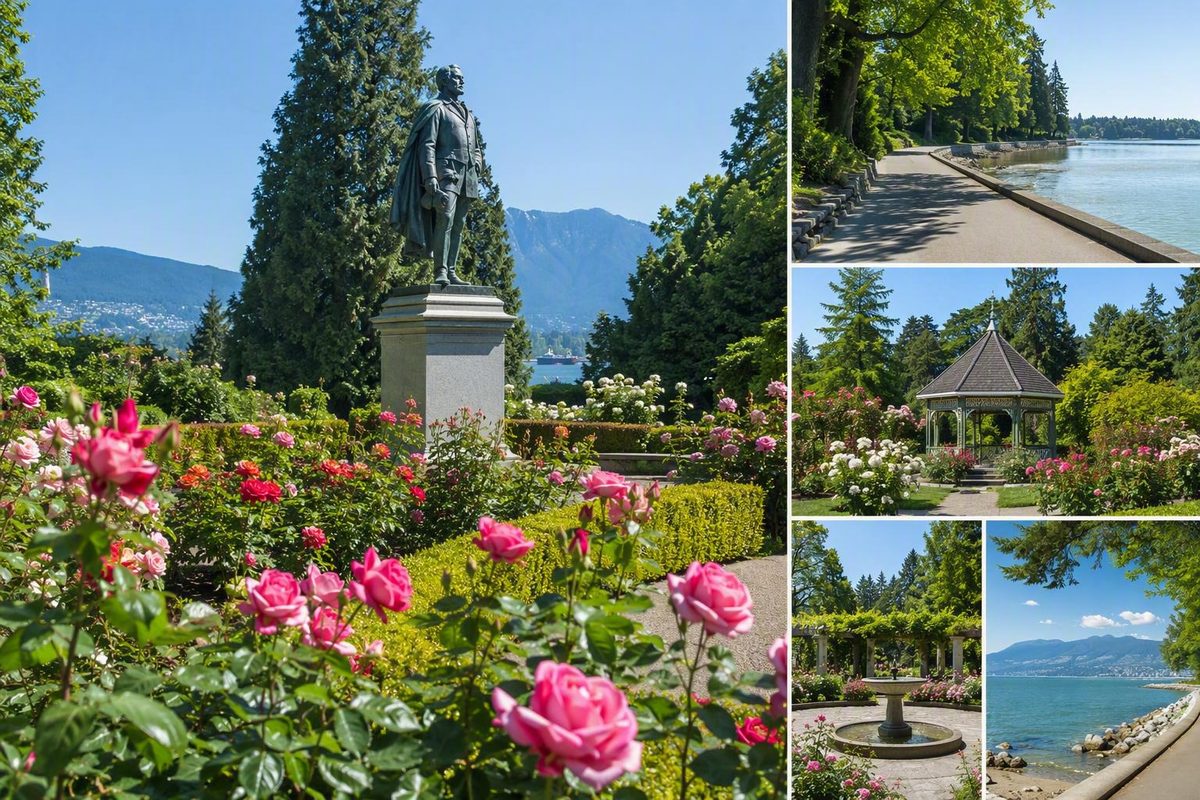
The Stanley Park Rose Garden works best as a seasonal stop within the compact group of gardens and landmarks near the park’s Georgia Street entrance. Aim for June if roses are the priority, use Pipeline Road and Lord Stanley’s statue for orientation, and combine the garden with the Shakespeare Garden, Stanley Park Pavilion and Malkin Bowl.
Stanley Park Rose Garden at a glance
The Rose Garden is a landscaped part of Stanley Park with formal rose beds, surrounding lawns and seasonal planting areas. The City of Vancouver reports more than 3,500 rose bushes, as well as a west coast-inspired arbour supporting climbing roses and clematis. Display beds extend toward the causeway and Stanley Park Pavilion, adding seasonal colour beyond the main rose display.
Treat the garden as a focused stop rather than something that must fill an entire Stanley Park day. Its location near several recognizable landmarks makes it easy to include in a short outing, place at the beginning of a longer park visit or use as a quieter transition between the entrance area and the forest.
When to visit for roses and seasonal flowers
June is the most practical month to target when roses are the main reason for your visit. It offers a reasonable chance of a strong display, but it is not a guaranteed peak-bloom window.
The City identifies flowering bulbs from March to May and annual and perennial colour from June to October on its Stanley Park gardens page.
| Visit window | Likely focus | Planning takeaway |
|---|---|---|
| March to May | Flowering bulbs | Choose spring for bulbs rather than expecting the main rose display |
| June and early summer | Roses | Best planning target for a strong display, not a peak-bloom guarantee |
| June to October | Annual and perennial colour | An alternative as the surrounding beds change through summer and early fall |
Roses may continue flowering through summer, but broad seasonal descriptions should not be treated as promises for a particular date. A June visit improves the odds of rose colour without settling what will be open on the day.
If one specific display will determine whether you visit, look for recent local bloom reports and check Stanley Park notices before travelling. That is more useful than planning around a fixed date from an older visitor account.
Where the garden is and how to find it
Use the Georgia Street entrance area, Pipeline Road, Lord Stanley’s statue and Stanley Park Pavilion as your main reference points. These landmarks are more dependable for trip planning than a postal code because third-party listings give conflicting codes for the garden.
Travel writer Linda Crampton reports that the path to the left of Lord Stanley’s statue leads toward the Rose Garden. Separately, StanleyParkVan’s visitor guide places the garden approximately 100 metres up Pipeline Road from the traffic circle near the Georgia Street entrance. Use these as approximate orientation cues rather than fixed turn-by-turn directions.
Before leaving, find the latest City of Vancouver Parks Map and Guide and confirm the garden’s position relative to your chosen entrance. On arrival, follow current signs and posted directions. Construction, maintenance or other access changes can make an older route description less useful even when the general landmarks remain recognizable.
This approach also avoids an easy planning mistake: entering an uncertain address and assuming it will lead to the most convenient pedestrian approach. Start with the park entrance and nearby landmarks instead.
Getting there without overcomplicating the trip
Choose your mode according to the rest of your day rather than treating the garden as an isolated address:
- Walk: A natural option when you are already in the West End or intend to explore more of Stanley Park on foot.
- Cycle: Useful when the garden is one part of a broader park route. Follow posted cycling and dismount instructions around paths and planted areas.
- Transit: Helpful for reducing the approach from downtown, especially when you want a contained garden visit rather than a full circuit of the park.
- Drive: Possible, but it adds a parking decision. Check current Stanley Park parking information before departure rather than assuming a convenient space will be available.
As time-sensitive third-party guidance, Moovit has listed bus 19 at Westbound Stanley Park Drive at Pipeline Road, with an estimated four-minute walk to the garden. This does not confirm current service. Verify the route number, stop location and service time in TransLink’s official trip planner before setting out.
Other routes shown for downtown or the West End may serve the broader area without stopping beside the garden. Consider the complete connection—including the final walk inside or toward Stanley Park—rather than choosing a route only because it appears in a general nearby-services list.
Avoid relying on fixed walking times from SkyTrain stations. Those estimates depend on the station, route, pace and current path conditions. For most visitors, the simpler decision is whether the Rose Garden will stand alone or connect to a larger park day: transit can suit a shorter stop, while walking or cycling often integrates more naturally with nearby sights.
A compact garden-and-landmarks route
For a simple route through this part of Stanley Park, use the following sequence:
- Lord Stanley’s statue — Begin with a recognizable orientation point near the park entrance.
- Rose Garden — Explore the rose beds, lawns, arbour and surrounding seasonal plantings.
- Shakespeare Garden — Continue into the garden area between the Rose Garden and the forest.
- Stanley Park Pavilion — Use the building as the next prominent landmark.
- Malkin Bowl — Finish at another recognizable point within the same general cluster.
The City places the Shakespeare Garden between the Rose Garden and the forest. Crampton’s article The Stanley Park Rose Garden in Vancouver, British Columbia reports that it contains plants connected with Shakespeare’s writings, accompanied by plaques showing relevant quotations. This makes it a logical transition from the formal flower beds toward the wooded park landscape.
Stanley Park Pavilion and Malkin Bowl are useful for orientation, but do not assume that dining, washrooms or indoor facilities will be available when you arrive. Check current park and venue information if any of those services are essential to your visit.
This cluster works well as a self-contained outing when you want to minimize backtracking. With more time, it can become the opening or closing portion of a broader Stanley Park plan. Decide that larger route in advance rather than adding distant attractions without accounting for the movement between them.
History, park hours and rules to know
The City of Vancouver says the Kiwanis Club established the Rose Garden in 1920. A garden plaque transcribed by StanleyParkVan says the original rose plot was planted to demonstrate the possibilities of growing roses in Vancouver.
Vancouver parks generally operate from 6 a.m. to 10 p.m. unless otherwise posted. These are general park hours, not confirmed Rose Garden-specific opening hours. Under the City of Vancouver’s general parks guidance, park parking is paid, overnight parking is prohibited, smoking is not allowed, and dogs must generally remain leashed unless an area is designated for off-leash use. Alcohol is permitted only at designated park sites and during specified hours.
Posted signs and location-specific notices take priority over general planning information. Do not assume that the general park hours confirm access to every path, garden area, building or service throughout that period.
Check before you go
- Find the latest City of Vancouver Parks Map and Guide.
- Review posted closure, maintenance or access notices.
- Look for recent bloom conditions if roses are the purpose of the trip.
- Confirm transit routes, stops and service times with TransLink.
- Check current Stanley Park parking information if driving.
- Read location-specific signs when you arrive.
If your visit depends on confirmed admission terms, reservation requirements, garden-specific hours or step-free access, verify those details with the City before travelling. The same applies when grades, path surfaces, parking proximity or nearby facilities will determine whether the outing works for you.
For the simplest plan, place the Rose Garden within the Georgia Street entrance cluster and aim around June when roses matter most. Spring bulbs and the changing annual and perennial beds provide alternatives outside early summer, while the nearby gardens and landmarks make the stop easy to scale to the time you have.