
Choose the Right Beach Section—and Let the Tide Set the Day
Last reviewed: August 25, 2026. Tide predictions, water quality, lifeguard coverage, parking, transit, concessions, washrooms, and accessibility equipment are date-sensitive; verify them before departure.
Spanish Banks at a Glance: A Beach, Not a Bank
If you search for “Spanish Banks Vancouver,” the result you probably want is a beach, not a Spanish financial institution. Spanish Banks is a connected public beach area on English Bay in Vancouver’s West Point Grey neighbourhood.
The most reliable geographic reference is Northwest Marine Drive west of Tolmie Street. The shoreline lies between Locarno Beach to the east and the University of British Columbia grounds to the west. It comprises three adjoining sections:
- Spanish Bank East
- Spanish Bank West
- Spanish Banks Extension
The sections share a shoreline, but they serve different plans. East and West have the broadest documented set of standard visitor facilities. West is also a designated quiet beach. Extension is most useful for activities assigned to its off-leash and kiteboarding zones. The City of Vancouver’s Spanish Banks Beach page documents the location, section names, principal amenities and activity areas.
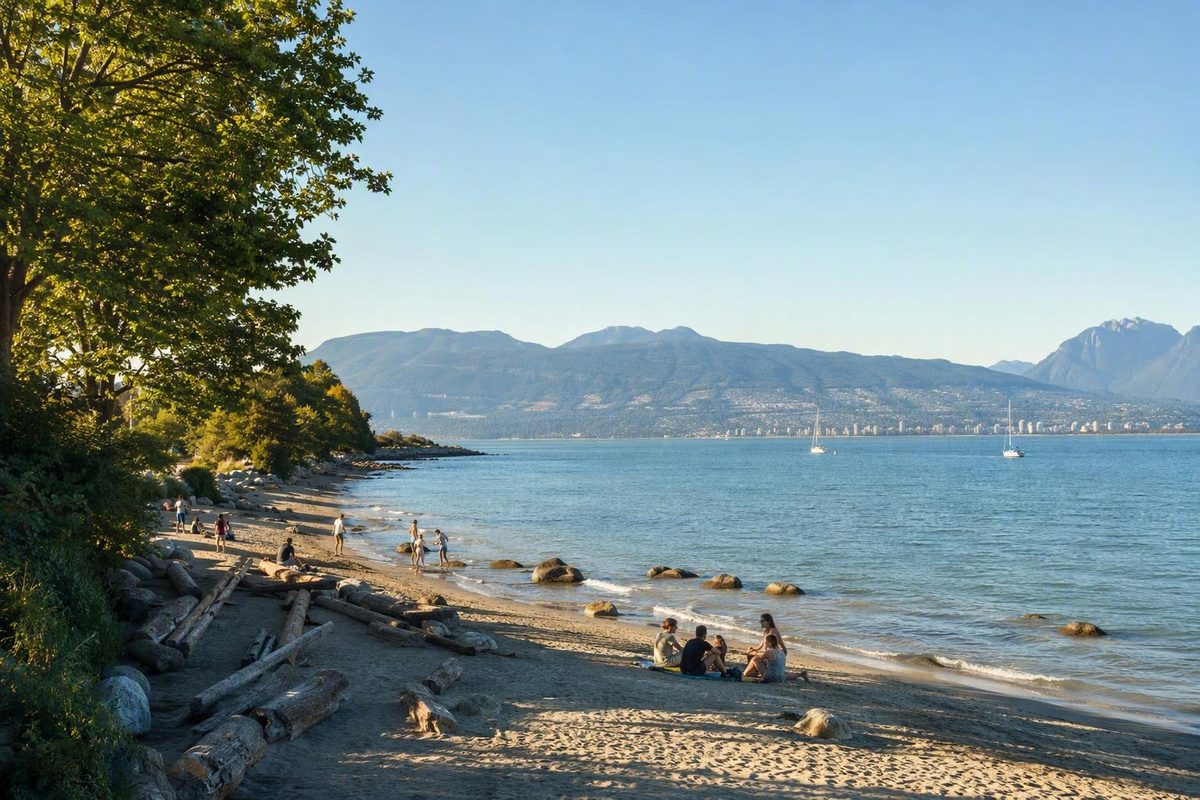
The other defining feature is the tide. At low tide, the water can be approximately one kilometre offshore, exposing extensive sandy flats. That landscape can suit walking, beachcombing and skimboarding, but it can disappoint anyone expecting to step directly from a towel into swimmable water. A third-party visitor guide documents both the approximate distance and the important caution that the seabed becomes deeper farther offshore despite the flats’ shallow appearance (Nomado Travel).
A generic Spanish Banks destination may place you far from the washrooms, volleyball courts, off-leash area or kiteboarding zone you intended to use.
Plan in this order:
- Check the current tide and beach conditions.
- Choose East, West or Extension for your activity.
- Navigate to that specific section.
- Confirm any seasonal or operational service you need.
East, West, or Extension? Choose the Section That Fits
East and West are the facility-oriented sections. Extension is the section to choose when your activity belongs in one of its designated zones.
| Section | Best-supported uses | Standard amenities | Dog access | Sound rules | Watersport zoning | Seasonal considerations |
|---|---|---|---|---|---|---|
| Spanish Bank East | Volleyball, picnics, swimming when conditions suit, waterfront-path access | Concession, public washrooms, picnic tables, eight volleyball courts | No designated off-leash area identified for East | General beach rules apply | Not the designated kiteboarding launch | Seasonal lifeguards and seasonal water wheelchair |
| Spanish Bank West | Quiet picnics, volleyball, swimming when conditions suit, dog outings within the marked area | Concession, public washrooms, picnic tables, eight volleyball courts | Designated off-leash area approximately 200 metres west of the building | Amplified sound prohibited | Not the designated kiteboarding launch | Seasonal lifeguards and seasonal water wheelchair |
| Spanish Banks Extension | Off-leash outings and kiteboarding or kitesurfing within designated zones | Do not assume the same facility set as East or West | Designated off-leash area | Follow posted rules | Designated kiteboarding launch zone | Verify current boundaries and conditions |
The City lists eight volleyball courts at East and eight at West, identifies West’s off-leash area as approximately 200 metres west of the building, and lists seasonal lifeguards and water wheelchairs at East and West. The water wheelchairs require two attendants. These are facility listings, not guarantees of day-specific availability (City of Vancouver).
Choose East for straightforward facilities and volleyball
East is a practical default when you want a concession, washrooms, picnic tables and volleyball without needing West’s quiet-beach or off-leash features.
Its seasonal lifeguard and water-wheelchair listings mean those services are associated with East during the relevant season. They do not establish that either service will be operating when you arrive.
Choose West for facilities plus quiet-beach rules
West has the same documented core facilities as East, but two differences may decide the visit.
First, it is a designated quiet beach where amplified sound is prohibited. Choose West for reading, conversation, a quiet picnic or a lower-noise afternoon—not for a gathering organized around speakers.
Second, West includes a designated off-leash area. Follow the current signs and marked boundary rather than treating the designation as permission for dogs to run off leash throughout the section.
Choose Extension for designated activity zones
Extension is not simply a western duplicate of East or West. Its principal planning value is its designated off-leash area and kiteboarding launch zone.
Citywide beach guidance limits dogs to designated off-leash areas and prohibits kiteboarding and kitesurfing at Vancouver beaches except at Spanish Banks Extension. East and West are therefore not alternative launch locations simply because wind or water conditions appear suitable (City beach guidance).
In practical terms:
- Choose East or West when washrooms, concessions, picnic tables or volleyball courts are priorities.
- Choose West for a quiet outing without amplified sound.
- Choose West or Extension for an off-leash outing, staying within the marked area.
- Choose Extension for kiteboarding or kitesurfing within the designated launch zone.
Plan the Visit Around the Tide
At Spanish Banks, tide timing changes the nature of the outing. It is not a minor detail to check after choosing an arrival time.
At lower tide, the water retreats across a broad intertidal area. The exposed flats create more room for walking, beachcombing, shallow-water play and skimboarding. At higher tide, the water is closer to the upper beach, which is usually more convenient when reaching the water is the priority.
Decide which version of the beach you want
A low-tide visit can work well when you want to:
- Walk over exposed sand
- Explore the tidal flats
- Beachcomb
- Skimboard where conditions permit
- Photograph broad foregrounds and reflections
- Give a group more room to spread out
A higher-tide visit may work better when you want to:
- Reduce the distance between your setup and the water
- Make swimming the central activity
- Avoid a long walk across wet or uneven flats
- Experience a more compact shoreline
Neither version is universally better. Low tide produces the landscape for which Spanish Banks is known, but it can leave swimmers facing a substantial walk before reaching deeper water.
Use a current prediction, not a saved tide time
Check a current tide prediction for the date of your visit. Do not rely on a screenshot, an old article or the timing from a previous trip; tide times and heights change daily.
Third-party Spanish Banks calendars may calculate estimates from Point Grey rather than report a direct observation from a gauge at the beach. They can help with broad timing, but they should be understood as estimates. For example, the TideTime Spanish Banks calendar explicitly says its figures are calculated from Point Grey.
A useful tide-first method is:
- Find the predicted low- and high-tide times for your date.
- Determine whether the tide will be rising or falling during the visit.
- Match that phase to your activity.
- Choose the appropriate beach section.
- Allow a conservative return margin if you intend to walk onto the flats.
Arriving while the tide is falling may give you expanding exposed space. Staying beyond low tide means the water will be advancing during the return. No single return-time formula works for every tide, route or visitor, so turn around early rather than trying to calculate a universal safe pace.
Do not assume the flats are uniformly shallow or firm
A broad expanse of wet sand can look simple and gently sloped. Deeper water lies farther offshore.
Keep sight of the shore and note a landmark near your entry point. If the tide is rising, return before water complicates the route. Closely supervise children, particularly near channels and pools. Treat distance as a limit to manage, not a target to achieve.
Match the Beach to the Activity
Spanish Banks accommodates many kinds of visits, but each activity has a more suitable section, tide state or safety check.
Volleyball
Choose East or West. Both have municipal volleyball courts and are better-supported choices than Extension when volleyball is the main purpose of the visit.
A listed court may still be occupied or temporarily unavailable. Bring your own ball and have a backup activity for busy periods.
Picnics and barbecues
East and West officially list picnic tables, making them the most straightforward choices for a facility-supported picnic. West suits groups that want a quiet outing and do not need amplified music.
Barbecues are permitted in all three sections, subject to current posted restrictions and changing fire-safety conditions. Permission to barbecue does not permit open fires or override a temporary restriction. Read the signs before setting up.
Walking and cycling
East and West form part of Vancouver’s Seaside Seawall system. Waterfront walking and cycling paths connect the Spanish Banks area with Locarno and Jericho to the east.
On foot, the sections can form one continuous waterfront outing even though their activity rules differ. By bicycle, plan for busy access points and shared waterfront areas. If you want to make Spanish Banks part of a longer route, Vancouver Know’s guide to planning a Vancouver seawall day can help structure a loop or one-way trip.
Skimboarding and tidal-flat exploration
Low tide is central to both activities. As the water recedes, thin sheets of water can remain across relatively level exposed areas, creating the conditions associated with skimboarding at Spanish Banks.
Inspect the surface before starting. Channels, debris, other visitors and dogs within designated zones may affect the usable area. For tidal-flat walking, wear footwear suited to wet and variable ground and avoid making a distant offshore point the objective.
Swimming
Before entering the water:
- Check the tide and the distance from the upper beach to the water.
- Review current water-quality results and advisories.
- Assess wind, weather, visibility and water conditions.
- Look for red-and-yellow lifeguard flags.
- Stay out when advisories, notices or conditions make entry inappropriate.
Seasonal monitoring does not prove that swimming conditions are suitable at a particular time. Likewise, a published lifeguard season does not prove that lifeguards are currently on duty.
Dog outings
Use only the marked off-leash areas at West or Extension. Carry a leash for travel to and from the designated area and keep the dog under control within it.
At West, use the posted signs to locate the designated space. At Extension, verify the boundary when you arrive so that the outing does not drift into adjacent areas intended for other users.
Kiteboarding and kitesurfing
Use the designated launch area at Spanish Banks Extension. Do not launch from East or West based solely on convenience, wind direction or apparent space.
The municipal designation identifies where the activity belongs. It does not replace an assessment of weather, wind, water, tide, skill level, posted closures or the position of other beach users.
Views and photography
The shoreline offers views across English Bay toward downtown Vancouver and the North Shore Mountains. Tide state changes the composition: low tide creates a broad reflective or textured foreground, while higher water produces a tighter beach-and-bay scene. Walking and cycling connections toward nearby beaches are also documented by Destination Vancouver.
Actual visibility depends on cloud, haze, light and weather. Descriptions such as “best sunset” or “most scenic beach” remain matters of preference.
Getting There and Moving Along the Waterfront
Use Northwest Marine Drive west of Tolmie Street as the stable geographic reference, then refine the destination to East, West or Extension.
Navigation services display different pins and street numbers because the beach extends along the waterfront and has multiple access points. A pin may identify a valid entrance without placing you near the facility or activity zone you need. Inspect the destination before beginning the trip.
Driving and parking
Some paid parking is available along Northwest Marine Drive, and EasyPark manages parking at Vancouver parks and beaches. Current prices, enforcement arrangements and availability are operational details rather than evergreen facts.
Before leaving, verify:
- Current rates and enforcement hours
- Restrictions or closures
- Accepted payment options
- Lot or roadside conditions
- Whether parking near your chosen section is likely to meet your needs
Even current information cannot guarantee a space. Allow time to adjust if the nearest parking area is full.
Transit
Transit reaches the surrounding West Point Grey area, but routes, stops, frequencies, detours and final walking approaches can change. Use a live transit planner rather than relying on a route number preserved in a travel article.
For a car-free visit:
- Enter the specific beach section as the destination.
- Compare that result with a generic Spanish Banks search.
- Inspect the final walking segment on a map.
- Consider distance, slopes, surfaces and crossings if mobility is a concern.
- Recheck the trip shortly before departure for disruptions.
Vancouver Know’s guide to experiencing Vancouver without a car provides broader planning context, but a live transit planner should determine the actual trip.
Bicycle and foot
East and West connect to the Seaside Seawall, while waterfront paths link Spanish Banks with Locarno and Jericho.
If you plan to visit several beach sections, arriving at one end and travelling along the waterfront may be easier than repeatedly relocating a vehicle. Account for the return distance, weather, daylight and the abilities of everyone in the group.
Amenities, Lifeguards, and Accessibility
The key distinction is between a listed facility and a confirmed operating service.
Stable facility listings
East and West officially list:
- Concessions
- Public washrooms
- Picnic tables
- Volleyball courts
- Seasonal lifeguards
- Seasonal water wheelchairs
Those listings are useful when selecting a section. They do not establish current concession hours, washroom status, staffing, stock, court availability or accessibility-equipment availability.
Do not assume Extension duplicates the East and West amenity set. Choose it for its designated activity areas.
Lifeguard coverage
City information describes lifeguarding at East and West from around Victoria Day to Labour Day, but seasons, daily hours and coverage can change. Red-and-yellow flags indicate that lifeguards are on duty.
If those flags are absent, do not infer coverage from the month, warm weather or the number of people swimming. Lifeguard presence also does not replace personal attention to advisories and water conditions.
Water wheelchairs and accessibility limits
East and West list seasonal water wheelchairs during the lifeguarded season, with two attendants required. Confirm the equipment and arrangements with Vancouver Parks before making it essential to the visit.
A water-wheelchair listing is not a complete accessibility audit. It does not establish that every parking space, route, surface, washroom, concession counter or water entry will suit every visitor.
When accessibility matters, ask section-specific planning questions:
- Is the water wheelchair available on the intended date?
- What assistance must the visitor arrange?
- Which arrival point is closest to the required facility?
- What surfaces and slopes are involved?
- Which washrooms are expected to be open?
- How will the tide affect the distance to the water?
- Are temporary closures or construction affecting the route?
These are questions to confirm, not claims that a particular barrier or service exists.
One pre-visit verification checklist
Use this checklist to avoid repeating operational research throughout the day:
- Tide: Current prediction and whether it will be rising or falling
- Weather: Wind, temperature, precipitation, visibility, heat and storm concerns
- Water quality: Current results and advisories
- Lifeguards: Expected service plus an on-site flag check
- Concessions and washrooms: Current opening status
- Water wheelchair: Section, date, availability and attendant arrangements
- Parking: Current rates, rules, payment information and conditions
- Transit: Live route and final walking segment
- Posted notices: Fire restrictions, closures and activity-zone boundaries
Rules and Safety That Shape the Day
Municipal rules determine where some activities belong and which plans need adjustment.
Barbecues, fires, smoking and alcohol
Barbecues are permitted in East, West and Extension, subject to posted restrictions and changing fire-safety conditions. General Vancouver beach rules prohibit fires, smoking, littering and unauthorized alcohol consumption. Current municipal rules and on-site notices control; do not assume a separate Spanish Banks alcohol policy.
Fishing, shellfish harvesting, inflatables and ball sports
Fishing and harvesting bivalve mollusks are not permitted at Spanish Banks. General beach rules also prohibit inflatables in the water and ball sports outside designated areas. Use the volleyball courts rather than turning crowded picnic or access spaces into improvised playing fields.
Sound, dogs and kiteboards
Amplified sound is prohibited at Spanish Bank West because it is a designated quiet beach. Off-leash use is limited to marked areas at West and Extension, and posted boundaries control. Kiteboarding and kitesurfing are assigned to Spanish Banks Extension rather than the whole shoreline. These regulated activities and the broader prohibitions above are set out in the City’s Spanish Banks and general beach guidance (City of Vancouver).
Water quality and swimming
Vancouver Coastal Health and Metro Vancouver monitor beach water quality weekly from May through September, but seasonal monitoring is not a same-day guarantee of suitable swimming conditions.
Check current results and posted advisories before entering. Look for the red-and-yellow flags that indicate lifeguards are on duty, and do not treat the presence of other swimmers as evidence that conditions are safe.
Tidal-flat precautions
If you walk onto the flats:
- Know whether the tide is rising or falling.
- Keep the shore and your entry landmark in sight.
- Watch for channels, pools, soft ground and changing footing.
- Do not assume the route remains shallow farther offshore.
- Supervise children closely.
- Turn back before advancing water alters the route.
- Avoid making maximum distance from shore the goal.
Low tide creates unusual room to explore, but apparent shallowness is not proof that every route is safe.
A Short History and Three Simple Visit Plans
The commonly published colonial naming account says that “Spanish Banks” commemorates a June 1792 meeting between George Vancouver’s British expedition and the Spanish expedition associated with Dionisio Galiano and Cayetano Valdés. Captain Richards bestowed the English name during an 1859 survey of Burrard Inlet (historical overview).
That explains the colonial English name, not the complete history of the place. This visitor guide does not attempt to provide a fuller Indigenous history without stronger Indigenous-led or primary sourcing.
Plan 1: Low-tide exploration with facilities nearby
- Check the current tide prediction and weather.
- Choose East or West for the documented washrooms, concession, picnic tables and volleyball courts.
- Wear footwear suitable for wet and variable ground.
- Note whether the tide is falling or rising.
- Keep the shore and entry point visible while exploring.
- Turn back before advancing water complicates the route.
- Reassess conditions before swimming.
This plan makes the flats the focus while keeping standard facilities nearby.
Plan 2: Quiet picnic at West
- Choose Spanish Bank West.
- Check the tide, weather and current transport information.
- Use the listed picnic facilities if available.
- Bring no amplified sound.
- Check fire-safety restrictions before using a barbecue.
- Keep dogs leashed unless you enter the marked off-leash area.
- Remove waste when you leave.
West’s quiet-beach designation is a rule, not merely a description of its atmosphere.
Plan 3: Dog outing or kiteboarding session
For an off-leash dog outing, choose the marked area at West or Extension. Confirm the boundary on arrival, carry a leash and do not assume adjacent sand is also off leash.
For kiteboarding or kitesurfing, choose the designated Extension launch area. Check wind, weather, tide, posted restrictions and the position of other users before setting up.
These are separate permissions within defined spaces, not general permission for dogs or kiteboards to use the entire shoreline.
A two-hour stop and a half-day outing can both work, but neither is an official or universally ideal duration. The right length depends on the tide, weather, activity, travel time and the needs of your group.
Frequently Asked Questions
Is Spanish Banks in Vancouver a beach or a financial institution?
It is a public beach area on English Bay in Vancouver’s West Point Grey neighbourhood. It consists of Spanish Bank East, Spanish Bank West and Spanish Banks Extension. For navigation, use Northwest Marine Drive west of Tolmie Street and select the section that fits your plan.
Which Spanish Banks section is best for dogs or kiteboarding?
For dogs, use the marked off-leash area at West or Extension. Dogs are not permitted off leash throughout the entire shoreline.
For kiteboarding or kitesurfing, use the designated launch area at Extension. East and West are not alternative launch locations under City guidance.
How far does the water go out at low tide?
The water can be approximately one kilometre offshore at low tide. The exposed distance and practical route vary with conditions, and channels or deeper water may interrupt the flats. Use a current prediction and do not treat the full distance as a walking target (visitor and tidal-flat guidance).
Are there washrooms, concessions, lifeguards and accessible beach equipment?
East and West officially list public washrooms, concessions, seasonal lifeguards and seasonal water wheelchairs. The equipment requires two attendants.
A listing does not guarantee day-specific availability. Confirm essential services before leaving and look for red-and-yellow flags when you arrive to verify that lifeguards are on duty.
Can visitors barbecue, play music, fish or harvest shellfish at Spanish Banks?
Barbecues are permitted in all three sections, subject to current restrictions. Amplified sound is prohibited at West. Fishing and harvesting bivalve mollusks are not permitted.
Current posted notices and municipal rules should guide the visit.
The final decision is straightforward: check the current tide and conditions first; choose East or West for the strongest documented set of standard facilities; choose West for a quiet outing; and choose Extension for its designated kiteboarding or off-leash areas. Before departure, verify parking, transit, lifeguards, water quality, accessibility equipment and posted rules.