
How to Visit the Museum of Anthropology at UBC From Downtown Vancouver
Plan a car-free trip from downtown Vancouver to MOA at UBC, including the campus walk, admission, hours, accessibility and what to prioritize.
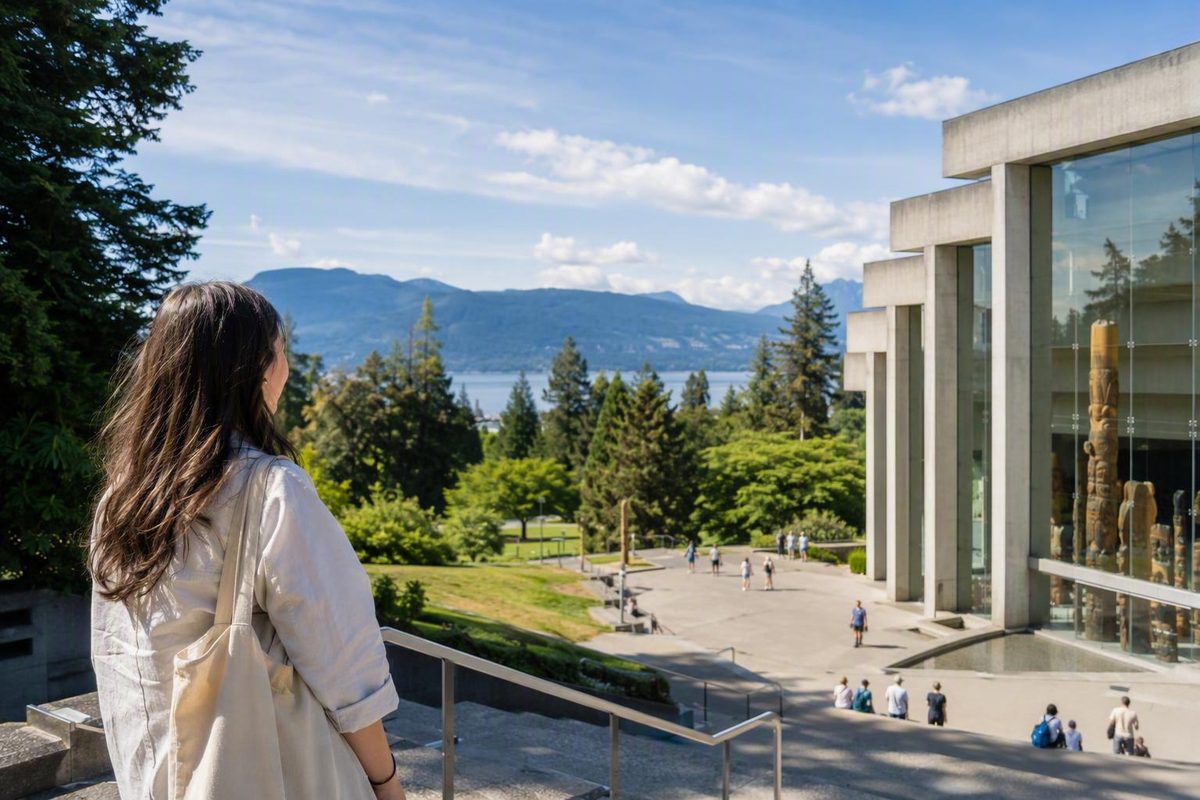
The Museum of Anthropology at UBC is a worthwhile half-day from downtown Vancouver, but it is not a quick downtown museum stop. Treat the journey to the northwest edge of the UBC campus as part of the outing: allow time for a bus ride, a 15- to 20-minute campus walk and at least two hours inside.
The simplest car-free route
Use TransLink’s trip planner on the morning of your visit and choose a bus itinerary ending at UBC Exchange. MOA lists the 25, 33, R4, 44, 49, 84, 99 B-Line and 480 as services reaching that exchange. From the last stop, the museum’s official directions call for a 15-minute walk northwest. If that walk is unsuitable, transfer at UBC Exchange to the 68 Wesbrook Village bus and leave at NW Marine Drive at West Mall (MOA directions).
The 4 and 14 are another option, but they terminate on University Boulevard and leave a stated 20-minute walk to MOA. Do not simply board the first bus displaying “UBC”: compare its downtown boarding point, travel time and final campus walk in the live planner.
All bus travel is charged as one zone, and a single fare remains valid for 90 minutes across TransLink’s bus, SkyTrain and SeaBus network. You can tap a Compass Card, Compass Ticket, contactless payment card or mobile wallet when boarding; cash paid on a bus transfers only to another bus (TransLink fare rules). For a day with just the outbound and return journeys, compare two single fares before buying a DayPass. See the broader Vancouver public-transit visitor guide if your museum trip is part of a busier day.
A low-friction sequence
- Check the live trip to UBC Exchange before leaving downtown.
- Save MOA’s address—6393 NW Marine Drive—rather than relying only on a “UBC” destination.
- At UBC Exchange, choose between the 15-minute walk and the short 68 bus connection.
- Buy museum admission at the desk; standard admission is not sold online.
- Check the return trip before leaving the building, particularly in the evening.
Hours, admission and bags
For visits from May 15 through October 15, MOA lists daily hours of 10 a.m.–5 p.m., with Thursdays extended to 9 p.m. From October 15 through May 15, it opens Tuesday–Sunday from 10 a.m.–5 p.m., again until 9 p.m. on Thursdays. Adult admission is $26, senior and student admission $23, youth admission $13, and Thursday admission is half-price after 5 p.m. Indigenous people, children five and under, and eligible UBC community members receive free admission (MOA visitor FAQ). Check that page again for your date because hours and prices can change.
Admission is purchased in person rather than reserved online. Travel light: large bags and backpacks cannot enter the galleries, and small lockers are limited and require a quarter. Food and drink, umbrellas, selfie sticks and tripods are also excluded from gallery spaces (MOA visitor FAQ).
What to prioritize inside
If this is your first visit, begin in the Great Hall rather than trying to inspect every case. It brings together Northwest Coast sculptures, textiles, bentwood boxes, feast dishes, canoes, poles, house posts and carved figures. The Bill Reid Rotunda displays The Raven and the First Men alongside other works by the Haida artist (MOA First Nations collections).
Then move into the Multiversity Galleries. These contain thousands of objects from worldwide research collections; MOA says members of source communities helped organize collections using their own classification systems. Digital catalogue terminals add images, audio and video (MOA Multiversity Galleries). This is a strong reason not to rush the museum into a narrow gap between downtown attractions.
MOA describes its work as building respectful relationships with communities represented in its collections and promoting understanding through partnerships with Indigenous, local and global communities. Read the object labels and community context rather than treating the large carvings only as architecture or photo subjects (MOA First Nations collections).
Accessibility and whether to add another UBC stop
MOA is wheelchair accessible. Its galleries occupy one floor and are mostly step-free, although some inclines may be difficult; alternate accessible paths are marked. Wheelchairs and portable seating are available to borrow, and one support person accompanying an Access 2 Card holder receives free admission. Outside, the gravel path west of the building is uneven in places (MOA accessibility details). The 68 connection from UBC Exchange can reduce the campus walk, but check its live timing before depending on it.
Add another campus attraction only if you have most of a day. Destination Vancouver characterizes UBC as a neighbourhood combining the university with beaches, forests and visitor attractions, including MOA (Destination Vancouver’s UBC guide). For a focused half-day, the better plan is museum, café or campus meal, then bus back downtown. If you want a fuller campus day, compare the nearby gardens in our Vancouver gardens guide before committing to a second admission and more walking.