
Trail Games for Every Group, from Quiet Observation to Clever Wordplay
Contact needs at least three players. Compare no-prep activities for easy walking with drawing, journaling and device-based options for suitable stops.
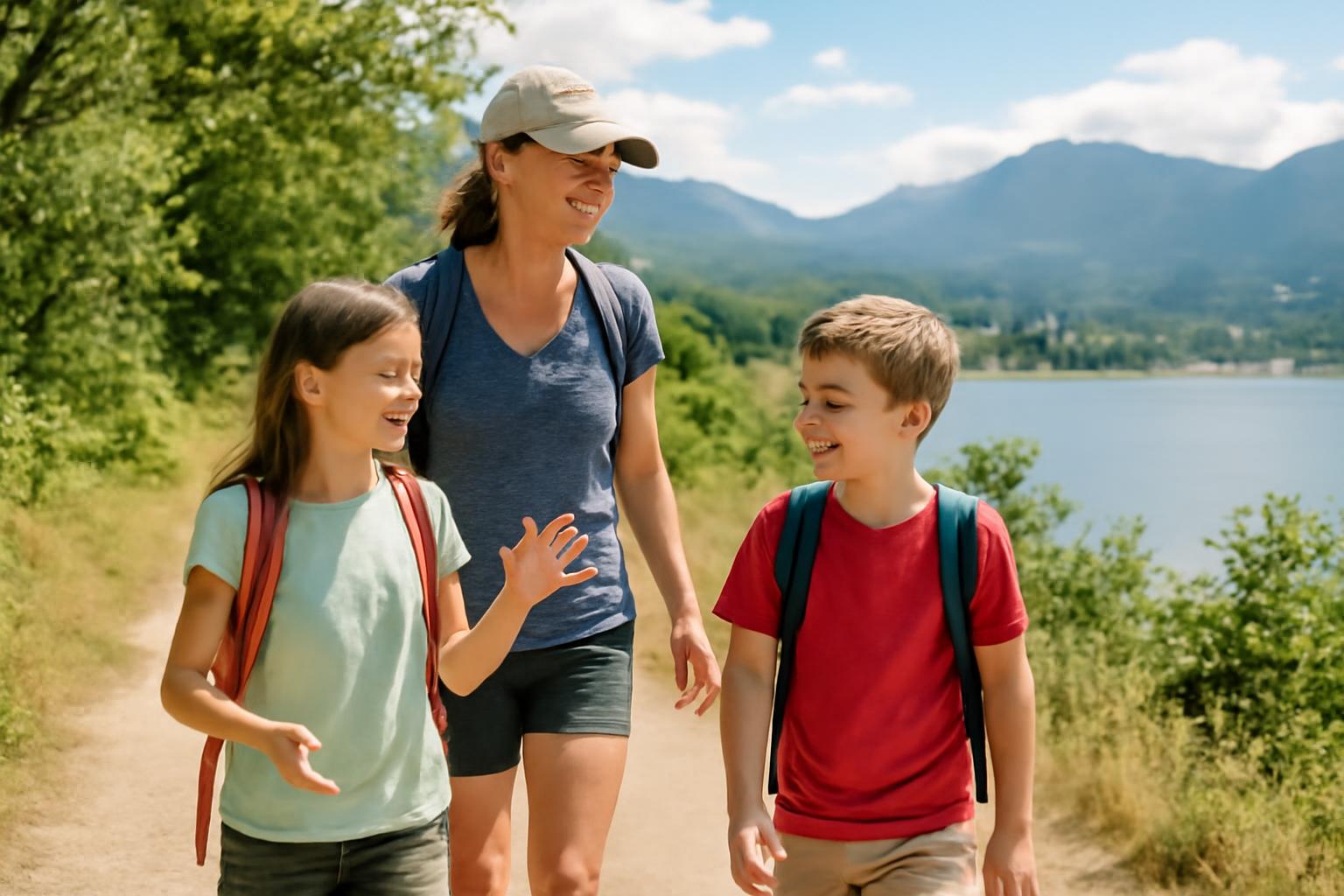
This guide covers games and short activities played during a real hike—not video games about hiking. The options range from no-equipment wordplay to quiet observation, prepared scavenger hunts, and creative activities for rest stops.
The useful question is not which hiking game is “best,” but which one fits the group and the current stretch of trail. A verbal game may work on a broad, easy path but become distracting at a crossing or navigation decision. Drawing may suit a scenic break but not active walking. Any game should be easy to pause as soon as the hike requires everyone’s attention.
The game rules below come from recurring formats in outdoor-activity guides. Claims that games prevent boredom, motivate children, strengthen relationships, or make distances feel shorter are personal impressions rather than established outcomes. Safety-related suggestions are conservative editorial precautions, not a complete substitute for current guidance from the manager of the trail or recreation area.
Choose a game that fits the hikers and the trail
Start with four variables:
- Group size: Is someone hiking alone, with a partner, or in a larger group?
- Attention required: Can participants continue watching their footing and surroundings?
- Supplies: Do you have paper, a camera, a printed card, or nothing at all?
- Setting: Is the group walking on easy terrain, taking a break, or settled at camp?
Use the following table as a quick selector. Age fit is deliberately broad: language, attention, mobility, sensory preferences, experience, and enthusiasm can matter as much as age.
| Game | Group size | Broad age fit | Supplies | Approximate format | Noise level | Recommended setting |
|---|---|---|---|---|---|---|
| I Spy | Pair or group | Younger children through adults | None | Visual guessing | Low | Walking on easy terrain |
| Twenty Questions | Pair or group | Older children through adults; simplify as needed | None | Yes-or-no guessing | Low | Walking on easy terrain |
| Collaborative Story | Pair or group | Mixed ages with adapted turns | None | Creative verbal | Moderate | Easy walking or stationary break |
| Alphabet Search | Solo, pair, or group | Broad mixed-age fit | None | Observation or naming | Low | Walking on easy terrain |
| I Went to the Market | Pair or group | Children through adults | None | Expanding memory list | Moderate | Walking on easy terrain |
| Categories | Pair or group | Children through adults | None | Recall and wordplay | Moderate | Walking on easy terrain |
| Would You Rather | Pair or group | Children through adults | None | Conversation | Low | Walking on easy terrain |
| Color or Shape Search | Solo, pair, or group | Especially simple for younger children | None | Visual observation | Low | Walking on easy terrain |
| Sound Mapping | Solo, pair, or group | Children through adults | Optional paper and pencil | Quiet listening | Silent during observation | Stationary break |
| Jenny’s Game | Pair or group | Children through adults | Loose natural object, where handling is permitted | Visual identification | Low | Stationary break |
| Drawing Swap | Pair or group | Children through adults | Paper and pencils | Drawing and searching | Low | Stationary break |
| Journaling | Solo or group | Children through adults | Notebook and pencil | Writing or drawing | Silent | Stationary break or camp |
| Inventing Collective Nouns | Solo, pair, or group | Older children through adults | None; notebook optional | Creative wordplay | Low | Easy walking or break |
| Convergence | Pair or group | Older children, teens, and adults | None | Word association | Moderate | Easy walking or break |
| Ketchup or Mustard | Pair or group | Older children, teens, and adults | None | Comparative guessing | Moderate | Easy walking or break |
| Hinky Pinky | Pair or group | Older children, teens, and adults | None | Rhyming riddles | Moderate | Easy walking or break |
| Contact | Group with a Defender and multiple guessers | Older children, teens, and adults | None | Cooperative word deduction | Moderate | Easy walking with close spacing |
| Counting Game | Larger group preferred | Older children through adults | None | Group coordination | Moderate | Easy walking with close spacing |
| Nature Charades | Group | Mixed ages | Optional prompt cards | Acting and guessing | Moderate | Camp or open area |
| Scavenger Hunt | Solo, pair, or group | Broad mixed-age fit | Optional list, pencil, or camera | Structured observation | Low to moderate | Easy walking with planned stops |
| Nature Bingo | Solo, pair, or group | Broad mixed-age fit | Bingo card and pencil | Structured observation | Low | Easy walking with planned stops |
| Geocaching | Solo or group able to follow the route and listing | Depends on route and participant skills | Published listing, smartphone, or GPS | Coordinate-based search | Low | Planned route with stationary device checks |
These setting labels are practical recommendations, not guarantees of safety. “Walking on easy terrain” assumes participants can still communicate, monitor the route, maintain suitable spacing, and respond to changing conditions.
Solo hikers can journal, create a sound map, complete an alphabet search, or invent collective nouns for things they observe—for example, a “murmur of maples.” Two people can play I Spy, Twenty Questions, collaborative storytelling, Convergence, Ketchup or Mustard, or Hinky Pinky. Contact requires at least three players, while the Counting Game is described as most effective with at least four and becomes difficult when players cannot hear one another clearly, according to the Washington Trails Association’s game rules.
For younger children, begin with immediate prompts: find something yellow, imitate an animal sound, notice something rough, or spot a round object. Older children, teens, and adults may prefer the inference and vocabulary involved in Contact, Hinky Pinky, or Yes-No Puzzles. These are starting points, not rigid age labels.
Games can also be adapted around individual preferences and abilities. A player who does not want to speak can point, sketch, keep score, or choose prompts. A visual search can become a sound or texture-description activity. A movement game can become a seated or stationary guessing round. Cooperative play can replace speed, elimination, or synchronized speech when those formats do not suit the group.
Whatever the choice, avoid a game that prevents participants from communicating, following the route, or responding when footing, weather, traffic, wildlife, or group spacing changes.
No-preparation games you can start while walking
No-preparation games can begin and end without unpacking anything. Most rely on observation, memory, imagination, or conversation.
I Spy: One person silently selects a visible object and gives a clue based on its first letter, color, shape, location, or another descriptive feature. Everyone guesses until somebody identifies it. Use color or texture clues when spelling is not a good fit, and choose objects likely to remain visible long enough to be guessed.
Twenty Questions: One person chooses a person, place, or thing. The others may ask up to 20 questions that can be answered yes or no before making their guess. Decide whether guesses count toward the limit and whether the chooser may answer “unknown” when necessary. The 20-question limit is part of the commonly described trail version of the game in this collection of no-equipment walking games.
Collaborative Storytelling: One hiker starts a story with a sentence or short passage, and each participant adds the next part. Rotate who starts so one person does not always control the setting or characters. For a quick version, use one sentence per turn. During a break, participants can agree on a longer turn limit as a house rule.
Alphabet Search: Find something beginning with A, then B, and continue in order. The group can require visible objects, allow anything associated with the hike, or choose a theme such as foods or place names. Agree in advance that unusually difficult letters may be skipped if the search stops being enjoyable.
I Went to the Market: The first player says, “I went to the market and bought…” followed by one item. The next repeats that item and adds another. Each person repeats the complete list before contributing something new. A themed round might use camping supplies, foods, animals, or imaginary treasures.
Categories: Choose a category—trees, cities, breakfast foods, book characters—and take turns naming new entries. Instead of eliminating someone who pauses or repeats an answer, keep a shared total and see how many valid responses the group can produce.
Would You Rather: Offer two alternatives and invite each person to choose and explain. Trail-friendly themes include travel, weather, foods, imaginary wildlife abilities, camping comforts, and landscapes. For example: “Would you rather cross a desert at sunrise or walk through a forest at dusk?”
Counting Game: The group counts upward, but only one person may say each number. Everyone must contribute before anyone speaks a second time. If two people answer simultaneously or someone says the wrong number, restart—or use another agreed reset rule. This works best when everyone can hear the group without shouting.
These formats recur in informal collections of hiking activities. They may provide conversation or variety, but whether they make a particular hike feel easier or more enjoyable is subjective.
Verbal games are practical only while conversation does not compete with awareness. Use a simple house rule: suspend the round on demanding ground, at crossings and intersections, while discussing the route, when the group stretches out, or whenever someone needs quiet concentration. There is no need to finish a question, list, or story before pausing.
Quiet observation and sensory games
A hiking game need not involve loud clues, racing, or elimination. Quiet observation can focus a short break on colors, shapes, textures, patterns, and sounds already present.
Color Search: Select a color and point out matching objects. Players can share one color or choose different ones. Keep the activity observational rather than picking living things.
Shape Search: Choose a shape—circle, triangle, spiral, line, or rectangle—and look for natural or human-made examples. A trail marker may form a rectangle; a curled tendril might suggest a spiral. Let participants explain imperfect matches instead of arguing over geometric precision.
First to Find: Name a visible feature, such as a bridge, trail sign, fallen branch, bench, campsite marker, or patch of a chosen color. The first person to see it calls it out. For a cooperative version, make a short shared list and complete it without individual scores.
A Fistful of Sounds: Stop at a suitable place and listen quietly. One published family version uses a 60-second listening period in which children say or record what they hear. Participants can count sounds on their fingers, name them afterward, or mark their direction on a simple sound map; see the Jellystone Park activity description.
Jenny’s Game: One participant examines an individual leaf, cone, or acorn, noticing its markings, shape, size, and imperfections. Mix it with similar objects and ask the participant to identify the original. Use only items already loose on the ground and only where handling is allowed by the rules for that location. Return the objects after the round.
Photo Scavenger Hunt: Photograph listed colors, shapes, tracks, patterns, signs, or scenes instead of removing them. Stop in an appropriate place before operating the camera. The picture records the observation without making collection the object of the game.
For a stationary creative variation, draw one observed detail, make a sound map, or write three short notes: one thing seen, one heard, and one felt. These choices can suit participants who prefer quiet individual attention over competitive play.
Many sensory and observation activities in the Appalachian Trail Conservancy’s activity guide are designed to take about 5–10 minutes, although selected writing and poetry activities require longer. The guide includes Color Search, Shape Search, Jenny’s Game, drawing, journaling, and sound mapping.
Quiet does not automatically make a game appropriate in every setting. Treat wildlife observation as observation, not as an invitation to approach or prolong an encounter. If posted instructions or current guidance for the location conflict with a game, end the game and follow that guidance.
Simple hiking games for children and mixed-age families
For young children or a group with varied abilities, begin with one-step instructions. “Find something blue” is easier to hold in mind than a complicated scoring system. Color, animal, sound, and object prompts can also be shortened or changed without formally ending the round.
An animal quiz can use sounds, foods, habitats, movement, or descriptive clues. One person might ask, “Which animal has a broad, flat tail?” or imitate a familiar sound for others to identify. Keep claims about local species within the group’s knowledge. If accurate identification matters, stop before consulting a field guide.
Toy Time gives a familiar toy a role in imaginative play. The toy might cross an imaginary bridge beside the trail, inspect a “castle” formed by a stump, or narrate the walk. Use nearby features as scenery without breaking, collecting, or rearranging them.
For collaborative storytelling, ask each child to add one sentence. If an open-ended turn is difficult, offer two directions: “Should the rabbit follow the river or climb the hill?” Older participants can connect the answers into a story without correcting every change in logic.
Movement games need tighter boundaries:
- Follow the Leader: Copy simple forward-walking movements without leaving the route.
- Red Light, Green Light: Move on “green” and stop on “red.”
- Simon Says: Follow only instructions prefaced by the correct phrase.
Treat these as open-area or very-easy-terrain options, not default trail games. Before starting, adults should consider space, footing, visibility, participant maturity, supervision, and other trail users. Do not give instructions that require running, walking backward, leaving the route, or disappearing around a corner.
Hike-and-seek requires even more caution. Some informal versions keep children visible or close to the trail, but visibility or a short distance does not establish that the game is suitable in a particular place. Terrain, vegetation, water, traffic, wildlife, other visitors, supervision, and a child’s response to instructions can all affect the decision.
When hiding people is unsuitable, preserve the game’s basic idea in another form. Hide a verbal clue in a story, ask players to spot a selected landmark, or have an adult identify an object that everyone else must find while remaining on the route.
Cooperative rules can keep the entire group participating:
- Build one alphabet together.
- Earn one group point for each new observation.
- See whether everyone can name an animal without repetition.
- Repeat a game later and try to beat the group’s previous total.
- Let a player request a clue instead of being eliminated.
Rotate roles after short rounds. A child who was the caller can become an observer; the storyteller can become the character chooser; the clue giver can become a guesser. Rotation is a practical way to share control rather than leaving one confident participant in charge throughout the hike.
Word games for teens and adults
More involved word games work best when players can hear complete clues and retain several ideas at once. They may suit easy walking or a break but become impractical when hikers are spread along a noisy or demanding route.
Contact combines individual deduction with cooperative clueing:
- One person, the Defender, chooses a secret word and announces its first letter.
- The other players think of possible words beginning with the revealed letter or letters.
- A player gives a definition without saying the proposed word. If the known letter is B, the clue might be, “Is it a place where books are borrowed?”
- Another guesser who believes they know the answer says, “Contact.”
- The clue giver and guesser count down and say their proposed word simultaneously.
- If the words match, the Defender reveals the next letter of the secret word—unless the Defender identifies a valid answer to the clue first.
- Play continues with clues matching the growing prefix until the secret word is guessed.
Contact requires at least three players: one Defender and at least two people who can make contact. It breaks down when players cannot hear definitions, challenges, and synchronized guesses.
Convergence: Two players count down and each says a word at the same time. They consider the relationship between those words and repeat with new choices, without discussing the intended answer. The goal is to arrive independently at the same word. If the opening words are “snow” and “mountain,” both players might eventually choose “ski.”
Ketchup or Mustard: A Word Master chooses a noun. The group asks whether it is more like one of two options—initially ketchup or mustard. The chosen comparison carries into the next question: “Is it more like mustard or a bicycle?” Players infer the target from the sequence of subjective comparisons. The Word Master can explain the reasoning afterward.
Hinky Pinky: Create a clue whose answer is two rhyming, two-syllable words. A one-syllable pair is called a hink pink, while a three-syllable pair is a hinkity pinkity. Players can prepare clues mentally and offer them whenever conversation has space.
Book Titles: Invent a fictional book title and ask everyone to create a subtitle, or supply the subtitle and ask for a title. A genre can shape the round: mystery, travel memoir, nature guide, romance, or absurd instruction manual.
Yes-No Puzzles: One person presents an unusual scenario with important information omitted. Everyone reconstructs what happened by asking questions answered with “yes,” “no,” or “unknown/irrelevant.” Screen borrowed prompts before using them with a mixed-age group because some puzzle collections contain crime, death, or other mature themes.
The detailed forms of Hinky Pinky, Book Titles, invented collective nouns, and Contact are described in this word-game guide for hikers. Its “best” label reflects the authors’ preferences rather than a comparative ranking.
Useful original prompt templates include:
- “A hiker reaches a familiar viewpoint but immediately knows something has changed. What?”
- “Someone packs an item they hope never to use, then feels relieved when they do not use it. What kind of item could it be?”
- “Two people describe the same trail correctly but appear to contradict each other. Why?”
- “Create a hink pink for a tiny light.”
- “Invent a subtitle for The Map That Refused to Fold.”
These are adaptable formats, not objectively superior adult hiking games. Pause them whenever the trail requires more attention than the wordplay.
Creative activities for rest stops and camp
Activities requiring sustained visual attention, writing, drawing, acting, or device use belong at a suitable stopping place. Keeping them separate from walking-friendly verbal games is intended to limit divided attention and give participants time to engage with the task.
Drawing Swap: Each person sketches a nearby detail without announcing the subject. Exchange drawings, then try to locate what the other person drew. Set a clear search boundary and keep the search within the designated rest area or established route.
Trail Journaling: Record observations through words, drawings, tracings, diagrams, or a sound map. Prompts might include “What changed since the trailhead?”, “Draw three kinds of edges,” or “Describe the nearest sound without naming its source.” Use tracings of textures or objects only when doing so does not require prohibited handling or removal.
Poesy Poetry or Place Poem: Build a short poem from observed sights, sounds, textures, and smells. One easy structure is five lines: something seen, something heard, something moving, a comparison, and a final line naming the place. For a quick break, write only three lines. The Appalachian Trail Conservancy activity guide estimates about 30–45 minutes for its more developed Poesy Poetry activity.
Nature Charades: Prepare outdoor-themed subjects—rainstorm, squirrel, growing tree, paddler, woodpecker, or falling leaf—and act them out without speaking. Use a campsite, rest stop, field, or another open area where movement will not obstruct the route.
Name That Tune: Hum a melody while others guess. Keep the volume appropriate for the setting and nearby visitors. If the location calls for quiet, substitute written song clues or save the game for camp.
For a short stop, time-box drawing, listening, poetry, or clue-making into rounds of about 5–10 minutes, matching the approximate format of many short sensory activities described by the Appalachian Trail Conservancy. A defined end can also keep a brief rest from becoming an unplanned extended activity.
Not everyone wants to act, sing, or read their work aloud. Offer equivalent roles: writing clues, sketching, keeping time, selecting prompts, deciding whether an answer fits, or contributing ideas to a shared story. Participation can remain flexible without requiring anyone to justify a quieter role.
Prepared trail games: scavenger hunts, bingo, and geocaching
A prepared activity offers more structure than an improvised word game. Build it around observations likely to occur on the chosen route rather than using a generic list that encourages wandering.
For a scavenger hunt, select a manageable mix of:
- Colors and shapes
- Tracks or signs of animals
- Sounds
- Locally appropriate species
- Trail signs and human-made features
- Geographic features
- Textures or patterns
- Changes in shade, elevation, or ground surface
Participants can announce, check off, sketch, or photograph each find. Make observation the object of the game rather than removal. Check the rules for the specific location before handling or collecting anything, because the supplied game guides do not establish what is permitted on a particular trail.
Use a short list or an agreed time limit so the hunt does not control the entire outing. The limit is a planning choice, not a universal standard.
A nature bingo card arranges likely observations in a grid. Balance the entries carefully. If every square is extremely common, the round ends immediately; if most are implausible for the location or season, nobody can progress. Add a free square or let the group replace one impossible entry after seeing actual conditions. The Appalachian Mountain Club’s trail-game collection likewise advises choosing bingo observations that are neither extremely rare nor extremely common.
A photo hunt can use the same list but require an image for each observation. Stop in a suitable place before handling a camera or phone. Do not walk backward or drift across the route while composing an image.
Geocaching is a coordinate-based activity in which participants consult a published cache listing and use a smartphone or handheld GPS to search for the cache. The supplied family game guides provide only introductory descriptions of this activity; they are not comprehensive instructions for access, navigation, placement, or cache etiquette.
Before leaving, review the particular cache listing and the current information for the route or recreation area. Consider route length, difficulty, conditions, and how the necessary listing and navigation information will remain available. Do not assume cellular service will be present, and do not make a game the group’s only route-planning method. If the listing, route, or search area does not suit the outing, choose another activity.
Possible supplies include:
- Printed checklist or bingo card
- Pencil or crayon
- Clipboard or firm writing surface
- Weatherproof sleeve or clear bag
- Camera
- Local field guide
- Smartphone
- Handheld GPS device
Preparation should support the hike rather than keep everyone focused on a card or screen for the entire route.
Know when to stop the game
Adopt one house rule before starting: anyone can call “pause,” immediately and without debate, whenever the route or surroundings require full attention. The same person can resume the game later, or the group can let it end.
The following are conservative operating rules for this guide, not a complete trail-safety checklist:
- Pause on demanding, narrow, slippery, crowded, or low-visibility sections.
- Pause for crossings, route discussions, changing conditions, or wildlife encounters.
- Keep the group within useful speaking distance.
- End movement games if their rules interfere with watching the route.
- Stop before reading, writing, taking photographs, or checking a device.
- Use a stopping place that does not obstruct other visitors.
- Keep voices low enough to hear one another and nearby warnings.
Listening and synchronized games become impractical when hikers stretch into a long line or background noise prevents clear communication. Do not shout merely to preserve a round.
Hiding, racing, acting, or leader games should not be used when they would move participants out of sight, away from the established route, or into unsuitable terrain. If maintaining the game conflicts with supervision or route awareness, end the game.
Stop before using anything that narrows attention or changes vision, including:
- Binoculars
- Cameras and phones
- Notebooks
- Field guides
- Bingo cards and checklists
- GPS devices
One family hiking guide specifically advises stopping before looking through binoculars rather than using them while walking, while another trail-game collection advises participants not to block the trail and to pause for other users. These are useful minimum precautions, not comprehensive guidance; see the trail-etiquette notes accompanying these children’s games.
For scavenger hunts, observation, drawing, and photography are practical defaults. If participants want to handle or remove something, check the current rules for that specific place rather than treating a generic activity sheet as permission.
For wildlife prompts, end or change the game if observation would encourage participants to approach, follow, feed, surround, or prolong an encounter. Follow current instructions for the location and animal involved; a general hiking-game guide cannot supply universal species-specific rules.
Most importantly, hiking games are optional entertainment. They do not replace route planning, suitable supervision, navigation, appropriate equipment, current local information, or judgment.
Before setting out, choose one no-prep verbal game, one quiet observation activity, and one stationary option. Use only the activity that fits the group and the current section of trail. Stop as soon as footing, navigation, weather, wildlife, traffic, supervision, or consideration for other visitors requires attention. Treat this list as adaptable inspiration—not a ranking or a guarantee that an activity suits every hike.
What are the easiest hiking games with no equipment?
I Spy, Twenty Questions, Alphabet Search, Would You Rather, collaborative storytelling, Categories, and I Went to the Market are among the simplest options. They need little explanation and can be shortened at any time.
For very young children, start with Color Search or a prompt such as “find something round.” For older players, add constraints: use only visible natural features in Alphabet Search, choose a narrow category, or limit storytelling turns to one sentence.
Even an equipment-free game should pause when conversation competes with footing, navigation, traffic awareness, or supervision.
Which hiking games work for two people or a solo hiker?
Two people can play I Spy, Twenty Questions, collaborative storytelling, Convergence, Ketchup or Mustard, Hinky Pinky, Would You Rather, and most observation searches.
A solo hiker can complete an alphabet search, keep a trail journal, create a sound map, photograph a prepared list, or invent collective nouns for observed subjects. Stop before writing, drawing, or operating a device.
Contact is not a two-person game because it requires a Defender and at least two players who can synchronize a matching guess.
Can children play hide-and-seek on a hiking trail?
Only when a supervising adult determines that the specific location, conditions, and group make a tightly controlled version appropriate. Keeping children visible or close does not make hide-and-seek universally suitable.
Consider terrain, water, vegetation, visibility, traffic, wildlife, other visitors, posted rules, the child’s maturity, and available supervision. Do not use the game if it would send a child off-route, out of sight, or around a blind corner.
When in doubt, preserve the searching element without hiding people. Use I Spy, First to Find, or an object-search game instead.
Should a hiking scavenger hunt involve collecting natural objects?
Observation is the more adaptable default. Participants can announce, check off, draw, or photograph plants, rocks, cones, tracks, and other finds without making removal part of the game.
Rules on handling or collecting can vary by location. Check current information for the specific trail or recreation area; a scavenger-hunt sheet is not permission to remove anything.
Are there video games that recreate the feeling of hiking?
Yes, although that is a separate meaning of “hiking games” from the real-trail activities covered here. An opinion-led gaming article discusses The Trail, The Long Dark, Firewatch, and the web-based Thru-Hiker’s Journey as games that evoke aspects of walking, wilderness travel, solitude, or long-distance journeys. It also mentions A Short Hike, Eastshade, and Outward among suggestions from readers or social-media contacts.
These are personal recommendations rather than a ranking of realistic hiking simulations; see the Bio Break overview of hiking-like video games.