
One Pair for the Jobsite and Trail—or Two?
A work hiker can be a sensible middle ground for moderate mixed use, while demanding jobs and serious hiking often justify separate, purpose-built pairs.
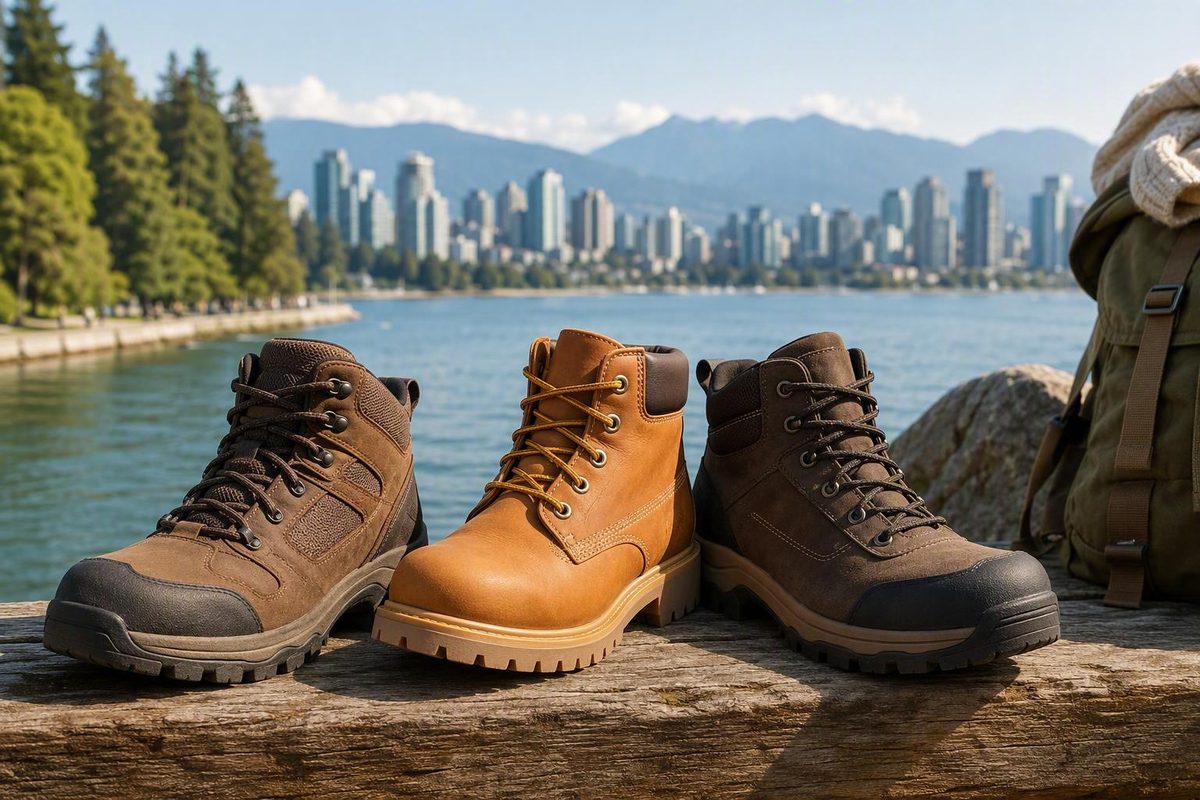
Choosing between hiking boots, traditional work boots, and hiker-style work boots is not mainly about appearance. It is about whether the footwear matches the hazards at work, performs on the surfaces you cross, and fits well enough for the hours and miles involved.
A hybrid can be practical, but only within clear limits. Confirm mandatory workplace protection first, then assess terrain, distance, weather, load, and fit. If either the job or the hiking is especially demanding, separate purpose-built pairs are usually the more defensible choice.
This is a general buying framework, not jurisdiction-specific compliance advice. Footwear rules, required markings, and accepted standards vary by country, province or state, industry, employer, and task. Obtain the current requirements from your employer or qualified safety contact before buying. Do not assume that a U.S. ASTM reference, a Canadian marking, or a retailer’s “safety” category automatically satisfies rules in another jurisdiction.
Start Here: Choose by Hazards and Terrain, Not by Appearance
Use this three-step sequence before comparing brands or prices:
- Identify every non-negotiable workplace requirement. Obtain your employer’s footwear policy or the relevant conclusions from its hazard assessment. Record any required toe, puncture, metatarsal, electrical, slip, heat, chemical, insulation, or other protection using the exact terminology supplied by the employer.
- Define the surfaces underfoot. Separate natural terrain—dirt, roots, rock, mud, snow, and slopes—from built surfaces such as concrete, tile, ladders, scaffolding, metal, gravel, and construction debris.
- Evaluate the use pattern. Consider walking distance, standing time, carried load, climate, water exposure, foot shape, socks, orthotics, and how much drying time the boots will receive.
Ordinary hiking boots are primarily designed for movement over varied natural terrain. Their common priorities include manageable weight, useful flex, trail traction, and comfort over distance. Work boots generally put more emphasis on occupational protection, durability, and support for workplace surfaces. These are category tendencies, not guarantees for every model.
A hiker-style work boot uses a hiking- or athletic-inspired shape while adding selected work-oriented features. Depending on the model, those may include a safety toe, waterproof construction, an electrical-hazard designation, puncture resistance, metatarsal protection, or workplace-oriented slip resistance. Commercial catalogs confirm that this hybrid category exists, but their labels are sales classifications rather than independent proof that a boot suits a particular workplace. For example, CAT Footwear lists hiker-style products with steel, composite, and soft toes as well as waterproof, electrical-hazard, slip-resistant, and nonmetallic filters.
Neither rugged styling nor the word “hiker” proves what a boot can do. A substantial leather hiking boot may look jobsite-ready while lacking protection required by an employer.
The quick outcome guide is straightforward:
- Trail-only users: Begin with terrain, trip length, carried load, weather, and hiking fit.
- Workers subject to documented footwear rules: Begin with the employer’s exact requirements.
- Mixed-use buyers: Consider a work hiker only after matching every mandatory requirement to the exact variant.
- Severe occupational hazards or serious hiking: Favor separate, purpose-built pairs.
A single boot must compromise somewhere. Industrial protection, low trail weight, flexible walking comfort, ventilation, and maximum durability do not always align. One pair may be adequate for moderate mixed use, but it should not be assumed to equal both specialized work footwear and specialized hiking footwear.
How Hiking Boots, Work Boots, and Work Hikers Differ
The practical differences become clearer when the categories are compared directly.
| Factor | Hiking boots | Traditional work boots | Hiker-style work boots |
|---|---|---|---|
| Primary purpose | Travel over natural terrain | Occupational protection, durability, and workplace support | Walking mobility with selected work features |
| Typical surfaces | Dirt, roots, rock, mud, and slopes | Concrete, debris, ladders, metal, gravel, and workplace contaminants | Mixed indoor-outdoor surfaces and moderate rough ground |
| Flexibility | Usually moderate; varies by hiking type | Often stiffer in protective or heavy-duty designs | Commonly more flexible than traditional work boots |
| Weight tendency | Often lighter than comparable work footwear | Often heavier because of substantial materials or protective components | Commonly positioned between athletic footwear and heavy work boots |
| Upper materials | Leather, synthetics, mesh, or combinations | Substantial leather or durable synthetics | Frequently leather-and-synthetic or athletic-inspired construction |
| Outsole priorities | Uneven terrain, slopes, loose ground, and mud shedding | Stability, wear, and specified workplace conditions | A compromise based on intended work and outdoor use |
| Safety features | No occupational protection should be assumed | May have job-specific protection, but features vary | Selected protection varies significantly by model and variant |
| Waterproofing | Common but not universal | Available in waterproof and water-resistant versions | Commonly offered but not inherent to the category |
| Breathability | Often prioritized in lighter models | May be reduced by heavy leather, insulation, or waterproof liners | Varies; waterproof hybrids may retain more heat |
| Best use | Hiking selected for terrain, distance, and load | Work governed by documented hazards | Moderate mixed use when the exact specifications match the job |
Hiking footwear is commonly shaped around rocks, roots, loose dirt, mud, changing slopes, and carried loads. Work footwear may instead be designed around concrete, debris, hard edges, ladders, contaminants, or repetitive standing. Those different problems influence the outsole, upper, midsole, flex, and protective construction.
Within hiking footwear, boots are generally more structured and durable than hiking shoes. Hiking shoes tend to be lower-cut, lighter, quicker drying, and more breathable. Greater structure becomes more attractive as terrain, weather, and carried load become more demanding. REI’s hiking-footwear guide describes the same progression toward more support, structure, and durability for harder terrain and heavier loads.
That does not mean a high collar guarantees protection from an ankle injury. Collar height is only one part of a complete design. Treat added structure as a choice related to terrain, load, and fit—not as a promise of injury prevention.
A traditional work boot can become unpleasant on a long or rugged hike when its weight, stiffness, warmth, or flex conflicts with the route. An outsole designed primarily for hard floors or workplace stability may also feel awkward on mud, side slopes, or irregular rock. These compromises become more noticeable as distance and elevation increase.
An ordinary hiking boot presents the opposite problem at work. Do not assume it includes:
- Safety-toe protection
- Electrical-hazard protection
- Puncture resistance
- Metatarsal protection
- Heat or chemical resistance
- Documented workplace slip performance
Category comparisons can narrow the search, but the final decision must be based on the exact model, exact variant, available documentation, employer acceptance, and fit.
Workplace Protection Comes Before Crossover Comfort
Before shopping, ask your supervisor, safety manager, union representative, or other designated contact for the current footwear requirements. If the employer uses a hazard assessment, request the footwear conclusions in writing. Do not rely on what coworkers happen to wear; their tasks, older policies, or boot variants may differ from yours.
Requirements and terminology vary by jurisdiction. A Vancouver or British Columbia worker should not treat U.S.-focused product language as a substitute for applicable Canadian rules, employer instructions, or accepted local markings. Likewise, a U.S. worker should not assume that a product sold elsewhere satisfies a particular employer’s policy. When the rule is unclear, resolve it with the employer before purchasing.
Treat each claimed feature separately. A safety toe, electrical-hazard designation, puncture-resistant construction, metatarsal guard, slip-related claim, insulation package, heat resistance, chemical resistance, and waterproof barrier describe different product characteristics. Catalogs themselves present these as separate filters; for example, Overlook Boots separates toe type, waterproofing, slip resistance, electrical-hazard features, puncture resistance, metatarsal guards, insulation, and several ASTM references. Those retailer classifications can help locate candidates, but they are not independent verification.
A waterproof composite-toe boot should not be presumed puncture-resistant or suitable for an electrical requirement. A soft-toe shoe may be acceptable where an employer has determined that protective toe caps are unnecessary, but it will not satisfy a rule specifically calling for toe protection. “Metal-free” also should not be treated as an electrical-protection claim unless the exact footwear documentation says so in terms accepted by the employer.
Use several layers of verification:
- Employer requirement: Record the exact wording supplied by the employer.
- Exact model and variant: Match the complete model or stock number, including toe and waterproof version.
- Manufacturer documentation: Obtain the specification sheet or current product documentation for that precise variant.
- Footwear marking or label: Compare the product’s permanent information with the manufacturer documentation and employer requirement.
- Employer approval: Complete any required approval process before wearing the boots at work.
- Retailer listing: Use it to find candidates, not as the final authority.
Pay close attention to variants. One named product family may include:
- Soft-toe and safety-toe versions
- Waterproof and non-waterproof versions
- Different boot heights or outsole packages
- Men’s and women’s versions
- Different model numbers under similar names
- Protective variants that are discontinued or unavailable
Never transfer documentation from one version to another merely because the boots share a family name or look similar.
Pre-purchase protection checklist
- [ ] Obtain the employer’s exact footwear requirement.
- [ ] Record every required protection, designation, or marking.
- [ ] Match each requirement to the exact model number and variant.
- [ ] Review current manufacturer documentation.
- [ ] Obtain employer approval where required.
- [ ] Inspect the footwear’s permanent label or marking.
- [ ] Complete a fit test with work socks, insoles, and orthotics.
- [ ] Confirm the return or exchange policy before outdoor use.
If the seller cannot identify which variant carries a claimed feature, pause the purchase. Comfort, appearance, and price cannot resolve incomplete documentation.
Safety Toes and Other Features: What Each Choice Changes
Hybrid catalogs include several toe categories:
- Steel
- Composite
- Alloy or aluminum
- Carbon-composite
- Soft toe, meaning no protective cap should be assumed
The material name is not a complete performance specification. A listing that says “steel toe” or “composite toe” still must be matched to the exact protection required by the employer and to documentation for the complete boot.
When comparing toe options, assess:
- The required impact or compression protection
- Total boot weight, not only cap material
- Toe-box shape and usable interior height
- Clearance above and beside the toes
- Contact with the cap edge
- Hot or cold working conditions
- Workplace restrictions involving metal
- Thick socks, orthotics, or replacement insoles
- Flex during crouching, kneeling, climbing, and descending
Do not assume composite toes are always lighter, warmer, roomier, or more protective than steel toes. Cap thickness and shape vary, and total weight depends on the entire boot. A steel-toe model may fit one foot better, while a composite or alloy model may suit another.
A metatarsal guard is marketed as protection for the top of the midfoot. It should not be treated as another name for a safety toe. If an employer requires both forms of protection, verify both separately.
A shank is a structural component that may add support or stability through part of the sole. Its presence alone is not enough reason to claim that a boot meets a puncture-protection requirement. Ask for separate documentation addressing puncture resistance when that protection is required.
Catalogs also distinguish among:
- Metal-free or nonmetallic construction
- Electrical-hazard designations
- Electrostatic-dissipative designations
Because these terms appear as separate commercial attributes, do not use them interchangeably. Carolina’s catalog, for example, separates electrical-hazard and electrostatic-dissipative filters while also listing nonmetallic shanks and several toe materials across its hiker-style assortment. The correct interpretation must come from the applicable requirement and documentation, not from an intuitive reading of the product name.
Use the following matrix only to organize questions. A job title does not determine the required footwear.
| Work setting | Questions for the employer or safety contact | Fit and use questions |
|---|---|---|
| Warehouse walking | Is toe protection required? What floor or static-control requirements apply? | Is the boot light and flexible enough for the walking distance? |
| Construction debris | Are toe, puncture, or metatarsal protections required? Are there ladder rules? | Does the tread retain debris? Is the boot stable on irregular material? |
| Landscaping | What protection is required for tools, machinery, or underfoot hazards? | Does the outsole manage mud, and can the upper be cleaned and dried? |
| Utility work | What exact electrical, toe, puncture, or metal restrictions apply? | Is the boot stable on rough ground and suitable for the climate? |
| Transportation | What protection and step or floor requirements apply? | Can the wearer drive comfortably while maintaining heel hold? |
| Low-hazard outdoor labor | Has the employer confirmed that a soft toe is acceptable? | Are ventilation, terrain grip, weight, and drying speed suitable? |
The matrix is not a compliance chart. Two people with the same job title can encounter different equipment, surfaces, chemicals, electrical conditions, or employer policies.
Match the Outsole and Waterproofing to the Actual Surface
“Good traction” is incomplete unless the surface and condition are named. Grip can change with tread geometry, rubber compound, contact area, contamination, temperature, wear, and the way the foot is loaded.
Greater contact area may be useful on hard surfaces. These are selection principles, not universal performance guarantees.
A workplace slip-resistant label does not prove grip on wet rock, mud, loose soil, snow, or ice. Likewise, aggressive hiking lugs do not prove performance on oily floors, smooth metal, ladders, or other industrial surfaces. Where a surface is central to the job, ask the manufacturer what the claim covers and have the employer decide whether that information is adequate.
| Surface or condition | What to verify |
|---|---|
| Warehouse or concrete floors | Relevant product documentation, expected contamination, cushioning, stability, and outsole wear |
| Construction debris | Employer-required puncture protection, outsole durability, tread clogging, and stability |
| Ladders | Employer rules and whether heel, arch, and outsole geometry suit the ladder system |
| Mud | Lug depth, spacing, shedding, braking feel, and cleanability |
| Loose soil or gravel | Edge grip, lateral containment, tread depth, and underfoot structure |
| Wet rock | Evidence relevant to wet mineral surfaces rather than a generic slip label |
| Rain | Water-resistant versus waterproof construction, tongue design, and drying plan |
| Shallow standing water | Barrier height, tongue construction, upper condition, and exposure duration |
| Snow | Insulation, low-temperature tread behavior, water protection, and gaiter compatibility |
| Ice | Whether the route or workplace calls for an ice-specific system; do not assume ordinary lugs are sufficient |
Water resistance and waterproofing are different product claims. A water-resistant upper may repel surface moisture without containing a waterproof barrier. A boot marketed as waterproof generally uses construction intended to limit water entry, but actual performance depends on the barrier, seams, tongue, upper, sole attachment, wear, and water depth. Protection does not extend above the physical barrier.
Water can enter over the collar, and moisture can accumulate inside through perspiration. Waterproof membranes can be valuable in sustained rain, wet vegetation, shallow water, or snow, but they generally reduce breathability and may increase warmth or sweat. REI describes the same ventilation trade-off in its comparison of hiking-footwear materials and waterproof membranes.
For hot, dry conditions where water exposure is not important, breathable non-waterproof footwear may be the better compromise. It may feel cooler and dry faster, though it does not provide the same external-water barrier. Choose according to the condition encountered most often rather than the feature that sounds most premium.
Fit for Long Shifts, Descents, and Uneven Ground
Fit is a pass-or-fail requirement. A boot with every necessary workplace feature is still a poor choice if it causes toe impact, severe heel movement, concentrated pressure, or unstable footing.
Try boots with the socks you intend to wear. Bring your orthotics and replacement insoles rather than assuming they will fit later. Where practical, test footwear later in the day, when feet may occupy more volume. Commercial hiking-fit guidance commonly recommends intended socks, usable toe room, limited heel lift, and later-day fitting because labeled size cannot predict the internal shape of every design across brands and models.
The toes need clearance without uncontrolled forward movement. This is particularly important on descents, when carrying a load, or during repeated stops on hard floors. Too little room causes contact at the front or sides; too much length can allow sliding and reduce control.
Check the following:
- Heel hold: Large or persistent lift is a warning, even though a stiff new boot may move slightly.
- Width: Look for pressure at the forefoot, little toe, and sides of any protective cap.
- Instep: Lacing should secure the foot without painful pressure or numbness.
- Toe-cap contact: Toes should not strike or rub the cap while walking, crouching, or descending.
- Flex-point alignment: The boot should bend in a usable relationship to the forefoot.
- Collar: Check the ankle and Achilles area for rubbing.
- Underfoot pressure: Watch for localized hard spots that simple lacing changes do not resolve.
- Inclines: Walk uphill, downhill, and across a slope where a fitting ramp is available.
The same labeled size can fit differently across brands, models, toe types, and variants. Prioritize actual fit over loyalty to a familiar size. A workable return or exchange policy is especially important when buying online.
Approach break-in cautiously. Substantial leather and rigid boots may soften and flex more naturally after gradual wear. Painful cap contact, severe heel slip, numbness, or concentrated pressure should not be dismissed as normal break-in.
Wide and extra-wide choices exist, but availability varies by model, size, gender, and protective variant. Toe material alone does not determine interior room.
Market coverage is uneven as well. Georgia Boot’s catalog includes both men’s and women’s hybrids, while other assortments are heavily weighted toward men. In one CAT catalog snapshot, 29 of 30 hiker-style listings were categorized for men and one for women. Counts and inventory change, but the imbalance illustrates why some shoppers may have fewer combinations of width, fit, and workplace features.
A ten-minute fit protocol
Use this indoors before removing tags or wearing the boots outside:
- Minute 1: Put on the intended socks, orthotics, and insoles. Lace both boots fully.
- Minutes 2–3: Stand and identify pressure at the toes, cap edge, instep, arch, heel, and collar.
- Minutes 4–5: Walk normally. Check for heel lift, sliding, asymmetry, or delayed toe contact.
- Minute 6: Bend the forefoot, crouch carefully, and simulate kneeling if relevant.
- Minute 7: Walk up and down an incline or stairs. Check for toe impact on descent.
- Minute 8: Stand on one foot at a time and shift weight laterally to assess containment.
- Minute 9: Retighten the laces once. Decide whether any problem is fixable by lacing or inherent to the shape.
- Minute 10: Remove the boots and check for concentrated redness or pressure.
Repeat the process at home on a clean surface if the return policy allows it. Passing ten minutes does not prove all-day comfort, but failing the test is a strong reason not to proceed.
Materials, Construction, Care, and Expected Trade-Offs
Full-grain leather commonly offers strong abrasion resistance and useful water resistance. Its trade-offs can include greater weight, lower breathability, slower drying, and more break-in than many synthetic uppers.
Synthetic uppers are generally lighter, quicker drying, and faster to break in. Some may show wear sooner under abrasion, but neither material should be assumed to last longer in every boot. Thickness, reinforcement, stitching, coatings, exposure, and care all matter.
Midsole materials also influence the experience:
- EVA is commonly used for lighter, softer cushioning.
- Polyurethane is generally firmer and often selected when longer-term support or durability is prioritized.
These are broad tendencies. Density, thickness, geometry, outsole stiffness, insoles, structural components, and wearer weight all affect how a boot feels and ages.
Many lighter work hikers use cemented construction, in which the sole assembly is bonded to the upper. Stitched or welted construction may permit resoling, but repairability must be confirmed for the exact model with the manufacturer or a qualified repair shop. A visible welt does not prove that repair will be possible or economical.
Use a simple care routine:
- Remove mud, grit, and workplace debris before it hardens.
- Clean outsole channels so wear or damage remains visible.
- Air-dry boots away from direct heaters and intense sunlight.
- Remove insoles when appropriate to improve drying.
- Condition suitable leather according to the manufacturer’s instructions.
- Inspect seams, sole attachment, tread, flex areas, eyelets, and the upper.
- Store boots in a cool, dry, ventilated location.
Do not judge serviceability from the upper alone. Outsoles can smooth, separate, harden, or wear unevenly. Cushioning can compress, linings can abrade, and fit can change as internal components wear. Waterproof performance can also decline with damage or deterioration.
There is no responsible universal mileage or lifespan promise. Replacement timing depends on construction, terrain, hours of use, walking mechanics, contamination, heat, moisture, care, drying time, and workplace requirements. If a boot is damaged, or its documentation and markings can no longer be matched confidently to the required protection, ask the employer and manufacturer whether it remains suitable.
Should You Buy One Hybrid Pair or Two Specialized Pairs?
One hiker-style work boot is a compromise, not an automatic money-saving solution. It can make sense when work and recreation overlap moderately and the exact boot satisfies every occupational requirement.
Plausible mixed-use settings include:
- Landscaping
- Utility work
- Transportation
- Outdoor labor
- Mixed indoor-outdoor walking
- Access to remote worksites on foot
Suitability still depends on the actual hazards. One landscaper may face puncture risks or machinery exposure while another works mainly on soft ground. Utility and transportation requirements can also vary by employer, task, and location. The occupation name does not settle the specification.
Occasional hiking on maintained trails may be reasonable in a well-fitting work hiker. Frequent long-distance hiking, heavy backpacking, steep descents, or rugged terrain strengthens the case for dedicated hiking footwear because trail-specific weight, flex, structure, and outsole design matter more as the demands increase.
The case for purpose-built work footwear becomes stronger around demanding welding, industrial electrical work, heavy machinery, repeated chemical exposure, severe puncture hazards, or specialized metatarsal, heat, or electrical requirements. The employer must define the required protection; a hybrid should not be stretched beyond its documentation merely to avoid owning another pair.
| Decision factor | One hybrid pair | Two specialized pairs |
|---|---|---|
| Compliance | Works only if the exact hybrid satisfies every workplace requirement | Work footwear can be selected without trail compromises |
| Trail mobility | May be adequate for moderate routes but heavier or stiffer | Hiking pair can be optimized for terrain, distance, and load |
| Standing comfort | Must balance walking flex with workplace support | Work pair can be selected for shift surfaces and standing demands |
| Heat management | Waterproof protective models may run warm | A breathable hiking pair can be reserved for hot, dry outings |
| Maintenance | One pair receives every type of dirt and exposure | Work and recreational exposures remain separated |
| Drying time | No backup while the pair dries | One pair can dry while the other is used |
| Wear concentration | All work and hiking wear falls on one pair | Wear is distributed by purpose |
| Replacement risk | One failure removes both work and trail footwear | Failure of one pair does not eliminate the other function |
| Upfront cost | Usually lower at purchase | Usually higher initially |
| Long-term value | Depends on wear and replacement frequency | May improve when each pair avoids unsuitable use, but is not guaranteed |
Current catalogs show waterproof safety-toe work hikers, lower-cut work shoes, and soft-toe hybrids from brands including Carolina, Georgia Boot, CAT, Thorogood, Reebok, KEEN Utility, and Danner. Marketed examples include the Carolina Challenge, CAT Invader Hiker, Georgia Boot Rumbler, Thorogood Crosstrex, and Reebok RB3022. These names illustrate the category; they are not independently tested recommendations.
Prices are time-sensitive. In catalog snapshots reviewed in August 2026, sale footwear appeared below $100, premium examples exceeded $200, and many displayed hybrids fell roughly between $125 and $200. Midwest Boots, for example, listed Thorogood Crosstrex and Reebok RB3022 variants with differing combinations of composite toes, waterproofing, metal-free construction, and metatarsal protection at different prices. Recheck the exact variant, specifications, price, and availability when buying.
Use this final checklist:
- [ ] Every mandatory workplace requirement is written down.
- [ ] The exact model and variant have matching manufacturer documentation.
- [ ] Any required permanent marking has been checked.
- [ ] Employer approval has been obtained where necessary.
- [ ] The outsole is selected for the actual work and trail surfaces.
- [ ] Waterproofing or breathability matches the dominant conditions.
- [ ] The boot fits with intended socks, orthotics, and insoles.
- [ ] Toe clearance and heel hold remain acceptable on descents.
- [ ] Weight and flex are reasonable for the walking distance.
- [ ] The return policy permits a meaningful indoor fit test.
- [ ] Current manufacturer information agrees with the retailer listing.
- [ ] A drying or backup plan exists if this will be the only pair.
The best crossover boot is not the one with the longest feature list. It is the exact variant that first satisfies every workplace requirement and then fits the user’s surfaces, climate, distance, and foot shape. A work hiker can be a sensible middle ground for moderate mixed use, but demanding jobs and serious hiking often justify separate pairs.
Can I wear work boots for hiking?
Sometimes. A well-fitting work boot may be acceptable for an occasional moderate hike if its outsole suits the terrain and its weight, stiffness, warmth, and toe room remain manageable. Traditional work boots become less attractive as the route grows longer, steeper, warmer, wetter, or more rugged.
Do not assume workplace-oriented slip claims establish traction on mud or wet rock. Test the fit on inclines, pay close attention to toe impact on descents, and move to dedicated hiking footwear when trail use becomes frequent or demanding.
Can hiking boots be used as work boots?
Only when the employer permits them and the exact footwear satisfies every applicable requirement. Ordinary hiking boots should not be assumed to provide safety-toe, electrical, puncture, metatarsal, chemical, heat, or workplace slip protection.
A hiking boot may be acceptable where the employer has no specialized footwear requirement. Where protection is required, appearance and general durability are insufficient. Verify the exact model documentation, permanent product information, and employer policy.
Are composite-toe boots better than steel-toe boots for hiking and work?
Not universally. Composite and steel describe cap materials, not the complete boot’s fit, weight, temperature feel, or suitability for a workplace.
Compare the employer’s required protection, total boot weight, toe-box volume, cap-edge contact, temperature, metal restrictions, outsole, and flex. A steel-toe boot may fit one person better, while a composite design may suit another. Material alone should not decide the purchase.
Are waterproof work hikers too hot for summer?
They can be. Waterproof membranes help restrict external water entry but generally reduce breathability, so warmth and perspiration may increase. Upper material, lining, socks, activity, humidity, and individual perspiration also affect comfort.
For hot, dry environments without meaningful water exposure, consider a breathable non-waterproof option. If rain, wet vegetation, or shallow water is routine, the waterproofing trade-off may be worthwhile. Remember that protection depends on the boot’s condition and does not extend above the physical barrier.
How can I tell whether a hiking-style work boot meets my employer’s requirements?
Start with the employer’s written footwear rule or hazard-assessment conclusion. Turn it into a list of exact requirements, then match each item to the manufacturer’s documentation and permanent information for the precise model and variant.
Do not rely solely on “work hiker,” “safety,” or “slip-resistant” filters. Confirm the model number, toe version, waterproof version, relevant markings, and any employer approval process. If the documentation belongs to another variant—or the seller cannot identify the applicable product information—do not assume the boot qualifies.