
Will the Extended R2 Beat SeaBus and SkyTrain?
Plan the extended R2 from Park Royal to Metrotown, compare transfers with SeaBus and SkyTrain, and see where the one-seat ride has the edge.
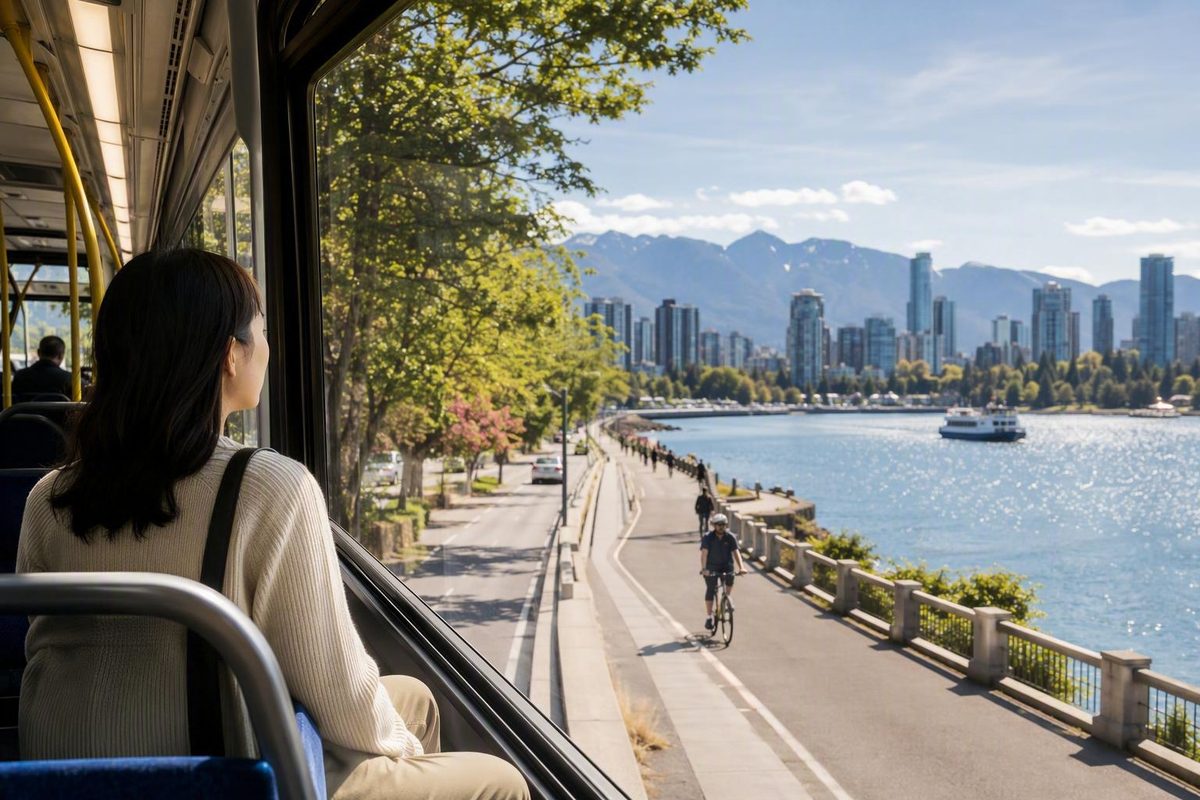
The extended R2 will be the simplest Park Royal-to-Metrotown option, but it is not yet proven to be the fastest. Allow roughly 50 to 80 minutes for the full one-seat ride. SeaBus plus the Expo Line may win when its connections align and bridge traffic is severe, especially from Lonsdale Quay, but no cited evidence establishes a consistent time advantage.
Choose your origin, destination and priority; the comparator shows where the R2 has a supported advantage and where travel-time evidence is still missing.
R2 Route and Transfer Comparator
The tool compares supported route structure, not unpublished travel times. The listed points include key existing R2 stops and all eight extension stops.
| Route Point | R2 Status | Rail Connection | SeaBus + Rail Alternative | Published Segment Time |
|---|---|---|---|---|
| Park Royal | Existing R2 | — | First connect to Lonsdale Quay | Full trip to Metrotown: ~50–80 min |
| Lonsdale Quay | Existing R2 | SeaBus | SeaBus to Waterfront; Expo Line to Metrotown | — |
| Phibbs Exchange | Existing R2 | — | No like-for-like direct rail alternative stated | 20%–30% projected saving to Metrotown; minutes — |
| Kootenay Loop | New stop | R5 connection | Rail does not directly serve this stop | — |
| Hastings at Gilmore | New stop | Selected R5 connection | Rail does not directly serve this stop | — |
| Hastings at Willingdon | New stop | Selected R5 connection | Rail does not directly serve this stop | — |
| Brentwood Town Centre | New stop | Millennium Line | Rail option requires additional connections from SeaBus | — |
| Willingdon at Goard Way / BCIT | New stop | — | Rail does not directly serve this stop | — |
| Willingdon at Moscrop | New stop | — | Rail does not directly serve this stop | — |
| Willingdon at Kingsway | New stop | — | Rail does not directly serve this stop | — |
| Metrotown Station | New terminus | Expo Line | Direct Expo Line destination from Waterfront | Park Royal origin: ~50–80 min by R2 |
Sources: TransLink R2 project and service-change material; reported pre-launch estimates from North Shore News and Daily Hive. “—” means the supplied evidence does not publish a figure.
The answer changes with the trip. From Park Royal, the R2 avoids the additional connection needed to reach the SeaBus. From Lonsdale Quay to Metrotown, SeaBus plus the Expo Line is a credible one-transfer alternative. For destinations on Hastings Street or Willingdon Avenue before Metrotown, the R2 generally has the structural advantage because it serves the corridor directly, while the downtown rail path requires backtracking or another local connection.
There is no evidenced stop at which one route becomes reliably faster in minutes. The geographic crossover is Metrotown, where the Expo Line directly serves the same destination as the R2. The time-based crossover will depend on bridge traffic, waits and the departure being compared.
Allow 50 to 80 Minutes for the Complete R2 Ride
North Shore News reported a 50-to-70-minute Park Royal-to-Metrotown estimate attributed to TransLink CEO Kevin Quinn. Read the North Shore News report.
Daily Hive separately reported an approximate 60-to-80-minute journey, varying by time of day, direction and traffic. See Daily Hive’s pre-launch estimate.
Together, those reports support a provisional 50-to-80-minute planning range. It is a synthesis of overlapping estimates, not an official timetable, observed average or guaranteed maximum. Both figures cover the entire route from Park Royal, not just the new Phibbs Exchange-to-Metrotown section.
TransLink confirms the route, stops, frequency and operating span but does not publish a final end-to-end duration in the cited project material. Check TransLink’s R2 Marine–Willingdon project page.
| Planning Question | Supported Answer |
|---|---|
| Park Royal to Metrotown | Roughly 50 to 80 minutes |
| Official timetable range | No |
| Guaranteed maximum | No |
| Phibbs to Metrotown duration | Not yet published in minutes |
| Transfer at Phibbs | Not required on the extended R2 |
Add a buffer for a work shift, class, medical appointment or reserved event. A delay after departure can push the trip beyond a pre-launch estimate.
The R2 Wins on Transfers, Not Yet on Proven Speed
The direct R2 requires no transfer between any two stops it serves. A passenger boarding at Park Royal, Lonsdale Quay or Phibbs Exchange can remain aboard for Burnaby Heights, Brentwood, BCIT or Metrotown.
The SeaBus comparison depends heavily on the North Shore starting point. From Lonsdale Quay to Metrotown, the basic alternative is SeaBus to Waterfront followed by the Expo Line, making one transfer. From Park Royal, the rider must first reach Lonsdale Quay, so the downtown route adds another connection before the SeaBus.
That does not prove the R2 is faster. Rail avoids traffic after Waterfront, while the R2 remains exposed to conditions around the Ironworkers Memorial Bridge, Hastings Street and Willingdon Avenue. Conversely, the R2 avoids transfer waits and the risk of arriving just after a connection departs.
A proper comparison needs door-to-door times for the same departure. That means counting the walk to transit, initial wait, every transfer, transfer waits and the final walk. No controlled comparison with all of those inputs appears in the supplied evidence.
Fare-zone totals are also not provided in the cited material. The exact fare should be checked for the travel date, payment method and time rather than inferred from the route alone.
Metrotown Is the Clearest Geographic Crossover
For a destination along Hastings Street or Willingdon Avenue, the extended R2 runs directly through the relevant corridor. Using SeaBus and SkyTrain would commonly leave the rider needing another connection or travelling beyond the most direct approach.
Brentwood Town Centre is an important intermediate case. The R2 directly serves the station and meets the Millennium Line there. A North Shore rider can therefore stay on one bus to Brentwood and transfer to rail only if the onward destination requires it.
At Metrotown, the routes finally converge on the same rail-served destination. The R2 meets the Expo Line at Metrotown Station, while the downtown alternative reaches Metrotown on that line from Waterfront. This is where SeaBus plus SkyTrain becomes the most coherent direct competitor.
The evidence does not identify a clock-time threshold at which the downtown path wins. It may do so when the SeaBus and Expo Line connect cleanly and the bridge corridor is badly congested. The R2 may win when it is due soon, road conditions are ordinary or an alternative connection involves a substantial wait.
For Park Royal riders, the extra trip to Lonsdale Quay weighs against the SeaBus option. For Lonsdale Quay riders, the comparison is closer because both choices begin at the same exchange: remain aboard the R2 or take SeaBus and transfer once at Waterfront.
Phibbs-to-Metrotown Is Projected to Be 20% to 30% Faster
TransLink projects a 20% to 30% reduction in travel time between Phibbs Exchange and Metrotown. CityNews reported that forecast with the extension announcement. See the CityNews report.
That percentage applies only to the new segment. It must be kept separate from the two complete-route estimates:
| Figure | What It Describes |
|---|---|
| 50 to 70 minutes | One reported estimate for Park Royal to Metrotown |
| Approximately 60 to 80 minutes | A separate estimate for Park Royal to Metrotown |
| 20% to 30% shorter | Projected Phibbs Exchange-to-Metrotown saving |
The available evidence gives no verified baseline or projected duration in minutes for Phibbs to Metrotown. Converting the percentage into minutes would require an established comparison time, route and operating conditions, none of which are supplied.
The extension also removes the mandatory transfer at Phibbs. These are separate benefits: the agency forecasts a shorter in-vehicle trip on the segment, while the through service eliminates a connection for riders arriving on the R2 from the North Shore.
Someone starting at Phibbs should not budget the full 50 to 80 minutes. That rider is joining partway through the route, but a supported minute figure will have to wait for the final timetable.
Eight New Stops Extend the R2 Through Burnaby
The service will be renamed the R2 Marine–Willingdon RapidBus and run continuously from Park Royal to Metrotown Station. It retains the existing North Shore section through Lonsdale Quay and Phibbs Exchange, serving major North Shore destinations before crossing the Ironworkers Memorial Bridge.
The eight extension stops are:
- Kootenay Loop
- Hastings Street at Gilmore Avenue
- Hastings Street at Willingdon Avenue
- Brentwood Town Centre Station
- Willingdon Avenue at Goard Way, near BCIT
- Willingdon Avenue at Moscrop Street
- Willingdon Avenue at Kingsway
- Metrotown Station
The route connects with the R5 Hastings Street RapidBus at Kootenay Loop and selected Hastings-area stops. It meets the Millennium Line at Brentwood and the Expo Line at Metrotown.
Temporary or existing stop locations may initially be used where permanent work is incomplete. Their effect on running time has not been established, but riders should check boarding locations near launch, particularly when accessible boarding is required.
Service Is Planned Every 6 to 7 Minutes at Peak Times
The extension is scheduled to begin Monday, September 7, 2026, after being moved forward from an early-2027 plan. Because the launch remains subject to operational changes, confirm it through TransLink’s fall service-change information before travelling.
| Period | Planned Service |
|---|---|
| Peak periods | Every 6 to 7 minutes |
| Off-peak periods | Approximately every 10 to 15 minutes |
| Daily span | Approximately 5 a.m. to 2 a.m. |
| Operating days | Seven days a week |
| Vehicle | 60-foot articulated buses |
These are planned intervals, not guarantees that every bus will arrive at an exact spacing. First and last departures will also vary by stop rather than occurring at precisely 5 a.m. and 2 a.m. everywhere.
Frequency strengthens the R2 comparison because waiting is part of total travel time. A direct bus arriving soon can beat a nominally faster itinerary with a poorly aligned connection. Near the beginning or end of service, the stop-specific timetable matters more than the general operating span.
The Extended R2 Replaces the 222, Not the 130
Route 222 Willingdon Express is planned to be discontinued when the extension launches. The R2 will replace the weekday peak-only service, serve its existing stops and add other stops along the corridor.
No equivalent-conditions running-time comparison between the old 222 and extended R2 is available. It is therefore unsupported to claim that every R2 trip will match a former 222 express trip minute for minute.
The clearer difference is availability. The 222 operates during weekday peaks, whereas the R2 is planned to run all day, seven days a week, with through service to the North Shore.
Route 130 will continue as a local service, although most trips are planned to begin or end at Kootenay Loop. During the weekday morning peak from 6 to 9 a.m. and afternoon peak from 3 to 6 p.m., the 130 is planned to run approximately every 10 minutes between Metrotown and Kootenay Loop. Read TransLink’s extension announcement.
The 130 may remain more convenient for some local journeys. For Park Royal-to-Metrotown travel, neither a 130 nor 222 transfer should be required after the R2 extension begins.
Mixed Traffic Keeps the Fastest Route Unsettled
The announced project does not include new bus-priority or HOV lanes in Burnaby. The R2 will operate in mixed or congested traffic on at least part of the corridor.
Reported sources of variation include time of day, travel direction, traffic around the Ironworkers Memorial Bridge and congestion on Hastings Street or Willingdon Avenue. Conditions can change during one trip, and congestion is not necessarily equal in both directions.
That exposure prevents a pre-launch declaration that the R2 will always beat SeaBus and SkyTrain. It also does not establish that the service will be unreliable. Representative peak, off-peak and direction-specific observations will be needed after operations begin.
A rider who values fewer transfers may prefer the R2 even when another route could be marginally faster. That advantage is especially relevant with luggage, a stroller or mobility considerations. A rider making a time-sensitive trip should compare live options for the same departure and consider travel through Downtown Vancouver followed by SkyTrain when a major bridge delay affects the bus corridor.
The 23-Minute Figure Does Not Apply to RapidBus
The R2 is not expected to travel from Park Royal to Metrotown in 23 minutes. That figure concerns a hypothetical North Shore-to-Metrotown SkyTrain concept, not the September 2026 RapidBus extension. Future BRT, LRT or rail concepts are separate projects. See the coverage distinguishing RapidBus from the rail concept.
For the extended R2, the supported pre-launch planning envelope remains roughly 50 to 80 minutes for the complete Park Royal-to-Metrotown ride. After launch, the official timetable and representative observed trips should replace that broad range.