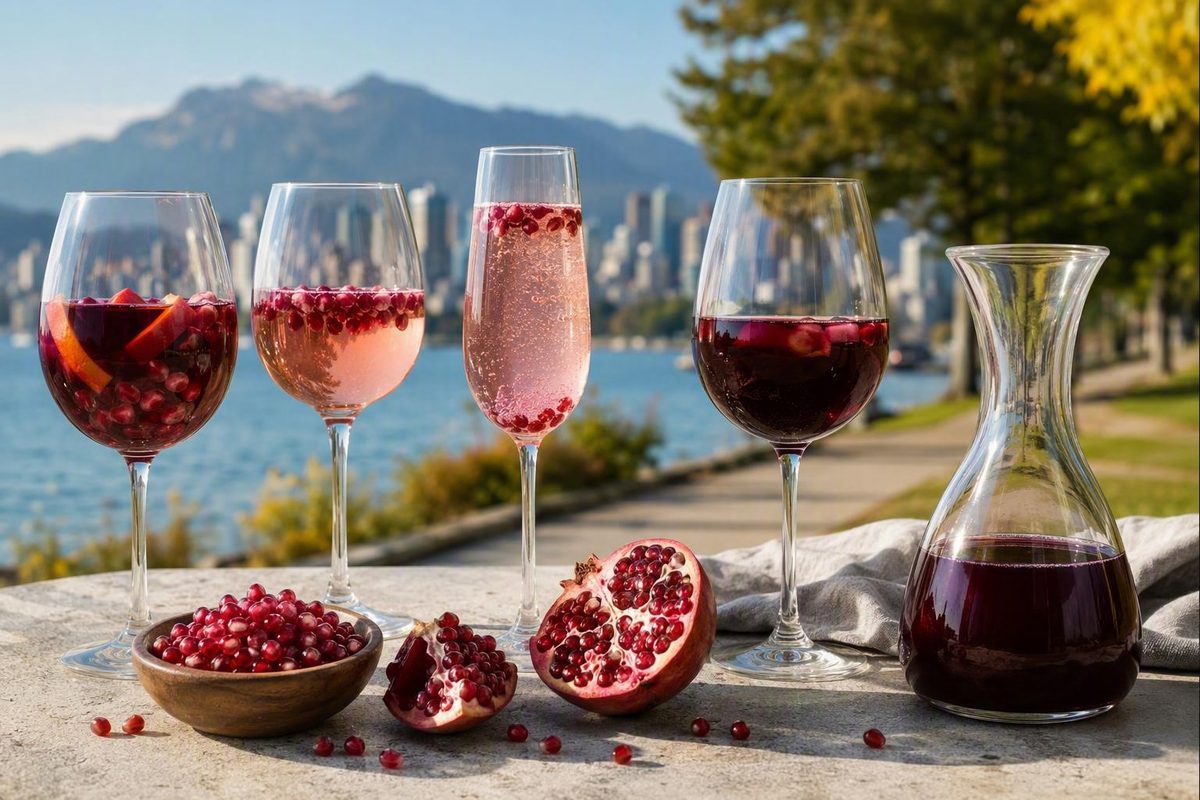
Four Ways to Bring Pomegranate Into Your Wine Glass
One 750 ml bottle with two cups of juice appears in multiple documented mulled-wine recipes. Compare that mix with sangria, sparkling drinks and fruit wine.

Pomegranate and wine can describe four distinctly different drinks: warm mulled wine, chilled sangria, a sparkling wine cocktail, or fruit wine made by fermenting a pomegranate-based must.
The mixed drinks begin with finished grape wine and take anywhere from a few minutes to assemble to at least 24 hours of chilling, depending on the recipe. Fermented pomegranate wine is a longer project involving yeast, primary and secondary fermentation, sediment removal, clearing, bottling, and aging.
Before choosing a bottle or buying ingredients, decide which experience you want.
First, Decide What You Mean by Pomegranate and Wine
Use this four-option guide as a starting point:
- Choose mulled wine for a warm, sweetly spiced drink.
- Choose sangria for a chilled, make-ahead punch that serves a group.
- Choose a sparkling variation for a cold, bubbly serve.
- Choose pomegranate fruit wine when you want a beverage in which pomegranate itself has been fermented.
The first three options start with finished grape wine. Depending on the recipe, you add pomegranate juice, sweetener, spices, citrus, spirits, or sparkling wine. Preparation can be quick, although chilling or gentle heating adds time.
True pomegranate wine is operationally different. It starts with a pomegranate-based must that undergoes fermentation. Documented home methods include primary fermentation, transfer into a secondary vessel, racking away from sediment, clearing, bottling, and aging. It is a winemaking project rather than a cocktail recipe.
Commercial bottles must be assessed individually. Casa de Fruta, for example, says its fruit wine contains pomegranate without grapes or fillers. That is a seller-provided fact about one product, not a definition that applies to the whole category. Separately, some documented home recipes add white grapes or white grape concentrate.
Wine suggestions also need to be kept in perspective. When a recipe author recommends Merlot, Shiraz, Zinfandel, Chianti, or Rioja, that is a practical preference—not evidence that the variety won a controlled comparison. Food pairings are likewise starting points rather than universal rules.
All versions made with alcoholic wine or spirits remain alcoholic. Warming wine gently and avoiding a boil may help preserve the intended flavor and texture, but it does not demonstrate that the alcohol has been removed. For strict zero-alcohol service, begin with juice and water or a base verified on its label as 0.0% ABV.
A Simple Pomegranate Mulled Wine Formula
A straightforward mulled version uses five ingredients:
- 1 bottle red wine
- 2 cups pomegranate juice
- 1/4 cup honey
- 1 cinnamon stick
- 1 teaspoon whole cloves
These quantities and the method below come from Food52’s honey-pomegranate mulled wine recipe.
- Combine the wine, pomegranate juice, honey, cinnamon, and cloves in a large heavy pot or slow cooker.
- Stir thoroughly to dissolve the honey.
- Warm the mixture slowly over low heat.
- Do not bring it to a boil.
- Serve warm in mugs or thick, heat-safe glasses.
The proportion of one 750-millilitre bottle of wine to two cups of pomegranate juice appears in more than one documented mulled-wine recipe. That makes it a useful recipe convention, not a scientifically tested optimum. Juice varies in sweetness and acidity, while wine varies in body, tannin, fruit character, and residual sugar.
For better sweetness control, begin with a dry red and treat the honey as adjustable. If the juice tastes particularly sweet, start with less honey. Once the mixture is warm and the honey has dissolved, taste carefully before adding more. Correcting an overly sweet batch is harder than increasing sweetness gradually.
A richer variation
For a more elaborate batch, Family Spice’s pomegranate mulled-wine recipe uses:
- 750 millilitres red wine
- 2 cups pomegranate juice
- 1/2 cup brandy
- 1/2 cup pomegranate arils
- 1/4 cup granulated sugar
- 1 sliced orange
- 2 cinnamon sticks
- 4 whole cloves
- 6 cardamom pods
The recipe lists 5 minutes of preparation, 30 minutes of cooking, and 11 servings. It directs the cook to warm the wine, juice, brandy, and sugar over medium-low heat until the sugar dissolves. The fruit and spices are then added, and the mixture continues cooking without boiling.
Remove loose cloves and cardamom pods before serving. An appropriate food-safe spice infuser or tied spice cloth can simplify removal, but whole spices can also be strained out before the drink is poured.
This variation has more balancing elements than the basic formula. Brandy contributes alcohol and flavor, orange adds citrus, arils reinforce the fruit character, and cardamom makes the spice profile more aromatic. Because the wine, juice, orange, and sugar all affect perceived sweetness, taste the components before increasing the sugar.
The same recipe permits slow-cooker preparation. Heat the mixture on low, then keep it on low or warm during service. The aim is to maintain a warm drink, not a vigorous simmer.
If you replenish a batch during a gathering, add wine, juice, and sweetener deliberately rather than topping it up with whichever ingredient is closest. Otherwise, the later servings may be markedly sweeter, weaker, or more alcoholic than the first.
Do not assign an improvised “alcohol-free” point or unsupported target temperature to either recipe. “Do not boil” is a preparation instruction, not a validated alcohol-removal process.
Choosing Wine Without Making the Drink Too Sweet
For most sweetened pomegranate drinks, start with a dry, fruit-forward wine. That leaves room for sweetness from pomegranate juice, honey, sugar, simple syrup, citrus juice, or liqueur.
This matters particularly when a recipe includes brandy or triple sec. Not every spirit tastes sweet, but the complete formula can accumulate sweetness quickly. Judge the finished mixture rather than classifying it solely by the base wine.
Documented recipe suggestions include:
- Zinfandel, Cabernet, and Merlot for the basic mulled version
- Merlot or Shiraz for the richer spiced version
- Chianti or Rioja for pomegranate sangria
These are recipe-author recommendations, not results from side-by-side controlled tastings. No grape or region can be declared universally best from the available evidence.
A practical buying rule is:
Choose a dry red with clear fruit character, then adjust the sweetener only after accounting for the pomegranate juice, citrus, spirits, and liqueurs in the complete recipe.
A very tannic or heavily oaked wine may remain forceful after juice and spices are added. A delicate wine may disappear beneath cloves, citrus, and brandy. Neither style is automatically unusable, but an affordable, fruit-forward red is usually easier to balance.
Wine served alongside pomegranate food requires a different decision. Fresh arils in salads, hummus, guacamole, curry, or goat-cheese bruschetta may suit a bright white, skin-contact white, or very light red. For richer or spicier dishes made with concentrated pomegranate flavors, chef Josef Centeno recommends moving toward a fuller-bodied wine, according to Wine Enthusiast’s pomegranate pairing guide.
That is advice for wine served with food. It does not automatically identify the best wine for a cocktail containing pomegranate juice, sugar, spices, and spirits.
Buying checklist
Before choosing a bottle, ask:
- Dry or sweet? Dry wine generally leaves more room for adjustment.
- Still or sparkling? The documented hot and cold recipes use still red wine as the base; sparkling wine appears as a finishing ingredient in the bubbly cocktail.
- Light or full-bodied? Choose enough body to remain present beside the juice and spices without making the mixture harsh.
- Are spirits being added? Brandy and liqueur affect flavor, alcohol, and overall balance.
- How sweet is the juice? Taste it rather than assuming all brands or batches are equivalent.
- Will food be served? Consider the weight, sweetness, fat, and spice of the complete menu.
Cold Options: Sparkling Cocktail and Make-Ahead Sangria
Pomegranate and wine does not have to be warm. Two documented cold formats are a sparkling red-wine cocktail and a fortified, make-ahead sangria.
Sparkling cocktail for eight
The Savory pomegranate-red wine cocktail lists eight servings, 5 minutes of preparation, and 120 minutes of chilling, using:
- 3/4 cup pomegranate juice
- 1 tablespoon sugar
- 1 750-millilitre bottle fruity dry red wine
- A pinch of ground cinnamon
- A pinch of ground cloves
- Ice
- Dry sparkling white wine, added to taste
Stir the pomegranate juice and sugar together in a pitcher until the sugar dissolves. Add the red wine, cinnamon, and cloves, then refrigerate the mixture for two hours. Pour it over ice and top each serving with sparkling wine.
Because the sparkling wine is added “to taste,” the exact quantity used is not fixed. The final volume and alcohol per serving therefore cannot be calculated reliably from the recipe as written.
Use genuinely small pinches of the ground spices. Stir the pitcher before serving so settled spice and juice are redistributed, and add the sparkling wine close to service to preserve its bubbles.
Make-ahead sangria for twelve
Mary DiSomma’s pomegranate red-wine sangria yields twelve 8-ounce servings and uses:
- 2 bottles Spanish red table wine
- 1 cup brandy
- 1/2 cup triple sec
- 1 cup orange juice
- 1 cup pomegranate juice
- 1/2 cup simple syrup, or more to taste
Combine the liquid ingredients, cover the container tightly, and refrigerate for at least 24 hours. Add the fruit garnish before serving. Suggested—not mandatory—garnishes include:
- Orange slices
- Apple slices
- Blackberries
- Pomegranate arils
The author recommends Chianti or Rioja. Treat the instruction to add more syrup conservatively: the recipe already includes orange juice, pomegranate juice, triple sec, and simple syrup. Taste the rested mixture before increasing the sweetness.
| Feature | Sparkling cocktail | Fortified sangria |
|---|---|---|
| Stated yield | 8 servings | Twelve 8-ounce servings |
| Base | 1 bottle fruity dry red wine | 2 bottles Spanish red table wine |
| Pomegranate juice | 3/4 cup | 1 cup |
| Other alcohol | Sparkling wine to taste | 1 cup brandy and 1/2 cup triple sec |
| Sweetener | 1 tablespoon sugar | 1/2 cup simple syrup or more to taste |
| Advance time | 2-hour chill | At least 24 hours |
| Service | Over ice, topped with sparkling wine | Chilled, with optional fruit garnish |
| Style | Bubbly and comparatively lighter-feeling | Larger and more heavily fortified |
The sangria contains substantial added spirits, but its recipe does not provide a verified alcohol or sugar calculation per serving. Serve measured portions and tell guests that brandy and triple sec have been added. Juice, fruit, ice, and sparkling wine may dilute a drink, but they do not make it nonalcoholic.
Serving, Make-Ahead Planning, and a Genuine Zero-Proof Route
The basic mulled drink can be prepared on the stovetop or in a slow cooker. A heavy pot gives direct control over a smaller batch, while a slow cooker is convenient for keeping the drink warm during service.
Family Spice says its richer mulled version can be made ahead and reheated without boiling. The author also says leftovers from that particular recipe may be refrigerated in an airtight container for up to five days or frozen in a suitable container for up to four months. Those are recipe-specific storage directions, not universal rules for every mixture of wine, juice, spirits, and fresh fruit.
Freezing may affect flavor or texture; the source does not establish that the drink will emerge unchanged.
For hot service, use mugs or thick glasses designed for hot liquids, and remove loose whole spices before pouring. For cold cocktails, use a pitcher or beverage vessel with enough room for stirring. Adding ice to individual glasses rather than the main pitcher avoids progressively diluting the whole batch. Add sparkling wine near serving time.
For a strict zero-alcohol drink, start without alcoholic wine.
A practical framework is:
- Use pomegranate juice as the fruit base.
- Dilute it to taste with water or a wine alternative verified as 0.0% ABV.
- Add sliced orange or a restrained quantity of orange juice.
- Season with cinnamon and cloves, with optional cardamom.
- Warm gently for a mulled drink, or chill and serve over ice.
- Adjust sweetness only after tasting the complete mixture.
This is a framework, not a validated flavor match for mulled wine. The documented nonalcoholic adaptation suggests diluted pomegranate juice and spices but does not provide tested proportions. Water will produce a simpler fruit drink; a verified 0.0% wine alternative may provide more wine-like acidity or structure, depending on the product.
For strict avoidance, check the exact alcohol statement and ingredient panel on every base, extract, syrup, and flavoring.
For alcoholic versions, disclose added spirits, serve responsibly, and provide water and zero-alcohol alternatives. This article cannot determine whether any drink is appropriate in circumstances involving pregnancy, children, driving, medications, or medical alcohol avoidance.
True Pomegranate Wine Is a Different Product
True pomegranate wine begins with a pomegranate-based must that undergoes fermentation. It is not simply finished grape wine mixed with pomegranate juice.
Casa de Fruta provides one commercial example. The seller says its pomegranate fruit wine contains no grapes or fillers and lists it at 12% alcohol on the product page. The seller also describes the bottle as sweet, smooth, and slightly tart, but those are product-specific promotional tasting notes rather than characteristics of all pomegranate wine.
Some documented home methods use pomegranate with added sugar and yeast, while others add white grapes or white grape concentrate. Those home-recipe practices do not establish what unrelated commercial producers use.
Finished style depends on the fruit and process. Sweetness can vary with the initial sugar level, yeast performance, fermentation endpoint, stabilization, and later sweetening. Acidity and alcohol likewise depend on the must and fermentation rather than on the word “pomegranate.”
It is therefore too broad to claim that pomegranate wine is always dry, always sweet, always low in alcohol, or always grape-free. Unsupported antioxidant comparisons and health claims should not be used to justify drinking it. Seller-hosted ratings and reviews also do not independently establish quality.
When buying a bottle, check:
- Fruit base: Is pomegranate the only named fruit?
- Grape-derived additions: Does the producer mention grape juice, concentrate, or blending wine?
- Sweetness: Is the bottle described as dry, off-dry, sweet, or dessert-style?
- Alcohol content: What percentage appears on the label?
- Format: Is it still, sparkling, fortified, or dessert-oriented?
- Tasting notes: Are they clearly specific to that product?
- Serving suggestion: Does the producer recommend chilling it, serving it with food, or using it in cocktails?
If these details are missing, do not infer them from color alone. Two ruby-colored fruit wines can differ substantially in sweetness, acidity, body, and alcohol.
Homemade Pomegranate Wine: Methods, Timeline, and Safety Boundaries
Home pomegranate wine is a multi-stage fermentation project, not juice left on a counter. The available evidence here consists mainly of home-recipe blogs, a winemaking retailer, and a proprietary fermentation seller—not university-extension or regulatory guidance.
Accordingly, this section is a non-instructional process overview, not a complete safety or stabilization manual. Before making wine, choose one complete, reputable method and obtain qualified guidance appropriate to your equipment and location. Do not combine additive quantities or bottling checkpoints from unrelated recipes.
Route one: bottled pomegranate juice
A documented one-gallon juice method lists:
- 96 ounces pomegranate juice
- 2 pounds sugar
- Yeast nutrient or raisins
- Tannin powder or strong black tea
- Acid blend or lemon juice
- Wine yeast
- Water as needed
The Practical Self Reliance recipe dissolves sugar in part of the juice, cools the mixture, combines the remaining ingredients, and ferments under an airlock. However, the recipe presents unresolved questions: it includes an acid addition while describing pomegranate as already acidic, and its formal ingredient list does not clearly define the yeast quantity. Those gaps are reasons to consult a complete and internally consistent method rather than guess.
The juice route reduces fruit preparation. If the selected method calls for pure pomegranate juice, use its ingredient requirements rather than substituting a juice blend without evaluating how that changes the recipe.
Route two: fresh pomegranates
One retailer’s approximately one-gallon fresh-fruit formula lists:
- 6 pomegranates
- 96 ounces water
- 2.75 pounds sugar
- 8 ounces white grape concentrate
- Acid blend
- Pectic enzyme
- Yeast nutrient
- Tannin
- 1 Campden tablet
- Lalvin EC-1118 wine yeast
The complete Northeast Winemaking method removes the peel and yellow skin, extracts juice through a straining bag, prepares the must, waits before adding yeast, and moves through primary and secondary fermentation. It also identifies the required equipment and method-specific handling steps.
A separate fresh-fruit formula uses six pomegranates, 4.5 litres of water, 250 millilitres of white grape concentrate, 800 grams of sugar, several winemaking additives, a Campden tablet, and wine yeast. Its author directs makers to discard the pale pith and retain the arils and seeds for the method.
The substantial differences between these formulas illustrate why they should not be blended casually. Sugar, water, acid, tannin, enzyme, nutrient, yeast, and stabilization instructions form part of a complete process, not a menu of interchangeable additions.
Basic equipment
Recurring equipment across the documented conventional methods includes:
- A primary fermenter
- A food-safe straining bag
- A hydrometer
- A siphon
- A one-gallon carboy or jug
- A fitted bung
- An airlock
- A stirring spoon
- Suitable bottles and closures
A hydrometer measures specific gravity. Comparing a reliable starting reading with later readings can help track changes during fermentation and estimate alcohol. An exact alcohol percentage cannot be stated without dependable starting and final measurements.
Recurring production stages
Although details differ, the documented methods generally include:
- Preparing equipment according to the chosen method’s sanitation procedure.
- Preparing the fruit or measuring the juice.
- Building the must with only the ingredients specified by that method.
- Adding yeast at the stated stage.
- Conducting primary fermentation.
- Transferring the wine into a secondary vessel fitted with an airlock.
- Monitoring progress, including method-specific hydrometer readings.
- Racking the wine away from sediment.
- Following complete stabilization instructions, if stabilization is part of the method.
- Allowing the wine to clear.
- Assessing fermentation status before bottling.
- Bottling and aging according to the selected procedure.
This sequence is descriptive, not sufficient instruction for safely completing a batch. The supplied sources do not provide authoritative, universally applicable dosing or bottling standards.
Active fermentation is not the complete timeline
The juice-based Practical Self Reliance method calls for two weeks of primary fermentation, followed by another four to eight weeks after racking and subsequent bottle aging. The author prefers several months of aging, but that is method-specific guidance.
A separate fresh-pomegranate method from Home Brew Answers keeps the wine with the fruit for about five to seven days, then transfers it to a secondary vessel and leaves it for at least two months or until clear before bottling. Its suggestion that the wine may improve toward one year is an author preference rather than a universal requirement.
Elapsed time alone does not prove that fermentation has ended. The available methods use process observations and, in some cases, specific-gravity readings. A calendar date or a dry taste should not be treated as sufficient evidence that a wine is ready to seal in bottles.
Pressure, oxygen, stabilization, and bottling
Active fermentation produces carbon dioxide. Brewsy’s commercial pomegranate-wine instructions specifically warn against tightly fastening a cap because pressure may build dangerously. That warning is one reason to follow the vessel and airlock requirements of a complete method rather than improvising with a sealed container.
During secondary fermentation, the Northeast Winemaking method recommends a fitted airlock and limited headspace to reduce oxygen exposure. Because that advice comes from a retailer’s recipe rather than an authoritative safety standard, follow the complete selected method and seek qualified guidance instead of treating one headspace measurement as universal.
Do not invent doses for sulfite, sorbate, acid blend, nutrient, tannin, or enzyme. One supplied method mentions potassium metabisulfite and potassium sorbate but does not provide all necessary quantities in the available text. That is not enough information to support a universal stabilization formula.
Similarly, no supplied evidence establishes that a proprietary seven-day process reliably produces stable, bottle-ready wine. Active fermentation, clearing, stability assessment, racking, bottling, and maturation are separate considerations.
The conservative boundary is simple: use one complete method, do not seal visibly active fermentation in an unsuitable container, do not guess additive doses, and do not bottle solely because a stated number of days has passed. For procedural safety beyond this overview, consult a vetted winemaking manual or qualified local winemaking resource.
Food Pairings Based on Tartness, Sweetness, and Weight
Pair the complete preparation, not the word “pomegranate.” Fresh arils in a salad create a different context from concentrated pomegranate glaze on lamb, sweet mulled wine, fortified sangria, or dry fermented fruit wine.
Consider:
- Sweetness
- Acidity
- Body
- Spice
- Alcohol
- Fat and protein
- The overall weight of the food
Fresh arils in salads, hummus, guacamole, curry, or goat-cheese bruschetta create a bright tart-sweet accent. A cited expert recommendation points toward bright white wine, skin-contact white wine, or a very light red. This is a flexible direction, not a universal rule.
Pomegranate molasses or glaze is more concentrated and often appears in richer dishes. Those preparations may support a fuller-bodied wine, particularly when meat, fat, sweetness, or substantial spice is involved. One wine writer specifically recommends fruity Grenache with pomegranate-glazed lamb and lamb koftas served with pomegranate in a red-wine pairing guide.
Mulled wine already contains sweetness and assertive spice. Rather than assuming a particular pairing is proven, compare the drink’s actual sweetness and spice intensity with the food. Delicate dishes may be overwhelmed, while rich or equally sweet foods can make the combination feel heavy.
The documented sangria author suggests empanadas, steak, sausage and peppers, and seafood paella. These are the author’s serving preferences, not independently verified matches, but they illustrate the kind of substantial food that may accompany a punch containing wine, juice, brandy, and liqueur.
Casa de Fruta suggests couscous and curry with its own sweet, slightly tart pomegranate wine. Those recommendations apply to that seller’s product description; they do not establish pairings for every pomegranate wine.
| Pomegranate preparation | Starting direction | Why it may work | Qualification |
|---|---|---|---|
| Fresh arils in salads or appetizers | Bright white, skin-contact white, or very light red | Maintains a light, fresh overall profile | Dressing, cheese, spice, and sweetness still matter |
| Pomegranate molasses or glaze | Fuller-bodied or fruit-forward wine; Grenache is one suggested option for lamb | Concentrated fruit and rich food can support greater body | Adjust for meat, sugar, fat, and spice |
| Mulled pomegranate wine | Compare the food directly with the drink’s sweetness and spice | Prevents one element from overwhelming the other | No universal pairing is established |
| Pomegranate sangria | Empanadas, steak, sausage and peppers, or seafood paella | Substantial foods may stand beside a fruity, fortified punch | These are recipe-author suggestions |
| Fermented pomegranate wine | Match only after checking the bottle’s style | The category may include dry, sweet, light, sparkling, or dessert-oriented wines | Read the label and taste before committing |
The most useful general rule is that lighter, brighter pomegranate preparations tend to suit lighter wines, while richer, sweeter, or spicier preparations can support more body. Individual recipes, bottles, and preferences still vary.
The original four-way decision remains the best guide: make mulled wine for a warm, spiced serve; choose sangria or a sparkling cocktail for a chilled gathering; buy pomegranate fruit wine to explore a genuinely fermented product; or approach home fermentation as a measured, multi-stage project rather than a quick kitchen recipe.
Dry wine offers more control over sweetness. Heated wine remains alcoholic. Pairings depend on the complete dish and drink. Home winemaking requires a complete method, appropriate equipment, reliable observations, and qualified safety guidance—not speed or guesswork.
What red wine is best with pomegranate juice?
There is no proven single best red wine. Recipe authors suggest Zinfandel, Cabernet, Merlot, Shiraz, Chianti, and Rioja.
For most mulled drinks and sangrias, a dry, fruit-forward red is a practical starting point because it leaves room for pomegranate juice and added sweetener. Consider the whole formula, including honey, sugar, syrup, brandy, citrus, and liqueur, rather than choosing solely by grape name.
What ratio of pomegranate juice to wine should I use?
For mulled wine, a recurring starting formula is one 750-millilitre bottle of red wine to two cups of pomegranate juice, as shown in the Food52 recipe. It is a convenient convention rather than a tested optimum.
For a colder, more wine-forward cocktail, the documented sparkling recipe uses 3/4 cup of juice per 750-millilitre bottle of red wine. Choose the ratio for the specific recipe, then consider the wine’s dryness, the juice’s sweetness, and any added sugar or spirits.
Does heating mulled wine remove the alcohol?
No. Gentle heating does not establish that all alcohol has been removed. Avoiding a boil is a preparation instruction, not a validated way to make wine zero-proof.
For strict zero-alcohol service, start with pomegranate juice and water or a base verified as 0.0% ABV. Do not rely on heating an alcoholic bottle.
Is pomegranate wine made from grapes?
Sometimes, but not always. Casa de Fruta says its own pomegranate wine contains no grapes or fillers. By contrast, several documented home methods add white grapes, grape juice, or grape concentrate.
Read the producer’s fruit-base and ingredient information rather than assuming every pomegranate wine follows the same method.
How long does homemade pomegranate wine take?
Expect weeks to months, not merely a few days. One documented juice method calls for two weeks in primary fermentation, another four to eight weeks after racking, and additional bottle aging. A fresh-fruit recipe uses approximately five to seven days with the fruit, followed by at least two months of clearing and optional longer aging.
These are recipe-specific schedules, not proof that fermentation ends on a particular day. Use a complete method and appropriate measurements to assess progress, and obtain qualified guidance before stabilization or bottling.