
Broadway Is Still Open to Car-Free Visitors
Walkers and transit riders can still reach West Broadway storefronts during the Cambie-to-Alberta road closure. Pick your route before leaving.
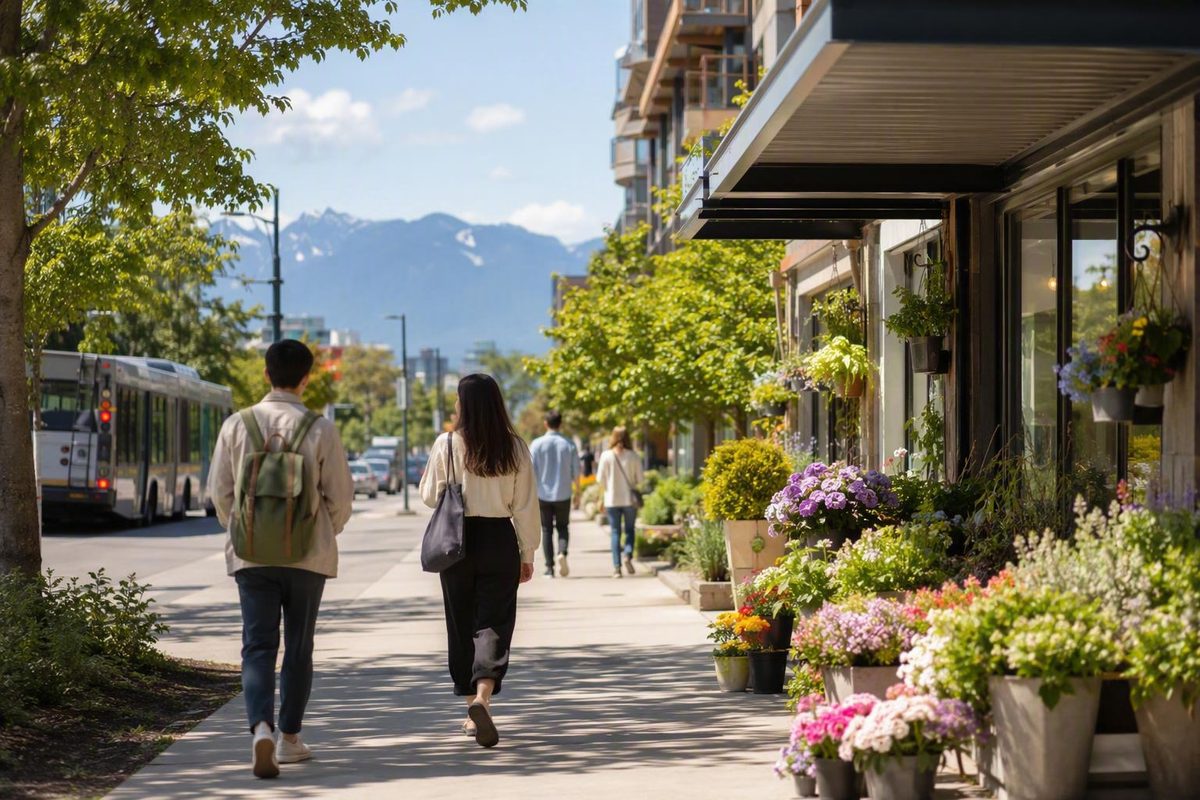
Car-free visitors can still reach every business along the West Broadway vehicle closure between Cambie and Alberta: sidewalks remain open while traffic detours to West 8th Avenue. The sharpest reported business decline—40 percent at Exit Escape—was attributed by its owner to lost parking and visibility, not the loss of pedestrian access (Business in Vancouver). For someone arriving on foot or by transit, this is an underrated time to make Broadway a destination rather than a corridor to avoid.
The closure began July 20, 2026 and was expected to last approximately six months, suggesting a reopening around January 2027 rather than guaranteeing one. The road is closed to vehicles, not visitors. Conditions can change quickly, so confirm a business’s hours, entrance and any accessibility requirements before making a special trip.
Why The Avoid-Broadway Advice Sounds Reasonable
The received view is not baseless. Construction fencing reduces storefront visibility. Familiar crossings and bus stops can move. Noise, dust and indirect approaches make a technically open business less inviting. Drivers face lost curb parking, detours and unclear pickup points.
Businesses are experiencing real harm. Exit Escape owner Rohit Jain estimated that business fell 40 percent within roughly a week and a half of the Cambie-to-Alberta closure and discussed reducing staffing from five employees to three. His comparison was with the preceding month or two, rather than a pre-construction baseline (Business in Vancouver).
Artigiano Coffee at 111 West Broadway closed in 2025 after construction eliminated parking and street visibility, according to the same report. Pizza 2 Pakora owner Neena Gill said limited parking deterred both customers and ride-hail drivers.
Enforcement figures reinforce the difficulty for motorists. Traffic-violation tickets rose from 13 in the week before the July 20 closure to 54 in its first week. Avoiding the closed segment is therefore sensible advice for through-drivers.
The consensus is also right about the limits of “open.” Fencing can obscure an entrance, and a familiar crossing may be unavailable. An open sidewalk does not establish that a temporary route will suit every wheelchair, mobility device, stroller or person with limited vision. Storefront-level accessibility requires direct confirmation.
What does not follow is that walkers and transit riders should avoid Broadway altogether. Their destination remains reachable, and the very businesses losing casual customers have a stronger need for intentional visits.
The Closure Removes Cars, Not Storefront Access
West Broadway is closed to vehicles between Cambie and Alberta. Local traffic and affected buses detour via Alberta Street, West 8th Avenue and Cambie Street. Pedestrians and residents retain access to businesses throughout the closure, according to the Vancouver Sun’s closure report.
The work supports removal of the temporary traffic deck and completion of work above Broadway–City Hall Station. Plans included removing 133 road-deck panels, backfilling above the station, installing or relocating permanent utilities and rebuilding the road. Reported work hours were 6 a.m. to 10 p.m., Monday through Saturday, with some overnight activity expected. Those are forecast windows, not a promise of identical conditions every day.
Sidewalks remain open, but crossings near Cambie, Yukon, Alberta and West 8th Avenue may be altered or temporarily closed during particular phases. You may be able to walk along a block without crossing Broadway at the point you normally use.
That distinction scopes the case for visiting. A person who can walk from the Canada Line or a bus stop loses no storefront access, but may face an indirect final block. A driver loses the direct Broadway approach and should use the West 8th Avenue detour, then park or arrange a drop-off outside the closure.
Choose how you will arrive; the route, accessible blocks and likely friction update below.
How You’ll Reach Broadway
Pick an arrival mode for the Cambie-to-Alberta closure. The table keeps the full corridor comparison visible.
“Open on foot” means pedestrian access is maintained; crossings and individual accessibility conditions can still change.
| Station Area | Road Condition | On Foot | Check Before Arrival |
|---|---|---|---|
| Broadway–City Hall | Cambie–Alberta closed; vehicles detour via West 8th | All blocks open | Crossing, side of street, entrance |
| Mount Pleasant | Four lanes reopened; intermittent work possible | Access continues | Frontage and curb restrictions |
| Oak–VGH | One lane each direction | Routes reported open | Appointment entrance, crossing |
| South Granville | One lane each direction intended | Access maintained | Turns, stops, crossing |
| Arbutus | One lane each direction, Burrard–Arbutus | Access maintained | Lane pattern, entrance |
Sources: Vancouver Sun closure notice; Business in Vancouver merchant report; Broadway Subway Project visitor and current-work information. Conditions are not live; verify official notices and the business’s entrance.
Transit And Walking Are The Predictable Options
The Canada Line serves Broadway–City Hall, while the #9 local bus and #99 B-Line continue operating during construction. Affected buses around the closed segment use West 8th Avenue, and stops can move. Check TransLink’s Trip Planner immediately before departure rather than relying on a stop used weeks earlier.
For the final block, determine which side of Broadway contains the business and find the current marked crossing. Check the return stop too: its location may not mirror the outbound stop during a detour.
Walking is similarly direct once you are on the correct side. Project information says sidewalks remain open and eight pedestrian bridges have been built at station sites to maintain access to shops and services. Business wayfinding is used around construction areas (Broadway Subway Project visitor information). Temporary signs and construction personnel override a familiar route.
This does not mean transit or walking is automatically easier for every person or trip. Driving may remain necessary for mobility needs, children, large purchases or medical visits. The narrower claim is that the vehicle closure does not remove the access on which a car-free visit depends.
Cyclists should confirm where they can legally secure a bicycle, since an otherwise workable route does not guarantee that a rack beside the destination is available. City information says local access is maintained around the 10th Avenue and Ontario Street bike-route area, but current traffic controls remain the authority.
Drivers Need A Final-Block Plan
Do not plan on direct curb access between Cambie and Alberta. Choose parking, loading or a drop-off outside the closure before entering the area, and expect to walk the last section.
The project reports more than 6,000 public parking spaces within two blocks of Broadway. That is a corridor-wide count, not a guarantee of an available or convenient space by one storefront. The current station-area parking and access maps show public parking and loading options, but posted signs govern when you arrive.
Free two-hour parking has also been reported on Broadway between Ontario and Columbia during traffic-deck removal. It is location-specific and time-sensitive, so verify the signs rather than treating it as a corridor-wide offer.
Taxi and ride-hail drivers may be unable or unwilling to stop at the usual Broadway curb. Ask the business which adjacent street or loading point currently works, and do not request a stop in a bus zone, construction entrance or posted no-stopping area.
The jump from 13 traffic tickets before the closure to 54 afterward illustrates why improvising is costly. It does not prove that every ticket resulted from construction, but it does show that motorists experienced substantially more conflict with the changed traffic pattern (Business in Vancouver).
Conditions Differ Beyond Broadway–City Hall
The six-month vehicle closure applies to the Cambie-to-Alberta segment, not the whole Broadway corridor. Other station areas remain accessible under different road arrangements.
| Station Area | Vehicle Condition | Pedestrian Status | Verify That Day |
|---|---|---|---|
| Broadway–City Hall | Closed Cambie–Alberta; West 8th detour | Sidewalks open; crossings can change | Side, crossing, entrance |
| Mount Pleasant | Four lanes reopened; intermittent work possible | Access continues | Frontage and curb restrictions |
| Oak–VGH | One lane each direction | Oak/Broadway routes reported open | Crossing and appointment entrance |
| South Granville | One lane each direction intended | Sidewalk access maintained | Turns, stops and crossing |
| Arbutus | One lane each direction, Burrard–Arbutus | Access maintained | Lane pattern and entrance |
All four lanes on East Broadway between Quebec and Main reopened on June 25, 2026, although intermittent closures may still occur for finishing work and streetscape restoration. That makes Mount Pleasant more straightforward than it was during the full closure, without restoring every pre-construction curb condition (current-work notices).
At Oak–VGH, road reconstruction and traffic-deck removal reduce Broadway to one lane in each direction. Medical and service appointments warrant extra time for congestion, the final walk and locating the correct building entrance.
South Granville is intended to retain one lane in each direction during traffic-deck removal. Broadway is likewise reduced to one lane each way between Burrard and Arbutus. These are capacity and curb-access problems, not blanket pedestrian closures.
The Reported Losses Point To Parking And Visibility
The evidence does not establish that all businesses or all types of customer are affected equally. It does show why a deliberate car-free visit can reach merchants who have lost spontaneous motorists.
Exit Escape, at 309 West Broadway, remained physically accessible when its owner reported the 40 percent decline. Jain attributed the loss to street parking and visibility. His estimate is serious but not an audited corridor-wide statistic, and its short comparison period cannot establish a long-term effect.
Other accounts show different exposure. Gather owner Lauren Lee shifted attention toward online sales, clothing rentals and personal-shopping services. Belmont Barbershop owner Rich Hope said booked appointments made the business less dependent on spontaneous foot traffic (Vancouver Sun).
Fable Diner’s owner reported reduced visits and said construction noise caused some customers to leave. The financial figures in that account were owner-supplied rather than independently audited (CBC News).
These examples support a bounded conclusion. Businesses dependent on curb parking, passing visibility and spontaneous visits are more exposed when construction interrupts those channels. Appointment businesses, delivery and online sales can provide alternatives, but do not guarantee resilience.
Construction is also not the sole proven cause of every closure. Reporting cites rent, sluggish demand, occupancy costs and other operating pressures. Maintained sidewalks, lighting, cleaning, signs, adjusted fencing and loading zones preserve physical access; they cannot guarantee previous sales or recover extra operating costs.
That is why “the sidewalks are open” and “businesses are struggling” can both be true. The first tells a visitor the trip is possible. The second explains why making that trip intentionally matters.
Confirm The Entrance, Not Just The Address
A corridor notice cannot provide a reliable live directory of every storefront. A business may operate behind fencing or through a redirected entrance; another may have reduced its hours, moved or closed. Papered or hidden frontage is not proof of closure, while old signage is not proof that a business remains open.
Before a special trip, confirm the business is operating, its hours that day and the entrance to use. Ask whether you should approach from the north or south side of Broadway and whether construction obscures the frontage.
For accessibility, ask specific questions rather than relying on a general assurance that the sidewalk is open. Confirm whether the usable entrance is step-free, the location and condition of curb cuts, any temporary ramp or gradient, narrow points around fencing and the nearest workable passenger drop-off. If the business cannot answer, the Broadway Subway Project contact page can clarify the current pedestrian route.
On arrival, use marked public paths, pedestrian bridges and instructions from flaggers or construction personnel. Do not enter a work area or use an unmarked crossing to shorten the route. The City of Vancouver’s project guidance remains the official corridor-level reference.
An Intentional Visit Works Better Than Browsing By Car
Construction has weakened the old pattern of driving along Broadway, looking for an appealing storefront and parking nearby. Replace that pattern with one named destination and one verified approach.
Grouping two or three businesses in the same station area can make one transit arrival or parking stop serve the whole visit. Confirm each location separately because neighbouring storefronts can have different hours, entrances and visibility.
For takeout or retail pickup, ask two distinct questions: which entrance is open, and which legal loading or stopping area is usable? “Pickup available” does not necessarily mean curbside pickup. Parking off Broadway and walking the final block may be simpler than circling for a stopping place.
The practical sequence is short: choose the business, confirm its entrance, check the current route, identify a backup crossing or arrival point, and follow on-site directions. Walkers and transit riders still have access to the whole closed segment; the disruption falls most heavily on the driving habits that construction has removed.